Showing posts with label Jane Leavy. Show all posts

Thursday, March 27, 2025

Throwback Thursday: It Happens Every Spring

It happens every spring. Baseball returns, a new season begins. Here's a blog post from April 2011 with a few memories about the game I loved while growing up.

This week I finished Ken Burns' epic documentary Baseball which is a masterful re-telling of the history of baseball from its roots to the present. But it is more than about baseball. Burns chose to use Baseball to tell America's story, a story filled with mythology and with many unpleasant realities we sometimes close our eyes to in order to enjoy the dream. One of those darker shadows in our history is race relations, and Burns handles this with such finesse while unflinchingly keeping it in our consciousness that we have a problem here.

Joseph Campbell once wrote, “Myths are public dreams, dreams are private myths.” Baseball has been a very public dream in America. We love these heroes, the gods who descended Olympus to be with us for a few seasons.

I grew up watching the Cleveland Indians in the fifties, glory years of the Yankees, our arch-adversary. Mickey Mantle was in his prime then, and when we moved to New Jersey in 1964 I had the privilege seeing the Mick play in Yankee Stadium as well. My biggest thrill was Bat Day in the mid-1960s, a game in which Mantle did not start but watched most of the game from the dugout. In the bottom of the eighth, with the Yankees down 2-1 and the bases loaded, Mickey Mantle was called in to pinch hit. The entire stadium was on its feet holding their bats skyward screaming for their hero to come through. The voltage was so high in that electrified crowd that would couldn't imagine it going higher. Suddenly the pitch and a swing and that most beautiful sound in the world (no doubt drowned out that afternoon by the noise, but I can imagine it because it is the most beautiful sound in the world, the meat of the bat striking a baseball). The ball shot out like a cannon burst in a line drive deep into left field, striking the grass and bounding on one hop over the wall, a ground rule double. The two runners who scored put the Yanks up by one, and an inning later that's how it ended. Every person there was satiated. They had feasted on the Mick, and the Mick did them good.

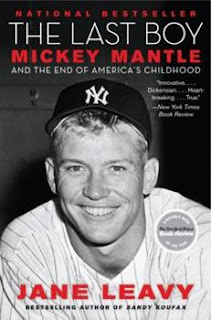
Mantle is the subject matter of Jane Leavy's The Last Boy, an audio book I started reading yesterday and which promises to be good. Mantle, like many American heroes, is a flawed man. His time in history was a period of innocence in which the sportswriters knew he was a man different from his iconic image. In those days the sportswriters could lose their jobs for writing some of the things they knew, Leavy notes. And today sportswriter might lose their jobs for not writing about what they knew. We live in a different time, a time of innocence lost.

When I was a kid you bought baseball cards both for the players you idolized and for the noise they made in the spokes of your bicycle. During the baseball card craze of the early nineties, kids bought cards looking for the ones with potential, sometimes throwing the rest straight into the garbage. Sometimes throwing them all straight into the can.

Ansel Adams said, “Myths and creeds are heroic struggles to comprehend the truth in the world.” Perhaps this is what Jane Leavy and Ken Burns are trying to do when they examine the mythological heroes and legends of our history, trying themselves to understand something about themselves because they are themselves one of us.

Food for thought as you await the next pitch.

Related Links

Thursday, February 17, 2022

The Shifting Tides of Sports Journalism

Jane Leavy's book about Mickey Mantle is more than the story of a baseball hero. The Sports Illustrated journalist titled her story The Last Boy because sports journalism was moving into a new era. Up till Mantle, the innocence of our heroes was preserved because of the unwritten rule that journalists protect the privacy of person's of importance. They helped maintain the images that had been carefully crafted.

In the political sphere it's well-known that FDR's physical handicap (polio) was veiled in order to project his strength as a leader of the free world. JFK's womanizing was equally well-known yet concealed by the press. In the same way, sports heroes were designed to inspire us. Their foibles were not to be our concern. 

Leavy essentially states that at a certain moment in time a shift occurred. Up until then, if you revealed what you knew about a player, you were bad. You were slapped on the wrist and sent to your room without supper. Post-Mantle, in the new era of sports journalism, if you failed to reveal something you knew, you were punished. Writers were no longer permitted to conceal. It was their job to reveal.  

FAST FORWARD

More recently the tide has shifted in another direction altogether. According to the documentary Shadows of Liberty, journalists--and not just sports journalists--have been reigned in again. This time, it is not for the purpose of protecting the privacy of our heroes. Rather, it is for the purpose of not offending the corporate sponsors. They pay big bucks to fund not only the games and cover the massive salaries of the players as well as the media, from moguls to minions. 

Shadows examines the media monopoly by corporations and the challenges this presents with regard to truth and democracy. In other words, money controls the narratives we are being sold daily that we're expected to accept. According to this 2012 documentary, the pendulum has swung back the other way. Journalists are gagged or prevented from covering issues deemed too controversial. 

Though one reviewer on imdb.com stated that "it didn't age well," it does offer a pretty good background regarding how our current media malaise was birthed. Another reviewer wrote this:

We still talk a good game in this country, but the Reality is far harsher than most would care to admit. A great deal of what's wrong with the U.$. is thoroughly examined in SHADOWS OF LIBERTY; i.e., the manipulation of the Masses by The Media and those who control it. Nike's purchase of CBS's silence regarding sweatshops in Vietnam is just one of the dark deals this doc sheds light on; another is a case I don't recall even hearing about at the time: the possible accidental downing of a passenger plane (TWA 800) by the U.$. Navy. The circle-the-wagons efforts to bury the story are dragged kicking and screaming into the light- although nothing's been done about it to this day, as far as I can discern. SHADOWS OF LIBERTY doesn't stop there, but I'll leave it up to you to track it down and see it. In a company- uh, country- where politicians are bought and sold at their own version of a stock exchange, ALEC (the American Legislative Exchange Commission, or Politico$ For $ale, for short), I think that it's about time that Republicans and Democrats who accept bribes (from "lobbyists") should be forced to wear the logos of their True Employers on their clothes.

Whereas freedom of speech and freedom of the press are specifically underscored as essential rights in the Constitution, the reality is far different. 

"Every journalist who isn't asleep understands that corporate power has made it impossible for them to do the job that needs to be done."--Journalist Norman Solomon, "Institute for Public Accuracy" Founder 

Between 1998 and 2005, media corporations spent $400 billion on lobbying and political contributions. The executives of these media corporations undoubtedly expect something in return for all this cabbage. 

Round and round and round it goes. Where it stops, nobody knows.

Related Links

Ken Burns' Baseball and a Memory of Mick

He Who Controls the Narrative Controls the People

Shadows of Liberty  

Wag the Dog

Wednesday, April 27, 2011

Ken Burns' Baseball and a Memory of the Mick

This week I finished Ken Burns' epic documentary Baseball which is a masterful re-telling of the history of baseball from its roots to the present. But it is more than about baseball. Burns chose to use Baseball to tell America's story, a story filled with mythology and with many unpleasant realities we sometimes close our eyes to in order to enjoy the dream. One of those darker shadows in our history is race relations, and Burns handles this with such finesse while unflinchingly keeping it in our consciousness that we have a problem here.

Joseph Campbell once wrote, “Myths are public dreams, dreams are private myths.” Baseball has been a very public dream in America. We love these heroes, the gods who descended Olympus to be with us for a few seasons.

I grew up watching the Cleveland Indians in the fifties, glory years of the Yankees, our arch-adversary. Mickey Mantle was in his prime then, and when we moved to New Jersey in 1964 I had the privilege seeing the Mick play in Yankee Stadium as well. My biggest thrill was Bat Day in the mid-1960s, a game in which Mantle did not start but watched most of the game from the dugout. In the bottom of the eighth, with the Yankees down 2-1 and the bases loaded, Mickey Mantle was called in to pinch hit. The entire stadium was on its feet holding their bats skyward screaming for their hero to come through. The voltage was so high in that electrified crowd that would couldn't imagine it going higher. Suddenly the pitch and a swing and that most beautiful sound in the world (no doubt drowned out that afternoon by the noise, but I can imagine it because it is the most beautiful sound in the world, a bat striking a ball). The ball shot out like a cannon burst in a line drive deep into left field, striking the grass and bounding on one hop over the wall, a ground rule double. The two runners who scored put the Yanks up by one, and an inning later that's how it ended. Every person there was satiated. They had feasted on the Mick, and the Mick did them good.

Mantle is the subject matter of Jane Leavy's The Last Boy, an audio book I started reading yesterday and which promises to be good. Mantle, like many American heroes, is a flawed man. His time in history was a period of innocence in which the sportswriters knew he was a man different from his iconic image. In those days the sportswriters could lose their jobs for writing some of the things they knew, Leavy notes. And today sportswriter might lose their jobs for not writing about what they knew. We live in a different time, a time of innocence lost.

When I was a kid you bought baseball cards for the players you loved and for the noise they made in the spokes of your bicycle. During the baseball card craze of the early nineties, kids bought cards looking for the ones with potential, sometimes throwing the rest straight into the garbage. Sometimes throwing them all straight into the can.

Ansel Adams said, “Myths and creeds are heroic struggles to comprehend the truth in the world.” Perhaps this is what Jane Leavy and Ken Burns are trying to do when they examine the mythological heroes and legends of our history, trying themselves to understand something about themselves because they are themselves one of us.

Food for thought as you await the next pitch.

Popular Posts