Showing posts with label FDR. Show all posts

Tuesday, January 20, 2026

The Smoot-Hawley Tariff Act of 1930

I first saw the Smoot-Hawley Act referenced in a tweet on X. A couple days later a second columnist referenced it. The next day a Wall Street Journal op-ed cited this tariff action that preceded the Great Depression. What was it and why was it suddenly in the news?

The Smoot-Hawley Tariff Act of 1930 was a U.S. law that raised tariffs on over 20,000 imported goods to historically high levels. Sponsored by Senator Reed Smoot and Representative Willis C. Hawley, it was signed into law by President Herbert Hoover on June 17, 1930. The act aimed to protect American farmers and industries from foreign competition by increasing the cost of imported goods and encouraging domestic production. 


Key features included tariff rates reaching up to 50% on some imports, with an average increase from about 38% to 45% over previous levels. It expanded on the Fordney-McCumber Tariff of 1922, but its scope and severity were unprecedented. The legislation was highly controversial. Over 1,000 economists signed a petition urging Hoover to veto it, warning of retaliatory trade measures and economic harm.


The effects were significant. Many countries, including Canada and European nations, retaliated with their own tariffs, leading to a sharp decline in international trade—U.S. exports and imports dropped by about 67% between 1929 and 1933, which exacerbated the Great Depression as global economic cooperation broke down. While it’s debated how much Smoot-Hawley directly caused the Depression’s severity, it’s widely seen as a policy misstep that worsened an already dire situation.


Throughout most of my adult life I've attributed the longevity of that period of economic austerity to FDR's policies. It would appear that this Tariff Act did not help matters, and very likely contributed to making them worse.


One difference between Smoot-Hawley and today's tariff action is that the latter was enacted by executive order, the former by an act of Congress. 


Politically, it contributed to the Republican Party’s loss in the 1932 elections, paving the way for Franklin D. Roosevelt’s administration, which later shifted toward freer trade policies with the Reciprocal Trade Agreements Act of 1934. Today, it’s often cited as a cautionary tale about protectionism’s unintended consequences.


Whether addressing local, state or Federal issues, it's not a matter of intentions that we judge our leaders by. Everyone claims their intentions were good. As for how this current action plays out, one would hope that our whimsical tariff war doesn't trigger a decade-long global economic slide. During a portion of that Great Depression there was 25% unemployment and food lines. What happens next in our current scenario is anyone's guess. 


Related Links

FDR's Folly

FDR Related Stuff


Painting at the top of the page by my grandmother, Elizabeth Sandy.

Wednesday, August 7, 2024

Why the Court Is Independent of the Executive Branch

There are reasons the Founding Fathers of our fledgling Republic distributed power amongst three branches of government. They were well aware of the consequences of having power solidified in a single entity, the monarch. Hence, they created a checks-and-balances system of government to prevent the consolidation of power.

Currently there is an attempt to restrain the judicial branch of government in the United States. This is not an isolated incident. A brief review of history reveals numerous examples of how totalitarian leaders took measures against judges or judicial bodies for verdicts or decisions that went against their interest. Here are a number of notable examples:

1. Joseph Stalin (Soviet Union): During Stalin's Great Purge (1936-1938), many judges, prosecutors, and legal officials were executed or sent to labor camps. While these purges were often justified under accusations of anti-Soviet activities or conspiracy, many were targeted simply because they were perceived as threats or had issued decisions that were not in line with Stalin's desires.


2. Adolf Hitler (Nazi Germany): In 1934, during the Night of the Long Knives, Hitler's regime executed many political adversaries, including members of the judicial system who were perceived as threats or who had opposed the Nazi party. While not directly a purge of judges for specific verdicts, it was a clear message to the judiciary to align with Nazi policies.  


3. Mao Zedong (People's Republic of China): During Mao's Cultural Revolution, the Red Guards targeted many legal officials, including judges, for being part of the "old society" or for issuing verdicts that did not align with the revolutionary ideology. Many were publicly humiliated, imprisoned, or executed.


4. Nicolae CeauČ™escu (Romania): 
Ceaușescu's regime was known for its brutal repression of dissent. Judges and legal officials who issued decisions contrary to the wishes of the Communist Party were often removed from their positions, imprisoned, or executed under trumped-up charges of corruption or anti-state activities.

5. Pol Pot (Cambodia): The Khmer Rouge, under Pol Pot, dismantled the existing judicial system entirely. Judges, lawyers, and legal officials were seen as enemies of the revolution and were often executed or sent to brutal labor camps.

6. Saddam Hussein (Iraq): Under Saddam Hussein's rule, judges who opposed or issued unfavorable verdicts against the regime were often executed or disappeared. The judicial system was heavily manipulated to serve the interests of Hussein and the Ba'ath Party.


* * *

In recent years I've been concerned about the manner in which our U.S. presidents create laws via Executive Order. It's true that presidential powers have been used from the. beginning. George Washington used an executive order to keep our country from getting tangled in a war between Britain and France. Thomas Jefferson also issued an executive order. Abraham Lincoln used his executive authority when he issued his Emancipation Proclamation.


The 20th century dawned with Teddy Roosevelt flexing his executive muscle, initiative 1000 executive orders during his presidency. FDR issued over 3700 executive orders to address the Great Depression and World War II. His attempt to stack the Supreme Court was especially noteworthy. Several of FDR's initiatives were determined to be unconstitutional and were struck down by the Court. In response he attempted to stack the court in his favor by adding six new Justices to the court for a total of 15. Critics saw it as an attempt to undermine the judiciary's independence and to consolidate executive power, which is exactly what it was. Ultimately, the Senate had its say, defeating the bill by a vote of 70 to 20.


Today President Biden is attempting to bring the Supreme Court under the wing of the Executive branch by doing away with lifetime appointments. He is currently pressing Congress to pass legislation that would establish term limits and a system enabling a sitting president to appoint justices every two years. This would give  the executive branch control of the jdcial branch of government, thereby weakening the original checks and balances system, changing our Constitution and threatening democracy. 


The unchecked consolidation of power is not in the best interest of the people or our future. When presidents can bypass Congress with Executive Orders and the Court becomes a branch of the Executive, we're getting closer to the political system our Founders railed against. 

Monday, January 23, 2023

The Acerbic Wit of H L Mencken: On Politicians

This weekend as I was corresponding with someone about the state of today's political scene a quote from Mark Twain, a notable cynic on these matters, came to mind. This was followed by another quote from the curmudgeonly H.L. Mencken, whose scathing pen was more fierce than any sword.

I've enjoyed reading Mencken in the past, in part because he never once paused to consider political correctness in his writing like most writers must today. Writing for the Baltimore Sun, he seemed to relish kicking over hornets' nests. Here are some of his razor-sharp barbs on politicians and politics which I copied them from Wikiquote.  

* * * * *

Off goes the head of the king, and tyranny gives way to freedom. The change seems abysmal. Then, bit by bit, the face of freedom hardens, and by and by it is the old face of tyranny. Then another cycle, and another. But under the play of all these opposites there is something fundamental and permanent — the basic delusion that men may be governed and yet be free.

* * * * *

All government, in its essence, is a conspiracy against the superior man: its one permanent object is to oppress him and cripple him...

The most dangerous man to any government is the man who is able to think things out for himself, without regard to the prevailing superstitions and taboos. Almost inevitably he comes to the conclusion that the government he lives under is dishonest, insane and intolerable, and so, if he is romantic, he tries to change it. And even if he is not romantic personally he is very apt to spread discontent among those who are.

* * * * *

My literary theory, like my politics, is based chiefly upon one idea, to wit, the idea of freedom. I am, in belief, a libertarian of the most extreme variety.

* * * * *

Every step in human progress, from the first feeble stirrings in the abyss of time, has been opposed by the great majority of men. Every valuable thing that has been added to the store of man's possessions has been derided by them when it was new, and destroyed by them when they had power. They have fought every new truth ever heard of, and they have killed every truth-seeker who got into their hands.
Homo Neanderthalensis Baltimore Sun (June 29th, 1925), The Impossible Mencken

    * * * * *

    No one in this world, so far as I know—and I have researched the records for years, and employed agents to help me—has ever lost money by underestimating the intelligence of the great masses of the plain people. Nor has anyone ever lost public office thereby.

    * * * * *

    Democracy, in fact, is always inventing class distinctions, despite its theoretical abhorrence of them.

    * * * * *

    If he became convinced tomorrow that coming out for cannibalism would get him the votes he needs so sorely, he would begin fattening a missionary in the White House yard come Wednesday. (Referring to FDR)

    * * * * *

    It is inaccurate to say I hate everything. I am strongly in favor of common sense, common honesty, and common decency. This makes me forever ineligible for public office.

    * * * * *

    Every decent man is ashamed of the government he lives under.

    * * * * *

    The chief difference between free capitalism and State socialism seems to be this: that under the former a man pursues his own advantage openly, frankly and honestly, whereas under the latter he does so hypocritically and under false pretenses.

    * * * * *
    I'd love to see what Mencken might have written about the past six or eight years. His way of putting things is entertaining, but if you've got thin skin, keep your distance. The best approach for all readers of Mencken is to enjoy the spicy flavor of the meat and spit out the bones.

      Friday, February 18, 2022

      Flashback Friday: Presidents Day Trivia Contest

      FLASHBACK FRIDAY
      This Trivia Quiz was created in 2012, 
      but should be just as much fun today.

      With this coming Monday being Presidents Day, this is as good a day as any to think about presidents. By presidents we're talking about U.S. presidents here. Sorry, I mean no offense to my readers in Germany, Britain, France, Italy, Mexico, Brazil, Zambia or Laos who were not required to memorize U.S. president-trivia in their schools while growing up. For the rest of you, here's a quiz to help keep your brain cells from atrophying. You can check your answers against my guesses at the end of this quiz. Be sure to keep score.
       
      Disclaimer: This quiz is for entertainment purposes only and should not be construed as having any usefulness for passing your U.S. citizenship exam. 
       
      1. Which president was nicknamed His Accidency? 
      a. Harrold Wilson 
      b. John Tyler 
      c. Chester Arthur 
      d. Grover Cleveland Alexander 

      2. Which President was called The Do-Nothing President? 
      a. Pat Buchanan 
      b. William Buckley 
      c. William Howard Taft 
      d. James Buchanan 

      3. Which president was sometimes called The Big Lub? 
      a. Grover Lightfoot 
      b. William Howard Taft 
      c. Teddy Roosevelt 
      d. Herbert Hoover 
       
      4. Who was the only president with a Ph.D.? 
      a. Charles Smedley 
      b. Woodrow Wilson 
      c. Calvin Coolidge 
      d. Benjamin Harrison 
       
      5. Who was the first president to actually dine with a black man in the White House? 
      a. Abraham Lincoln 
      b. Ulysses S. Grant 
      c. Teddy Roosevelt 
      d. John F. Kennedy 
       
      6. Teddy Roosevelt was evidently into pets. Match the the following pets to their names. 
      a. Guinea Pig 
      b. Snake 
      c. Bull Dog 
      d. Chesapeake Retriever 
      Their names were: Pete, Father O'Grady, Emily Spinach, and Sailor Boy... but in which order? 

      7. Who was the first president's wife to be called the First Lady of the Land? 
      a. Letitia Tyler 
      b. Lucy Hayes 
      c. Eliza Johnson 
      d. Frances Clara Cleveland 
       
      8. Who was the first president to fly in a helicopter? 
      a. Silent Cal 
      b. FDR 
      c. Ike 
      d. Harry S. Truman 
       
      9. Who was the first president to fly in an airplane? 
      a. Herbert Hoover 
      b. Teddy Roosevelt 
      c. FDR 
      d. Calvin College 

      10. This president raised 11 children, none of whom were his own. (He is one of three presidents to have had adopted children.) 
      a. Chester Arthur 
      b. Andrew Johnson 
      c. Andrew Jackson 
      d. James Polk 
       
      11. When he was vice president, he presided over the Senate wearing a pair of pistols, as a precaution against the frequent outbursts of violence. (See? Contentiousness in the congress is nothing new.) 
      a. Hebert Hoover 
      b. Andrew Johnson 
      c. Martin Van Buren 
      d. Lyndon Johnson 
       
      12. Which president was the first to see a baseball game and saw the Cincinnati Reds beat the Washington Senators 7-4? 
      a. Benjamin Harrison 
      b. Teddy Roosevelt 
      c. William McKinley 
      d. Woodrow Wilson
       
      13. How many presidents did not win the popular vote yet won the election? 
      a. 5 
      b. 8 
      c. 15 
      d. 11 
       
      14. How many Americans understand how the Electoral College works?
      a. 5
      b. 8
      c. 15
      d. 11 
       
      15. Who was the first president not born on the continental United States?
      a. George Washington
      b. John D. Rockefeller
      c. Andrew Johnson
      d. Barack Obama
       
      Bonus: Which website did I borrow all this information from?
      a. ClassroomHelp.com 
      b. NationalGeographic.com
      c. Infoplease.com
      d. None of the above. I took good notes in school and remembered all this stuff. 


      ANSWERS
      1. (b) 2. (d) 3. (b) 4. (b) 5. (c) TR dined with Booker T. Washington. 6. Some of the pets TR had in the White House for his family included a Bull Dog named Pete, a Guinea Pig named Father O'Grady, a snake named Emily Spinach and a Chesapeake Retriever named Sailor Boy. 7. I think it was Lucy. 8. (c) 9. There is a dispute here as my sources conflict. One source says it was Teddy, the other says FDR. 10. (c) Yes, Jackson had 11 adopted children. 11. (c) 12. (a) 13. (c) 14. Trick question. Nobody knows how it works. 15. (d) He was born in Sasketchewan. No, wait, Rio. Actually it was Hawaii, which was not a state until I was in elementary school. Bonus Question: a, b and c. Score five points for having read this all the way through, and one point for each correct answer. If you did better than 18, you're pretty sharp. Take a bow.

      Thursday, February 17, 2022

      The Shifting Tides of Sports Journalism

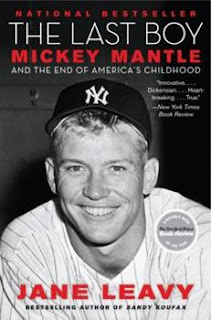
      Jane Leavy's book about Mickey Mantle is more than the story of a baseball hero. The Sports Illustrated journalist titled her story The Last Boy because sports journalism was moving into a new era. Up till Mantle, the innocence of our heroes was preserved because of the unwritten rule that journalists protect the privacy of person's of importance. They helped maintain the images that had been carefully crafted.

      In the political sphere it's well-known that FDR's physical handicap (polio) was veiled in order to project his strength as a leader of the free world. JFK's womanizing was equally well-known yet concealed by the press. In the same way, sports heroes were designed to inspire us. Their foibles were not to be our concern. 

      Leavy essentially states that at a certain moment in time a shift occurred. Up until then, if you revealed what you knew about a player, you were bad. You were slapped on the wrist and sent to your room without supper. Post-Mantle, in the new era of sports journalism, if you failed to reveal something you knew, you were punished. Writers were no longer permitted to conceal. It was their job to reveal.  

      FAST FORWARD

      More recently the tide has shifted in another direction altogether. According to the documentary Shadows of Liberty, journalists--and not just sports journalists--have been reigned in again. This time, it is not for the purpose of protecting the privacy of our heroes. Rather, it is for the purpose of not offending the corporate sponsors. They pay big bucks to fund not only the games and cover the massive salaries of the players as well as the media, from moguls to minions. 

      Shadows examines the media monopoly by corporations and the challenges this presents with regard to truth and democracy. In other words, money controls the narratives we are being sold daily that we're expected to accept. According to this 2012 documentary, the pendulum has swung back the other way. Journalists are gagged or prevented from covering issues deemed too controversial. 

      Though one reviewer on imdb.com stated that "it didn't age well," it does offer a pretty good background regarding how our current media malaise was birthed. Another reviewer wrote this:

      We still talk a good game in this country, but the Reality is far harsher than most would care to admit. A great deal of what's wrong with the U.$. is thoroughly examined in SHADOWS OF LIBERTY; i.e., the manipulation of the Masses by The Media and those who control it. Nike's purchase of CBS's silence regarding sweatshops in Vietnam is just one of the dark deals this doc sheds light on; another is a case I don't recall even hearing about at the time: the possible accidental downing of a passenger plane (TWA 800) by the U.$. Navy. The circle-the-wagons efforts to bury the story are dragged kicking and screaming into the light- although nothing's been done about it to this day, as far as I can discern. SHADOWS OF LIBERTY doesn't stop there, but I'll leave it up to you to track it down and see it. In a company- uh, country- where politicians are bought and sold at their own version of a stock exchange, ALEC (the American Legislative Exchange Commission, or Politico$ For $ale, for short), I think that it's about time that Republicans and Democrats who accept bribes (from "lobbyists") should be forced to wear the logos of their True Employers on their clothes.

      Whereas freedom of speech and freedom of the press are specifically underscored as essential rights in the Constitution, the reality is far different. 

      "Every journalist who isn't asleep understands that corporate power has made it impossible for them to do the job that needs to be done."--Journalist Norman Solomon, "Institute for Public Accuracy" Founder 

      Between 1998 and 2005, media corporations spent $400 billion on lobbying and political contributions. The executives of these media corporations undoubtedly expect something in return for all this cabbage. 

      Round and round and round it goes. Where it stops, nobody knows.

      Related Links

      Ken Burns' Baseball and a Memory of Mick

      He Who Controls the Narrative Controls the People

      Shadows of Liberty  

      Wag the Dog

      Saturday, December 7, 2019

      Beyond Pearl Harbor: Things You Probably Didn't Know About the Day of Infamy

      Bombing of Pearl Harbor. Photo: U.S. Navy. Public domain.

      The USS West Virginia was struck by 6 torpedoes and 2 bombs.
      On the morning of December 7, 1941, Japan launched a sneak attack on the U.S. Pacific Fleet’s base at Pearl Harbor in Hawaii, as part of a plan to eliminate any potential challenge to Japanese conquests in Asia.*

      * * * *

      The Japanese attack force—which included six aircraft carriers and 420 planes—sailed from Hitokappu Bay in the Kurile Islands, on a 3,500 mile voyage to a staging area 230 miles off the Hawaiian island of Oahu.

      The attack killed 2,403 service members and wounded 1,178 more, and sank or destroyed six U.S. ships,. They also destroyed 169 U.S. Navy and Army Air Corps planes.*

      More than half the fatalities were on the USS Arizona . 
      THERE ARE a lot of things that happened that are seldom noted when we remember this historic event. That same day, the Japanese followed up with assaults on the Philippines, Guam, Midway Island and the Wake Islands. They also attacked the British colonies of Malaya, Singapore and Hong Kong. Soon after they invaded Thailand. Within months all of these were conquered, the Japanese flag flying over all.

      Most history books describe the assault on these Southwest Pacific islands as taking place the next day. The history books state that they were bombed and attacked on December 8. This is because the International Date Line is West of Hawaii. The Japanese, according to their history books, place the attack on Pearl Harbor as having occurred on December 8.

      10 Peso Note in Philippines. Colonies had U.S. notables on their money.
      What I also find interesting is that in our contemporary minds, we consider the attack on Hawaii an attack on the United States when in reality Hawaii was no more a state than the Philippines, Guam or the Wake Islands. In fact, all of these island territories had been colonies of the United States at one time. Because the term "colony" was out of favor and politically incorrect, we began calling them territories.. (Hawaii became a state in 1959.) Not only did Japan attack all of these, the Japanese soon overran these others completely.

      16 million Filipinos, who saluted the U.S. flag and called FDR their commander-in-chief, were no longer free. You can see whose face is on their 10-peso bill (above), reminding them who holds the cards.

      Losses at Wake Island. (National Archives)
      The bombing of American airfields made us unable to defend these territories and by Christmas the U.S. abandoned Manila to the Japanese with the colony easily overrun. Within a couple days of Pearl Harbor, the U.S. forces in Guam and the Wake Islands had already surrendered after their planes were destroyed while still on the ground.

      President Roosevelt's "Day of Infamy" speech to the nation downplayed the losses of the Western Pacific, and up-played the significance of Hawaii. Even though the colony was 3/4s Asian and Pacific Islanders, FDR elevated the status of Hawaii by calling it an "American island." His intent was to end our nation's isolationist stance. He could now, with the support of the people, enter the war.

      * * * *
      Related Links
      Pearl Harbor Facts
      The Infamy Speech by FDR
      Some of the information in this blog post comes from the introduction to Daniel Immerwahr's How to Hide an Empire

      Sunday, November 18, 2018

      Executive Order 9066: Just One More Cause for Shame


      Executive Order 9066

      The President Authorizes Japanese Relocation

      In an atmosphere of World War II hysteria, President Roosevelt, encouraged by officials at all levels of the federal government, authorized the internment of tens of thousands of American citizens of Japanese ancestry and resident aliens from Japan. Roosevelt’s Executive Order 9066, dated February 19, 1942, gave the military broad powers to ban any citizen from a fifty- to sixty-mile-wide coastal area stretching from Washington state to California and extending inland into southern Arizona. The order also authorized transporting these citizens to assembly centers hastily set up and governed by the military in California, Arizona, Washington state, and Oregon. Although it is not well known, the same executive order (and other war-time orders and restrictions) were also applied to smaller numbers of residents of the United States who were of Italian or German descent. For example, 3,200 resident aliens of Italian background were arrested and more than 300 of them were interned. About 11,000 German residents—including some naturalized citizens—were arrested and more than 5000 were interned. Yet while these individuals (and others from those groups) suffered grievous violations of their civil liberties, the war-time measures applied to Japanese Americans were worse and more sweeping, uprooting entire communities and targeting citizens as well as resident aliens.


      OK, LET'S ADD SOME TEETH TO THIS NEW DEAL*
      On March 21, 1942, Roosevelt signed Public Law 503 (approved after only an hour of discussion in the Senate and thirty minutes in the House) in order to provide for the enforcement of his executive order. Authored by War Department official Karl Bendetsen—who would later be promoted to Director of the Wartime Civilian Control Administration and oversee the incarceration of Japanese Americans—the law made violations of military orders a misdemeanor punishable by up to $5,000 in fines and one year in prison.

      EXPERTS RECOMMENDED THAT FDR NOT DO THIS* 
      The Munson Report, a private study initiated by FDR to determine whether Japanese-Americans were a threat, determined that there was no need to be concerned. A second investigation started in 1940, written by Naval Intelligence officer Kenneth Ringle and submitted in January 1942, likewise found no evidence of fifth column activity and urged against mass incarceration. Both investigations and recommendations were ignored.


      Images on this page are from this book by Maise & Richard Conrat.
      Not quite the American Dream.

      "There's no place like home?"
      Over 100,000 were interred to assuage public fears.
      Another example of democracy gone awry?  
      Or executive authority overstepping?

      *SOURCE: History Matters

      Saturday, January 20, 2018

      Did Trump Borrow a Play from the FDR Playbook?

      Did Donald Trump do something original when he started his Twitter feed? Or is his Twitter feed simply a 21st Century version of a play from the FDR playbook?

      This week I re-read David Brinkley's story in the June 1988 Journalism Review. In some ways it's good to be reminded that there's nothing new under the sun.

      The image on the cover is familiar to most, a headshot of Franklin Delano Roosevelt, with the blurb announcing the magazines feature story: "David Brinkley on Roosevelt vs. The Press." The actual title of the feature is An Age Less Than Golden: Roosevelt vs. the Wartime Press.

      David Brinkley served as an American newscaster from 1943 to 1997, an era of remarkable change that included wars, rumors of wars and walks on the moon. When I was a kid growing up he was the Brinkley half of the number one news program The Huntley-Brinkley Report with Chet Huntley. In 1988 he published a bestselling book titled Washington Goes To War, hence the appearance of this feature article in the Washington Journalism Review. that begins, "Franklin Roosevelt exercised more power for more years than any president in American history."

      The article begins by detailing the manner in which FDR exercised power over business and the unions. When the war was underway Roosevelt went so far as to tell car manufacturers what they were to produce, and it wasn't cars. The automakers went to Washington to lobby for the right to make cars because people needed them and public transportation was inadequate. The meeting was supposed to be a public meeting, but Roosevelt shut the doors and locked the reporters out. In the meeting GM president Charles Wilson explained that Detroit had 75 million dollars of inventory in engines and car bodies, drive shafts and chrome bumpers. The president essentially said, "You can build the cars but they won't have any wheels because there is no rubber for tires." After Pearl Harbor Roosevelt brought the unions in line as well, forbidding strikes until the war was over.

      But from the beginning of his presidency the media nettled him, harassing him daily, "the one major element in American society still beyond his control," Brinkley wrote.

      From the first of his four terms FDR would start his day reading "fat bundles of newspapers" that were brought to him from across the land. The newspaper editorials were harsh and he would get quite torqued about the things many of them were saying, so much so that Senate Majority Leader Alben Barkley asked him, "Why don't you just ignore those sons of bitches?" Brinkley asserts, "But he never could."

      Their chief gripe was that the president won political power with "false campaign promises to reduce the size and cost of government," among other things.

      Rather than have his message filtered through the newspapers, FDR came up with an end around. These were the early days of radio. This was the birth of his "Fireside Chats" (which often didn't match what his scriptwriters wrote because I liked to ad lib.)

      What's interesting to me is that FDR's frustrations with the media took place at a time in history when they still played nice to some extent. That is to say, they showed respect for the president by not showing him with a disability. His wheelchair was concealed. The long affair with his mistress was shoved into a drawer. But as sportswriter Jane Leavy noted in The Last Boy, her bio of Mickey Mantle, "His time in history was a period of innocence in which the sportswriters knew he was a man different from his iconic image. In those days the sportswriters could lose their jobs for writing some of the things they knew. And today sportswriter might lose their jobs for not writing about what they knew. We live in a different time, a time of innocence lost." (emphasis mine)

      There has never been a president like our current one. Loose cannon? Bull in a china shop? Epithets readily come to mind. Some of his behavior makes me think of the kid who had the words "Kick Me" taped to his back in sixth grade. (oh, that was me.) Easy target.

      But the Twitter move was brilliant. And I've been told he had the best and brightest embedded in the Facebook war room, or something of that kind. Social media was the powerful weapon he used and it hamstrung his media enemies while fermenting a loyal base.

      Does social media work as a marketing tool? Ask the POTUS. You can follow him on Twitter @realDonaldTrump or you can frequently find a ringside seat at the various Trending Topics in which are recurring as the seasons. Enjoy the show.

      Disclaimer: I tend to be cynical about political solutions and consider politics a false hope and a distraction. Like other forms of entertainment -- sports, movies, etc -- it helps to keep things in balance. 

      Wednesday, April 8, 2009

      FDR's Folly

      Books have a pretty high place in our home. My wife placed a little plaque just inside the front door that reads, "A house without books is like a room without windows." And so it is that many of our conversations with friends revolve about current readings.

      Not too long ago a good friend of mine told me about the very interesting book he was reading called FDR's Folly by Jim Powell. In light of the Reason magazine article cited yesterday, in which a panel of economists expressed their concerns about the stimulus package recently passed, I thought this worth recommending.

      It is apparent that there is a war of ideas at play in the world. In Washington, the Social Planners have been eager for their day, and it it would appear to have arrived at last. This book tells how it played out back in the 30's. Ironically, the spin machinery was effective at leaving FDR firmly entrenched as an icon of the 20th century.

      Here are some observations regarding the book that can be found on Amazon.com, followed by additional comments from a reader.

      Editorial Reviews of FDRs Folly

      “Admirers of FDR credit his New Deal with restoring the American economy after the disastrous contraction of 1929—33. Truth to tell–as Powell demonstrates without a shadow of a doubt–the New Deal hampered recovery from the contraction, prolonged and added to unemployment, and set the stage for ever more intrusive and costly government. Powell’s analysis is thoroughly documented, relying on an impressive variety of popular and academic literature both contemporary and historical.”–Milton Friedman, Nobel Laureate, Hoover Institution

      “There is a critical and often forgotten difference between disaster and tragedy. Disasters happen to us all, no matter what we do. Tragedies are brought upon ourselves by hubris. The Depression of the 1930s would have been a brief disaster if it hadn’t been for the national tragedy of the New Deal. Jim Powell has proven this.”–P.J. O’Rourke, author of Parliament of Whores and Eat the Rich

      “The material laid out in this book desperately needs to be available to a much wider audience than the ranks of professional economists and economic historians, if policy confusion similar to the New Deal is to be avoided in the future.”–James M. Buchanan, Nobel Laureate, George Mason University

      “I found Jim Powell’s book fascinating. I think he has written an important story, one that definitely needs telling.”–Thomas Fleming, author of The New Dealers’ War“Jim Powell is one tough-minded historian, willing to let the chips fall where they may. That’s a rare quality these days, hence more valuable than ever. He lets the history do the talking.”–David Landes, Professor of History Emeritus, Harvard University

      “Jim Powell draws together voluminous economic research on the effects of all of Roosevelt’s major policies. Along the way, Powell gives fascinating thumbnail sketches of the major players. The result is a devastating indictment, compellingly told. Those who think that government intervention helped get the U.S. economy out of the depression should read this book.”–David R. Henderson, editor of The Fortune Encyclopedia of Economics

      About the Book
      For generations, the collective American consciousness has believed that the former ruined the country and the latter saved it. Endless praise has been heaped upon President Franklin Delano Roosevelt for masterfully reining in the Depression’s destructive effects and propping up the country on his New Deal platform. In fact, FDR has achieved mythical status in American history and is considered to be, along with Washington, Jefferson, and Lincoln, one of the greatest presidents of all time. But would the Great Depression have been so catastrophic had the New Deal never been implemented?

      In FDR’s Folly, historian Jim Powell argues that it was in fact the New Deal itself, with its shortsighted programs, that deepened the Great Depression, swelled the federal government, and prevented the country from turning around quickly. You’ll discover in alarming detail how FDR’s federal programs hurt America more than helped it, with effects we still feel today, including:

      • How Social Security actually increased unemployment
      • How higher taxes undermined good businesses
      • How new labor laws threw people out of work
      • And much more

      This groundbreaking book pulls back the shroud of awe and the cloak of time enveloping FDR to prove convincingly how flawed his economic policies actually were, despite his good intentions and the astounding intellect of his circle of advisers. In today’s turbulent domestic and global environment, eerily similar to that of the 1930s, it’s more important than ever before to uncover and understand the truth of our history, lest we be doomed to repeat it.
      A reader named Doug offered the following comments on the book.

      A common historical misconception is that FDR's New Deal rescued the United States from the Great Depression. However, Cato Institute Historian Jim Powell argues that the New Deal exacerbated and elongated the Great Depression. With impressive attention to detail, Powell examines the long-term results of the New Deal and persuasively argues that they crippled the U.S. economy.

      In this detailed book, you will learn about the numerous programs the FDR administration brought about, including the following:

      * Programs that inundated private businesses with unprecedented waves of regulations, such as the Agricultural Adjustment Administration, the National Recovery Administration and the Securities and Exchange Commission.

      * Programs that redistributed wealth from producers to consumers, such as the Federal Emergency Relief Act and the Reconstruction Finance Corporation.

      * Programs that nationalized industries, centrally planned infrastructure or created make-work projects to increase employment such as the Civilian Conservation Corps, the Public Works Administration and the Tennessee Valley Authority.

      Powell argues that these programs typically led to poorly planned infrastructure that was more expensive than what could have been acquired in a free market. The economic results of FDR's programs were devastating. For example, consider the Agricultural Adjustment Administration (AAA). The price and production controls of the AAA led to perverse practices such as millions of tons of domestic oat and corn being burned while the U.S. simultaneously imported oat and corn, millions of peaches being left to rot and millions of "excess" pigs being needlessly slaughtered while lard was being imported from overseas. The extent of economic regulation under the FDR Administration reached such absurd levels, there was even a government board organized solely to control the production and pricing of milk!

      In closing, a quote from F. A. Hayek: "We shall not grow wiser before we learn that much that we have done was very foolish."

      Wednesday, March 4, 2009

      FDR Related Stuff

      I read a short biography of Franklin Delano Roosevelt last week by Roy Jenkins and Arthur Schlesinger. It is not a book that will appear on my recommended readings because it skimmed too superficially across the surface of his life story. Nevertheless, it was a good setup for reading the much longer, in depth analysis of FDR and the Great Depression years called The Forgotten Man, by Amity Shlaes.

      In case you're wondering, FDR's relationship to Uncle Teddy was as a fifth cousin. Eleanor, Teddy's niece, was likewise FDR's fifth cousin. The Roosevelt's were deeply rooted in early America (1600's) and were in that wealthy strata which most people only dream about. FDR's strings to power are many, including being coat tail relations to John Quincy Adams, Martin Van Buren, Millard Filmore (seventh cousin once removed), Rutherford B. Hayes, Grover Cleveland and William Taft. I guess you might say it's "all in the family."

      I did learn some other details about FDR of which I was unaware or had forgotten. In particular, I didn't realize that he got polio as a young adult, after a swim. I guess we've grown up in a half-century of polio-free living, so we know little about this terrible disease. I always assumed, and I do not know where I got this notion from, that you caught the disease as an infant or something like that. For FDR there's no doubt it was a setback, but it's a mark of his great ambition and fortitude that he didn't cave in and call it quits at that point, or lower his aims.

      It would be easy to imagine him drawing on this experience in later life, especially with unexpected setbacks like the sudden and devastating attack on Pearl Harbor, or the discovery that Hitler was working on The Bomb.

      The most interesting aspect of the book was how swiftly it moved along the mile markers of his life. While reading, I thought at first that this rapid summary was all preface to the real in depth story that would follow. But once past an event, the author never looked back. About halfway through I realized that this was the style of the book, and that I was no longer reading the preface. (You know how they sometimes summarize the story as an intro and then rehash it all in greater detail afterwards.)

      The book avoided anything that might offend either fan or foe of the four term president. It mentions, for example, his stacking of the Supreme Court as a fact much like the length of his hair or the state he was from.

      In one section they mentioned how he placed boards in front of the presidential desk in the Oval Office to hide his leg braces, referencing his efforts to keep up appearances. This brought to mind a 1932 booklet I once read by some Harvard scholar that said that in America you can not hope to be elected unless you said you believed in God and were a Christian. In other words, ambitious politicians whose personal philosophy was Machiavellian would be required to set that on a shelf when wearing their public persona. Eventually, this awareness of the facade by the general public helped foster a general cynicism in the Boomer generation, which is even more deep-seated today.

      This past summer, I discovered that as a boy FDR had been here in Superior, Wisconsin. (I live in Duluth, but work in Superior, across the bridge... the bridge to somewhere, as opposed to the sister bridge to nowhere, off to its left.) The story is embossed on a sign erected in front of the S.S. Meteor, last of the great whaleback ships that carried grain and goods to and from the Twin Ports. There were 43 of these whalebacks launched between 1888 and 1898, and young FDR came to Superior to watch one of them launched. According to the sign, "In his enthusiasm to get a good view, he was swept into the slip by waves. A member of the Superior Fire Department rescued him before he reached deep water." The six year old boy who later made history could have been history.

      On my wall here is a little saying by Bruce Barton which I have quoted before, but it's appropriate enough to repeat: "Sometimes when I consider what tremendous consequences come from little things... I am tempted to think there are no little things."
      CLICK ON PHOTOS TO ENLARGE

      Popular Posts