Showing posts with label Mickey Mantle. Show all posts

Saturday, April 5, 2025

In What Way Was John Glenn the Last American Hero?

Alice George titled her book The Last American Hero: The Remarkable Life of John Glenn to reflect her view of Glenn as a singular figure in American history—a man whose life embodied a heroic ideal that she believes has faded from the national consciousness. In her portrayal, Glenn isn’t just a hero for his feats as a fighter pilot, astronaut, and senator, but a symbol of a bygone era when Americans embraced real, flawed individuals as icons of courage and service. She suggests that his 1962 orbit of Earth, his steady character, and his lifelong dedication to public duty made him a unifying figure during a fractious time, like the Cold War and the turbulent 1960s—a role she argues is rare in today’s cynical age.

George doesn’t explicitly dissect the title in the book, but her narrative implies a nostalgia for a time when figures like Glenn could capture the public’s imagination without being torn down by modern skepticism. In interviews around the book’s 2020 release, she noted how Glenn’s death in 2016 prompted obituaries that universally hailed him as heroic, striking her as a contrast to a culture quick to spotlight flaws over valor. She seems to propose that Glenn might be “the last” because society now favors fictional superheroes over flesh-and-blood ones, a shift she ties to a loss of faith in human potential amid scandals and division. The title’s provocative edge—implying no successors—challenges readers to consider whether such heroes can still emerge, or if Glenn’s mold, forged in a specific American moment, is truly broken.


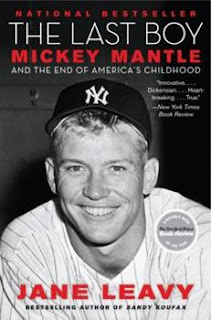
The book brought to mind two other books I've read in recent years, the first being The Last BoyJane Leavy's book about Mickey Mantle. "The Sports Illustrated journalist titled her story The Last Boy because sports journalism was moving into a new era. Up till Mantle, the innocence of our heroes was preserved because of the unwritten rule that journalists protect the privacy of person's of importance. They helped maintain the images that had been carefully crafted.


"Leavy essentially states that at a certain moment in time a shift occurred. Up until then, if you revealed what you knew about a player, you were bad. You were slapped on the wrist and sent to your room without supper. Post-Mantle, in the new era of sports journalism, if you failed to reveal something you knew, you were punished. Writers were no longer permitted to conceal. It was their job to reveal."(1)


In both books, the authors use a singular iconic figure to illustrate how journalism in particular, and the broader culture in general, have changed.


The second book that came to mind was Ghost Burglar, by Jim King and Jack Burch. Ghost Burglar is the story of Bernard Welch, one of the most successful thieves in U.S. history, as well a surprisingly witty prison escapee, with two such exits under his belt. 


The book does an excellent job of showing the education of Bernard Welch, how he learned his trade and how he’d become so elusive. How did he end up with a home, including a sauna and indoor pool, in one of Duluth's most elite neighborhoods? That was a lesson he learned from an incident earlier in his career. He was an east coast crook, rich neighborhoods from Jersey to D.C., but he got caught because 200 miles away is still too near when fencing stolen goods. During his first stint in prison he assessed the mistakes he'd made and refined his methods. One of these was how to put his stolen merchandise back into the market and he settled on an unsuspecting community a thousand miles away.(2)


The reason this latter book came to mind is because one of the homes Bernard Welch robbed was that of John Glenn's. There were awards Glenn had received for his achievements, made of gold, which the burglar stole and melted down for resale. 


Though each of these books tell different tales, it's interesting how they also intersect and reveal things about the times we live in.


(1) The Shifting Tides of Sports Journalism

(2) Ghost Burglar

Related Link
Eight Minutes with Jack Burch and Jim King, Co-Authors of Ghost Burglar

Thursday, March 27, 2025

Throwback Thursday: It Happens Every Spring

It happens every spring. Baseball returns, a new season begins. Here's a blog post from April 2011 with a few memories about the game I loved while growing up.

This week I finished Ken Burns' epic documentary Baseball which is a masterful re-telling of the history of baseball from its roots to the present. But it is more than about baseball. Burns chose to use Baseball to tell America's story, a story filled with mythology and with many unpleasant realities we sometimes close our eyes to in order to enjoy the dream. One of those darker shadows in our history is race relations, and Burns handles this with such finesse while unflinchingly keeping it in our consciousness that we have a problem here.

Joseph Campbell once wrote, “Myths are public dreams, dreams are private myths.” Baseball has been a very public dream in America. We love these heroes, the gods who descended Olympus to be with us for a few seasons.

I grew up watching the Cleveland Indians in the fifties, glory years of the Yankees, our arch-adversary. Mickey Mantle was in his prime then, and when we moved to New Jersey in 1964 I had the privilege seeing the Mick play in Yankee Stadium as well. My biggest thrill was Bat Day in the mid-1960s, a game in which Mantle did not start but watched most of the game from the dugout. In the bottom of the eighth, with the Yankees down 2-1 and the bases loaded, Mickey Mantle was called in to pinch hit. The entire stadium was on its feet holding their bats skyward screaming for their hero to come through. The voltage was so high in that electrified crowd that would couldn't imagine it going higher. Suddenly the pitch and a swing and that most beautiful sound in the world (no doubt drowned out that afternoon by the noise, but I can imagine it because it is the most beautiful sound in the world, the meat of the bat striking a baseball). The ball shot out like a cannon burst in a line drive deep into left field, striking the grass and bounding on one hop over the wall, a ground rule double. The two runners who scored put the Yanks up by one, and an inning later that's how it ended. Every person there was satiated. They had feasted on the Mick, and the Mick did them good.

Mantle is the subject matter of Jane Leavy's The Last Boy, an audio book I started reading yesterday and which promises to be good. Mantle, like many American heroes, is a flawed man. His time in history was a period of innocence in which the sportswriters knew he was a man different from his iconic image. In those days the sportswriters could lose their jobs for writing some of the things they knew, Leavy notes. And today sportswriter might lose their jobs for not writing about what they knew. We live in a different time, a time of innocence lost.

When I was a kid you bought baseball cards both for the players you idolized and for the noise they made in the spokes of your bicycle. During the baseball card craze of the early nineties, kids bought cards looking for the ones with potential, sometimes throwing the rest straight into the garbage. Sometimes throwing them all straight into the can.

Ansel Adams said, “Myths and creeds are heroic struggles to comprehend the truth in the world.” Perhaps this is what Jane Leavy and Ken Burns are trying to do when they examine the mythological heroes and legends of our history, trying themselves to understand something about themselves because they are themselves one of us.

Food for thought as you await the next pitch.

Related Links

Thursday, February 17, 2022

The Shifting Tides of Sports Journalism

Jane Leavy's book about Mickey Mantle is more than the story of a baseball hero. The Sports Illustrated journalist titled her story The Last Boy because sports journalism was moving into a new era. Up till Mantle, the innocence of our heroes was preserved because of the unwritten rule that journalists protect the privacy of person's of importance. They helped maintain the images that had been carefully crafted.

In the political sphere it's well-known that FDR's physical handicap (polio) was veiled in order to project his strength as a leader of the free world. JFK's womanizing was equally well-known yet concealed by the press. In the same way, sports heroes were designed to inspire us. Their foibles were not to be our concern. 

Leavy essentially states that at a certain moment in time a shift occurred. Up until then, if you revealed what you knew about a player, you were bad. You were slapped on the wrist and sent to your room without supper. Post-Mantle, in the new era of sports journalism, if you failed to reveal something you knew, you were punished. Writers were no longer permitted to conceal. It was their job to reveal.  

FAST FORWARD

More recently the tide has shifted in another direction altogether. According to the documentary Shadows of Liberty, journalists--and not just sports journalists--have been reigned in again. This time, it is not for the purpose of protecting the privacy of our heroes. Rather, it is for the purpose of not offending the corporate sponsors. They pay big bucks to fund not only the games and cover the massive salaries of the players as well as the media, from moguls to minions. 

Shadows examines the media monopoly by corporations and the challenges this presents with regard to truth and democracy. In other words, money controls the narratives we are being sold daily that we're expected to accept. According to this 2012 documentary, the pendulum has swung back the other way. Journalists are gagged or prevented from covering issues deemed too controversial. 

Though one reviewer on imdb.com stated that "it didn't age well," it does offer a pretty good background regarding how our current media malaise was birthed. Another reviewer wrote this:

We still talk a good game in this country, but the Reality is far harsher than most would care to admit. A great deal of what's wrong with the U.$. is thoroughly examined in SHADOWS OF LIBERTY; i.e., the manipulation of the Masses by The Media and those who control it. Nike's purchase of CBS's silence regarding sweatshops in Vietnam is just one of the dark deals this doc sheds light on; another is a case I don't recall even hearing about at the time: the possible accidental downing of a passenger plane (TWA 800) by the U.$. Navy. The circle-the-wagons efforts to bury the story are dragged kicking and screaming into the light- although nothing's been done about it to this day, as far as I can discern. SHADOWS OF LIBERTY doesn't stop there, but I'll leave it up to you to track it down and see it. In a company- uh, country- where politicians are bought and sold at their own version of a stock exchange, ALEC (the American Legislative Exchange Commission, or Politico$ For $ale, for short), I think that it's about time that Republicans and Democrats who accept bribes (from "lobbyists") should be forced to wear the logos of their True Employers on their clothes.

Whereas freedom of speech and freedom of the press are specifically underscored as essential rights in the Constitution, the reality is far different. 

"Every journalist who isn't asleep understands that corporate power has made it impossible for them to do the job that needs to be done."--Journalist Norman Solomon, "Institute for Public Accuracy" Founder 

Between 1998 and 2005, media corporations spent $400 billion on lobbying and political contributions. The executives of these media corporations undoubtedly expect something in return for all this cabbage. 

Round and round and round it goes. Where it stops, nobody knows.

Related Links

Ken Burns' Baseball and a Memory of Mick

He Who Controls the Narrative Controls the People

Shadows of Liberty  

Wag the Dog

Friday, September 11, 2020

Important Dates in Major League Baseball from September and October

This is a continuation of the Robert Lookup Baseball Trivia Series.


* * * *
IMPORTANT DATES
in Major League Baseball
September / October 
* * * *

September 1, 1906
Joe Harris of the Boston Red Sox pitches 24 innings in one game, an American League record.

Pitcher Walter Johnson was one of the great ones.
September 4, 1908
Walter Johnson shuts out the Yankees/Highlanders 3-0, the first of three shutouts against the Yankees in four days. Saturday's September 5 game was 6-0 and Monday's 4-0.

September 5, 2001
Roger Clemens bests the Jays 4-3 for his 19th win out of 20 decisions, tying Rube Marquanrd of the 1912 New York Giants. Clemens also passed Jack Chesbro and Whitey Ford for the longest winning streak in Yankee history. Chesbro won 14 straight in 1904 and Ford 14 in 1961.

September 6, 1990
Cal Ripken plays in his 2,131st consecutive game to surpass Lou Gehrig's 56-year-old record. Baltimore beat Anaheim 4-3.

September 7, 1993
Mark Whiten of the Cards hits four home runs. He had 12 RBIs in the first game and 1 RBI in the second of a double header.

September 10, 2000
Randy Johnson becomes the 12th player in Major League history to reach 3,000 strikeouts, fanning a season high 14 i seven innings as Arizona lost 4-3 to Florida in 12 innings.

Sept 16, 1997
Curt Schilling strikes out 9 in Phillies win over the Mets to become the 13th pitcher since 1900 to achieve 300 strikeouts in a season.

September 22, 1904
Jim O'Rourke plays one game for the New York Giants and singles in four at bats. He plays catcher that day. 54 years old, he also played for the original Boston Nationals, the only National League player to play both in 1876 and the 20th Century.

September 22, 1911
Cy Young, 44, beats Pittsburgh 1-0 for his 511th and last victory.

September 25, 1995
Seattle uses 11 pitchers in a game, the most ever.

October 3, 1951
The historic homer by Bobby Thompson.
The shot heard round the world. Bobby Thomson of the New York Giants hits a 3-run homer in the ninth inning of the third game to beat the Dodgers 5-4 and win the National League pennant. (EdNote: When I was a bus boy at Fiddler's Elbow Country Club in 1969-70, Bobby Thomson was a member there. On one occasion, another employee took me downstairs where the lockers were and pointed to him, saying, "There's Bobby Thomson" as I peaked round the corner. He was putting on his cleats to head out for a round of golf.)

October 3, 1993
The Blue Jays become the first team in American League history to have teammates finish 1-2-3 in the batting race. John Olerud led the league in hitting, .363; Paul Molitor hit .322; Roberto Alomar hit .326.

October 8, 1959
Mike Morgan is born in Tulare, California

October 20, 1931
Mickey Mantle is born in Spavinaw, Oklahoma.

* * * *

Related Links
A-List of all MLB pitchers with 300 strikeouts or more in a single season.
The shot heard round the world.

Saturday, January 20, 2018

Did Trump Borrow a Play from the FDR Playbook?

Did Donald Trump do something original when he started his Twitter feed? Or is his Twitter feed simply a 21st Century version of a play from the FDR playbook?

This week I re-read David Brinkley's story in the June 1988 Journalism Review. In some ways it's good to be reminded that there's nothing new under the sun.

The image on the cover is familiar to most, a headshot of Franklin Delano Roosevelt, with the blurb announcing the magazines feature story: "David Brinkley on Roosevelt vs. The Press." The actual title of the feature is An Age Less Than Golden: Roosevelt vs. the Wartime Press.

David Brinkley served as an American newscaster from 1943 to 1997, an era of remarkable change that included wars, rumors of wars and walks on the moon. When I was a kid growing up he was the Brinkley half of the number one news program The Huntley-Brinkley Report with Chet Huntley. In 1988 he published a bestselling book titled Washington Goes To War, hence the appearance of this feature article in the Washington Journalism Review. that begins, "Franklin Roosevelt exercised more power for more years than any president in American history."

The article begins by detailing the manner in which FDR exercised power over business and the unions. When the war was underway Roosevelt went so far as to tell car manufacturers what they were to produce, and it wasn't cars. The automakers went to Washington to lobby for the right to make cars because people needed them and public transportation was inadequate. The meeting was supposed to be a public meeting, but Roosevelt shut the doors and locked the reporters out. In the meeting GM president Charles Wilson explained that Detroit had 75 million dollars of inventory in engines and car bodies, drive shafts and chrome bumpers. The president essentially said, "You can build the cars but they won't have any wheels because there is no rubber for tires." After Pearl Harbor Roosevelt brought the unions in line as well, forbidding strikes until the war was over.

But from the beginning of his presidency the media nettled him, harassing him daily, "the one major element in American society still beyond his control," Brinkley wrote.

From the first of his four terms FDR would start his day reading "fat bundles of newspapers" that were brought to him from across the land. The newspaper editorials were harsh and he would get quite torqued about the things many of them were saying, so much so that Senate Majority Leader Alben Barkley asked him, "Why don't you just ignore those sons of bitches?" Brinkley asserts, "But he never could."

Their chief gripe was that the president won political power with "false campaign promises to reduce the size and cost of government," among other things.

Rather than have his message filtered through the newspapers, FDR came up with an end around. These were the early days of radio. This was the birth of his "Fireside Chats" (which often didn't match what his scriptwriters wrote because I liked to ad lib.)

What's interesting to me is that FDR's frustrations with the media took place at a time in history when they still played nice to some extent. That is to say, they showed respect for the president by not showing him with a disability. His wheelchair was concealed. The long affair with his mistress was shoved into a drawer. But as sportswriter Jane Leavy noted in The Last Boy, her bio of Mickey Mantle, "His time in history was a period of innocence in which the sportswriters knew he was a man different from his iconic image. In those days the sportswriters could lose their jobs for writing some of the things they knew. And today sportswriter might lose their jobs for not writing about what they knew. We live in a different time, a time of innocence lost." (emphasis mine)

There has never been a president like our current one. Loose cannon? Bull in a china shop? Epithets readily come to mind. Some of his behavior makes me think of the kid who had the words "Kick Me" taped to his back in sixth grade. (oh, that was me.) Easy target.

But the Twitter move was brilliant. And I've been told he had the best and brightest embedded in the Facebook war room, or something of that kind. Social media was the powerful weapon he used and it hamstrung his media enemies while fermenting a loyal base.

Does social media work as a marketing tool? Ask the POTUS. You can follow him on Twitter @realDonaldTrump or you can frequently find a ringside seat at the various Trending Topics in which are recurring as the seasons. Enjoy the show.

Disclaimer: I tend to be cynical about political solutions and consider politics a false hope and a distraction. Like other forms of entertainment -- sports, movies, etc -- it helps to keep things in balance. 

Thursday, October 15, 2015

Throwback Thursday: It Happens Every Fall (Baseball Memories)

It's that time of year again. The Major League Baseball playoffs are underway, and the hibernating fan in me begins to awaken. Congrats to the teams that have progressed thus far. The Cubs fans must surely be biting their nails with excitement as their team has passed another hurdle. Good luck! 

When you get to the end you will notice that this 2008 post was written at a different time of the year. 

As noted in a previous post, no man is an island. Nor any woman. From the moment we enter this world we not only have a connection to our personal families, and simultaneously connected to our extended family, the body of humanity.

Of course this is not something we immediately sense – and some never sense it at all. But as we enter this world, we do come to appreciate and understand that our grand appearance here takes place within a context, for some less fortunate than others.

I made my entry into the world as a firstborn to young parents in Cleveland, Ohio. (Feet first, for what it's worth.) My mom and dad each had rural roots, West Virginia and Kentucky respectively, but had taken up residence in a second floor apartment in a section of Cleveland known as Little Italy.

They were evidently avid baseball fans because the four teddy bears in my crib were named after the 1952 Cleveland Indians starting rotation: Mike Garcia, Bob Lemon, Early Wynn and fireballer Bob Feller. These guys were awesome pitchers in their prime but only handed Indians fans one pennant in the fifties due to the heartless dominance of the Yankees of that era.

I don’t recall what happened to Wynn and Garcia (the teddy bears), but Lemon and Feller accompanied me for many a year. So did the love of baseball.

One of my mom’s favorite players was the Indians’ second baseman Bobby Avila. Three times a candidate for the League’s Most Valuable Player, Avila hailed from Mexico, a fact which I learned many years later while living in Monterrey in 1981. My wife and I were walking through the Baseball Hall of Fame in that city whereupon I saw a Cleveland Indians baseball uniform. (I will try to find the photo I took and post it here.) It immediately made me think of my Mom.

In the fifties my grandfather and dad took my brothers and I to many a ball game at Cleveland Stadium. I can recall box seats behind the Indians dugout on a bright sunny afternoon. On another occasion I remember box seats just a little to the right of the backstop during a double header in which the Yankees’ Elston Howard hit home runs over the deep center field fence in each game.

Each spring, as the baseball season commenced, our family watched the movie It Happens Every Spring, starring Ray Milland, about a professor who discovers a way to juice a baseball so that it avoids being hit by wood. Like the annual airing of The Wizard of Oz, our family watched this Saturday Night at the Movies feature year in and year out.

Within this context, it’s hard to imagine not having an interest in baseball.

Maybe things would have been different if the Indians had not been contenders. And probably it would have been much different if I had been born and raised in a town with no team at all. But it is what it is. And for this reason, to some extent Fate has a hand in how we become who we are… though I must immediately add that I believe, too, that our decisions today help make us who we will become.

Besides my own appearance here, other significant events of 1952 include the publication of Hemingway’s Old Man and the Sea and John Steinbeck’s East of Eden. Herman Wouk won the Pulitzer Prize in fiction for The Caine Mutiny. Dwight “Ike” Eisenhower won the 1952 election for president of the United States. The Korean Conflict was happening across the Pacific, and McCarthyism was in full swing in the corridors of power here in the homeland.

Two other features of note. First, not that it matters much, 1952 was a Leap Year. And second, 1952 was a year in which a major wave of Baby Boomers entered the world. One of them was Bob Costas, a sports announcer who many Americans recognize and still welcome into their homes via television. Currently he is the anchor for this year’s Olympic Games. He is a passionate fan of baseball to such an extent that he has even been considered for the position of baseball commissioner.

Costas has certainly had a charmed life, being in a position where he not only gets to meet his heroes and the great sports figures of our time, he gets to ask them probing questions, to find out what makes them tick. Hopefully he still gets a thrill from this privileged position. He certainly excels at projecting the kind of educated passion that makes people (and by this, I mean viewers) want to spend time in his presence.

If I were interviewing Mr. Costas, I would like to know…
Did your parents name your teddy bears after the New York Yankees starting rotation? (He grew up in the Queens, New York.)
How many Yankees vs. Indians double headers did you see in the fifties?
When did you see your first All Star Game? (I saw mine in Cleveland, 1963.)
What would you consider the three greatest sports moments of the past thirty years?
And finally, what makes you tick? It has to be more than the money, which can’t be half bad. What do you love most in life and what are your goals for the next thirty years?

And, if you could ask Mr. Costas a couple questions, what would they be?

Bob Costas Trivia: Costas was a huge Mickey Mantle fan and purportedly carried a 1958 Mickey Mantle baseball card in his wallet. Here's a picture of my own 1958 Mickey Mantle card, one of baseball's legendary heroes when we were both young fans.

And now, back to the Olympics. Go, team.

Monday, April 6, 2015

Play Ball! America's Game Begins Yet Another Season

It happens every spring. Baseball returns, a new season begins. Here's a blog post from April 2011 with a few memories about the game I loved while growing up.

This week I finished Ken Burns' epic documentary Baseball which is a masterful re-telling of the history of baseball from its roots to the present. But it is more than about baseball. Burns chose to use Baseball to tell America's story, a story filled with mythology and with many unpleasant realities we sometimes close our eyes to in order to enjoy the dream. One of those darker shadows in our history is race relations, and Burns handles this with such finesse while unflinchingly keeping it in our consciousness that we have a problem here.

Joseph Campbell once wrote, “Myths are public dreams, dreams are private myths.” Baseball has been a very public dream in America. We love these heroes, the gods who descended Olympus to be with us for a few seasons.

I grew up watching the Cleveland Indians in the fifties, glory years of the Yankees, our arch-adversary. Mickey Mantle was in his prime then, and when we moved to New Jersey in 1964 I had the privilege seeing the Mick play in Yankee Stadium as well. My biggest thrill was Bat Day in the mid-1960s, a game in which Mantle did not start but watched most of the game from the dugout. In the bottom of the eighth, with the Yankees down 2-1 and the bases loaded, Mickey Mantle was called in to pinch hit. The entire stadium was on its feet holding their bats skyward screaming for their hero to come through. The voltage was so high in that electrified crowd that would couldn't imagine it going higher. Suddenly the pitch and a swing and that most beautiful sound in the world (no doubt drowned out that afternoon by the noise, but I can imagine it because it is the most beautiful sound in the world, the meat of the bat striking a baseball). The ball shot out like a cannon burst in a line drive deep into left field, striking the grass and bounding on one hop over the wall, a ground rule double. The two runners who scored put the Yanks up by one, and an inning later that's how it ended. Every person there was satiated. They had feasted on the Mick, and the Mick did them good.

Mantle is the subject matter of Jane Leavy's The Last Boy, an audio book I started reading yesterday and which promises to be good. Mantle, like many American heroes, is a flawed man. His time in history was a period of innocence in which the sportswriters knew he was a man different from his iconic image. In those days the sportswriters could lose their jobs for writing some of the things they knew, Leavy notes. And today sportswriter might lose their jobs for not writing about what they knew. We live in a different time, a time of innocence lost.

When I was a kid you bought baseball cards both for the players you idolized and for the noise they made in the spokes of your bicycle. During the baseball card craze of the early nineties, kids bought cards looking for the ones with potential, sometimes throwing the rest straight into the garbage. Sometimes throwing them all straight into the can.

Ansel Adams said, “Myths and creeds are heroic struggles to comprehend the truth in the world.” Perhaps this is what Jane Leavy and Ken Burns are trying to do when they examine the mythological heroes and legends of our history, trying themselves to understand something about themselves because they are themselves one of us.

Food for thought as you await the next pitch.

Sunday, August 10, 2008

1952: From the Beginning

As noted in a previous post, no man is an island. Nor any woman. From the moment we enter this world we not only have a connection to our personal families, we are simultaneously connected to our extended family, the body of humanity.

Of course this is not something we immediately sense – and some never sense it at all. But as we enter this world, we do come to appreciate and understand that our grand appearance here takes place within a context.
My own context was as a firstborn to young parents in Cleveland, Ohio. My mom and dad each had rural roots, West Virginia and Kentucky respectively, but had taken up residence in a second floor apartment in a section of town known as Little Italy.

They were evidently avid baseball fans because the four teddy bears they surrounded me with in my crib were named after the Cleveland Indians starting rotation: Mike Garcia, Bob Lemon, Early Wynn and fireballer Bob Feller. These guys were awesome pitchers in their prime but only handed Indians fans one pennant in the fifties due to the heartless dominance of the Yankees of that era. I don’t recall what happened to Wynn and Garcia (the teddy bears), but Lemon and Feller accompanied me for many a year.

So did the love of baseball. One of my mom’s favorite players was the Indians’ second baseman Bobby Avila. Three times a candidate for the League’s Most Valuable Player, Avila hailed from Mexico, a fact which I learned many years later while living in Monterrey in 1981. My wife and I were walking through the Baseball Hall of Fame in that city whereupon I saw a Cleveland Indians baseball uniform. (I will try to find the photo I took and post it here.) It immediately made me think of my Mom.

In the fifties my grandfather and dad took my brothers and I to many a ball game at Cleveland Stadium. I can recall box seats behind the Indians dugout on a bright sunny afternoon. On another occasion I remember box seats just a little to the right of the backstop during a double header in which the Yankees’ Elston Howard hit home runs over the deep center field fence in each game.

Every spring, as the baseball season commenced, our family watched the movie It Happens Every Spring, starring Ray Milland, about a professor who discovers a way to juice a baseball so that it avoids being hit by wood. Like the annual airing of The Wizard of Oz, our family watched this annual Saturday Night at the Movies feature year in and year out.

Within this context, it’s hard to imagine not having an interest in baseball.

Maybe things would have been different if the Indians had not been contenders. And probably it would have been much different if I had been born and raised in a town with no team at all. But it is what it is. And for this reason, to some extent Fate has a hand in how we become who we are… though I must immediately add that I believe, too, that our decisions today help make us who we will become.

Besides my own appearance here, other significant events of 1952 include the publication of Hemingway’s Old Man and the Sea and John Steinbeck’s East of Eden. Herman Wouk won the Pulitzer Prize in fiction for The Caine Mutiny. Dwight “Ike” Eisenhower won the 1952 election for president of the United States. The Korean Conflict was happening across the Pacific, and McCarthyism was in full swing in the corridors of power here in the homeland.

Two other features of note. First, not that it matters much, 1952 was a Leap Year. And second, 1952 was a year in which a major wave of Baby Boomers entered the world. One of them was Bob Costas, a sports announcer who many Americans recognize and welcome into their homes via television. Currently he is the anchor for this year’s Olympic Games. He is a passionate fan of baseball to such an extent that he has even been considered for the position of baseball commissioner.

Costas has certainly had a charmed life, being in a position where he not only gets to meet his heroes and the great sports figures of our time, he gets to ask them probing questions, to find out what makes them tick. Hopefully he still gets a thrill from this privileged position. He certainly excels at projecting the kind of educated passion that makes people (and by this, I mean viewers) want to spend time in his presence.

If I were interviewing Mr. Costas, I would like to know…
Did your parents name your teddy bears after the New York Yankees starting rotation? (He grew up in the Queens, New York.)
How many Yankees vs. Indians double headers did you see in the fifties?
When did you see your first All Star Game? (I saw mine in Cleveland, 1963.)
What would you consider the three greatest sports moments of the past thirty years?
And finally, what makes you tick? It has to be more than the money, which can’t be half bad. What do you love most in life and what are your goals for the next thirty years?

And, if you could ask Mr. Costas a couple questions, what would they be?

Bob Costas Trivia: Costas was a huge Mickey Mantle fan and purportedly carried a 1958 Mickey Mantle baseball card in his wallet. Here's a picture of my own 1958 Mickey Mantle card, one of baseball's legendary heroes when we were both young fans.

For the record, there was another significant person born in 1952… the day after I was born on September 11 that year. I did not meet him till sometime after I started dating his sister in 1976. A quick tip-of-the-hat to my brother-in-law Lloyd…

And now, back to the Olympics. Go, team.

Popular Posts