Showing posts with label sculpture. Show all posts

Saturday, September 7, 2019

A Tribute to Major Joseph P. Gomer and the Tuskegee Airmen

Duluth airport lobby. Major Joseph P. Gomer,
Tuskegee Airman 
This past week I finally watched The Tuskegee Airmen, the true account of a group of African American pilots who overcame racist opposition in every way to become one of the most successful fighter squads of World War II. It's another important film that uplifts you for the heroism recounted, and depresses you for the various ways racist attitudes continued to be an impediment to making our country what it ought to be.

The trigger for watching this film is a statue in the lobby of our Duluth International Airport. I don't know how many dozens of times I walked past this statue of airmen Joseph P. Gomer before actually reading the story etched on the base.

How this came about was that in 2014 I interviewed sculptor Timothy Cleary who teaches here in the Twin Ports at the University of Wisconsin--Superior. He was in the process of creating a sculpture to honor another pilot, Cdr. David Wheat, who had been shot down over North Viet Nam and taken captive, a man who spent seven years in the infamous Hanoi Hilton.

When the David Wheat sculpture was installed, I became curious how a sculpture of this Tuskegee Airmen came to be here. As it turns out, Major Joseph Gomer was born in Iowa Falls, Iowa and eventually lived in Duluth, where he passed in 2013.

According to an October 2013 Bob Berg story at LakeSuperior.com,
After the war, Joe stayed in the Air Force, in aircraft maintenance and missile work, becoming a nuclear weapons technician. He retired as a major in 1964, then worked for the U.S. Forest Service in Minnesota, retiring in 1985.

At Duluth International Airport is a life-size bronze statue of Joe Gomer as a young pilot in his flight suit. The pedestal contains a quote from Joe: “We’re all Americans. That’s why we chose to fight. I’m as American as anybody. My black ancestors were brought over against their will to help build America. My German ancestors came over to build a new life. And my Cherokee ancestors were here to greet all the boats.”

THE TUSKEGEE AIRMEN (film)
The film does an excellent job of displaying the various ploys racist whites attempted in order to thwart these pilots' desire to serve their country. Upon their arrival at the training base in Tuskegee a white officer whose job is to train them gives them a written test because he doesn't believe they could have scored the high scores purportedly reported. He, and many others did not believe blacks were smart enough to fly airplanes.

In my own life I have heard a variation of this idiotic assertion a few times by people who did not believe blacks were smart enough to be an NFL quarterback. I would like to have these people debate Thurgood Marshall, Tony Dungee or Thomas Sowell on that point. We'd quickly see who had the low I.Q.

Another way in which the airmen's efforts to serve took place in Washington. "Sure, they can learn how to fly, but our white bombers need white escorts." The Tuskegee Airmen did get deployed, but they were left in North Africa and not slated to help protest the bombers.

Once that barrier was overcome the Tuskegee Airmen proved to be so successful that there was not a single bomber shot down in Italy while under their protection.

When the final assault on Berlin was being orchestrated, the Tuskegee "Red Tails" (they painted their planes' tails red so they could clearly identify comrades) the top command did not want to deploy them, again for race reasons. What happened, however, was that the bomber pilots requested the Red Tails because with the white fighters protecting them they lost about a third of their teams. When the Red Tails were their guardians NOT ONE was shot down by enemy fighter.

Here are a couple comments from reviewers at imdb.com

reviewer 1
This is a movie that should be viewed by all Americans interested in seeing a slice of Americana which has for so long been ignored. Most will identify with the raw emotion evoked by the plight of these brave and talented men. Black Americans will be moved to tears as we are reminded of what those trailblazers overcame so that future Black soldiers, airmen and every day citizens could take their rightful place in American society, proud of their past and heritage. We all owe a debt of gratitude to the Tuskegee Airmen. This movie makes it clear why.

from another review
I've met a couple of the original Tuskeegee pilots, and I've heard their stories. The discrimination and bigotry shown in the film was NOTHING compared to the realities that they faced day after day. Even after the war, as decorated fighter pilots, the bigotry they faced on their return to the US was unbelievable.

* * * *
The film is in our local library, but if it is not in yours you can probably find it on Netflix.
* * * *

ABOUT JOSEPH GOMER


Retired United States Air Force Major Joseph Philip Gomer served as a fighter pilot with World War II's famed Tuskegee Airmen. Gomer was born on June 20, 1920 in Iowa Falls, Iowa. From the time he was a small boy, he dreamed of flying airplanes.

Gomer received his wings in May of 1943. He was assigned as a Second Lieutenant to the segregated 332 Fighter Group and sent to Ramitrella, Italy, to join the 301st Fighter Squadron.

The 332 Fighter Group served as escorts for the 15th Air Force, running bombing missions in Germany. Engaging German fighters and attacking enemy positions, they fulfilled their mission to perfection-never losing a bomber to the enemy. The white bomber pilots called their guardians the "Red Tailed Angels" after the distinctive markings on their planes. Many of these white bomber pilots did not know that their guardians were black.

In Italy, the Red Tails flew over 1,500 sorties, downing 111 enemy aircraft and sinking one German destroyer as 66 black pilots were killed in action. Joseph Gomer shared a tent with three other airmen, but within eight months all of them were killed, leaving him the sole survivor. He crash-landed a P-39, lost his canopy, and was bullet ridden in a P-47, but fought with skill and valor in over 68 sorties with the enemy. Fighting racism as well as the Germans, Gomer remained with the Air Force after the war and was still in service on July 26, 1948, when President Truman signed Executive Order 9981 integrating the United States Armed Forces.

* * * *

Another Sad Anecdote
This was also shared on imdb.com.
One old fighter pilot told me of how he had just come ashore from the troopship in full uniform, and was almost immediately arrested by the military police in New York City on a charge of impersonating an officer and wearing unauthorized decorations; the MP just KNEW that there was no such thing as a Black fighter pilot. 

* * * *
Films like this are important. They bring to light the myriad ways racism has divided us from our brothers and sisters and thwarted African American advances. It's a story that reveals things that should not be left concealed.

Related Links
The Tuskegee Syphilis Experiment
Green Book

Saturday, June 15, 2019

Local Art Seen: Sculpture Show @ the Tweed. Museum Director Ken Bloom Retires.

"Pair, Pear" by Isidro Blasco (detail)
The food was good. The music was good. The speakers were good. The afterparty was good. And the setting was great.

After 15 years, that fellow from Brooklyn, the one who some thought would never stay, seemed like he'd never leave. And actually, the big surprise might be that he isn't really leaving. That is, he's not leaving Duluth, he's only stepping down from his position as museum director.

For Ken Bloom it will be a new chapter, not the end of the story.

He's not the first East Coast or West Coast artist to have move here and fallen in love with the region. Bloom's passion is photography, and his aim will be to stay, with wife Danielle, and have Duluth his continued "base of operations."

When it comes to the economics of retirement, you can own 40 acres here or 40 square feet in Manhattan, so why go back? (For my fact checkers, this is hyperbole, but not by much.)

UMD catered the food, Blackwoods the bar, with short farewell remarks by Jim Klueg (an art prof at UMD's School of Fine Arts), Rick Smith (director of the American Indian Learning Resource Center), Annie Dugan, and Ken himself, the highlight being Ken's screeching mike. (Just kidding, again.) These were followed by musical performances by Soprano Alice Pierce and pianist Jacqueline Foley.

The talks began with Jim Klueg welcoming us, then introducing Rick Smith, who thanked Ken for being respectful of the sacred items in the collection including repatriated spirit bags and birchbark scrolls.

"Time Bomb" by Karess Pastore
Klueg then introduced Annie Dugan, former director of the Duluth Art Institute, among other roles here in the region. Annie was in school when he first learned of Ken Bloom's selection to be Tweed Director. The person who informed her said, "He's not going to last long at all. He's from Brooklyn and doesn't even try to hide it."

Dugan said that while she was at the DAI "Ken came to openings, but also came back to look at the work." This is what impressed her. He cared about the art and took time to engage it. She spoke briefly about the importance museums like the Tweed offer "in service to the art, the cultural context, people and the stories."

"Cubic Herd" by Leslie Bohnenkamp
Always eloquent, she spoke about the challenges art museums face today, citing a New York Times article "Can Museums Find A Way Forward?"

Ken Bloom was then introduced and he began by indicating that all he did was "under the watchful eye of George and Alice Tweed." He talked about the mission of the Tweed, that it was an elevating opportunity for the whole community. The Tweeds gave their collection the the University so that it would be shared.

Ken Bloom awaiting introduction. 
"This museum is unique," Bloom said. "It is about us, our collective history. All exhibition s and acquisitions are paid for by you, the community. UMD pays for overhead and staff, but this is your museum."

Though he's lived in New York, Pennsylvania, North Carolina, Japan and elsewhere, he is retiring here "because the lake got me. And my wife Danielle got me,..."

He noted that this was his first real opportunity to craft a collection. And at this moment the current show of art by Minnesota's Native Americans provided a visual endorsement of his description of our region as "the Ojibwa Riviera."

He closed with this takeaway: "Art is our way of expressing our community and our time here on earth."

EdNote: Except for the photo of Ken above, all photos here are from the sculpture exhibit upstairs featuring works currently in the Tweed collection.


"Untitled" by Isidro Blasco

"Figure Fragment #AV" by Orazio Fumagalli

Related Links
Powerful Images & Native Stories Fill Main Hall at the Tweed
Museums Confront Their Crowded Basements

Meantime, art goes on al around you. Get into it.

Sunday, July 22, 2018

In the Twin Ports Public Art Isn't Just for the Birds

This blog post has two aims. The first is to share a few insights about public art in Duluth. The second is to announce a Call for Artists to participate in the Superior Storm Drain Project.

One thing Duluth is famous for is its abundance of parks and recreational activities. It's something many of us possibly take for granted. It's hard to believe that a town our size has more than 80 parks, 11,000 acres of green space, nearly 7,000 acres of city Parkland, 12 miles of paved, accessible trails, 85 miles of bike-optimized multi-use trails and 150 miles of hiking trails.

Something else you've no doubt seen but not given much thought to is the quantity of public art in our city. We even have a Statue of Liberty, designed by Frédéric Auguste Bartholdi, the very same Frenchman who designed the famous torch-bearer in New York Harbor. It's a scale-replica of the original which was a gift to America from the people of France. How we ended up with this one in Duluth was a mystery to me, but this web page provides a few of the details. What's strange is how people living in Duluth can be here for decades without noticing it. I first became aware of it last year when I participated in the William A. Irvin 5K Run last year. The runners begin at the ship and proceed along the waterfront behind the DECC. When you come around the corner it's right there, nestled nestled amongst the trees.

Grandma's Marathon finishers pass Sterling Rathsack's statue each spring.
The statue featured above is probably quite familiar to all of us. Because of its prominent location as you enter the Canal Park area you really can't miss it there in front of the Caribou Coffee/Zita Pizza building. The sculpture, installed in 1992, is the work of Superior artist Sterling Rathsack. There is a totem pole feel to the design which features a squatting man with a boy on his shoulders, a seagull landing on the boy's head. It's titled Man, Child and Gull.

Like the other sculptures in the city, there is a measure of responsibility associated with the works. Someone needs to take care of them now and then. Maintenance washing, treating, sometimes painting. These and other duties fall to a handful of volunteers known as the Duluth Public Arts Commission. Public art is a responsibility, that includes keeping a status inventory as well as a maintenance regimen.

Another familiar sculpture in Canal Park is Richard Salews' Determined Mariner, also installed in 1992. The piece is cast and patinated bronze on a cast concrete base with recessed lighting. The Connecticut artist has produced many commissioned works in various parts of the country. This one is located across from Grandma's Restaurant near the entrance to Duluth's famous Lakewalk.

NEWS FROM ACROSS THE BRIDGE
Superior Storm Drain Project
ON THE SUPERIOR SIDE of the St. Louis River Bay the call has gone out for artists to consider participating in the making of Storm Drain Art. The project's aim is to draw attention to the

The Storm Drain Art Project's goal is to work with artists to bring attention to storm drains and increase public understanding of the direct connection between storm drains and the nearest lake or stream through storm drain art. All painting supplies, site selection, and safety equipment will be provided by the City of Superior.

The EPA has identified stormwater as the biggest pollution threat to surface water nationwide. As stormwater flows over the ground it picks up all the pollutants in its path, including common non-point pollution such as litter, pet waste, oil and other debris. This project aims to draw attention to the role storm drains play in polluting nearby waters, and in our case this means Lake Superior, the largest freshwater body of water in the world. The City of Superior has 3,000 storms drains, for what it's worth.

THIS PROJECT HAS AN IMPORTANT DEADLINE THAT POTENTIAL ARTIST CANDIDATES SHOULD BE AWARE OF. August 1st is when your concept design should be submitted by. They are looking for 12 artists with at least two being professionals, two amateurs and two students.

If interested you'll find ALL THE DETAILS HERE. Your point person, if you have questions or need more info is Andrea Crouse. She can be reached at crousea@ci.superior.wi.us.

EdNote: It's my understanding that only artists who live or work in Superior are eligible.


Meantime, art goes on all around you... and sometimes even beneath you! Enjoy it.

Saturday, November 18, 2017

Brooklyn Museum Honors Rodin with Major Exhibition on Centennial of His Passing

The power of the Dali Museum in St. Petersburg is derived in part from seeing all these striking works in one place, experiencing the progression of his vision as well as the scale of so many of these pieces. This year, the Brooklyn Museum is doing a similar unveiling of its Rodin collection in what will undoubtedly be a rewarding experience for anyone able to take it in. The exhibition will feature 58 Rodin pieces, honoring the 100th anniversary of Rodin's death in November 1917. This body of work provides an overview of his career from 1840 to 1917 during one of the most significant periods in art history, the movement from classical to modern.

If you recall, this period included the transition through French Impressionism that included Monet, Van Gogh, Gauguin, Seurat, Renoir. The sculptor Rodin was a close friend of Monet, the famous painter of water lilies, to whom he once wrote: “the same feeling of fraternity, the same love of art, has made us friends for ever… I still have the same admiration for the artist who helped me understand light, clouds, the sea, the Cathedrals that I already loved so much,but whose beauty awakened at dawn by your rendering touched me so deeply.” *

Auguste Rodin, who grew up poor, was teased for his lack of academic prowess and retreated into shyness. Around age ten he took an interest in drawing and molding clay and no doubt got enough strokes from this that he kept it up and pursued a career in art. Failing to get the recognition he desired resulted in an emotional collapse after which he recuperated in a monastery. After his recovery he rented a studio and began hiring models to pursue the recognition he believed he deserved.

His best known works include The Thinker, and The Kiss. He also produced busts of notable literary figures including Balzac and Victor Hugo, indicative of the caliber of his associations. A visit to Italy in 1875 resulted in his first-hand experience of Michelangelo's sculptures, inspiring a renewed pursuit of heightened realism in his own pieces. 

Like many artists doing groundbreaking work Rodin's achievements were not appreciated during much of his life. He didn't fit the mold of what was expected, had broken with tradition and pursued his own vision. By the turn of the century, however, he was world-renowned after his work was displayed at the World's Fair.

Rodin's The Thinker may be universally recognized, but is only one of the many thousands of busts and fragments and statues he created over the course of five decades. If you have the opportunity, the Brooklyn Museum will be sharing its collection throughout the winter. Or, you may wish to make your way to the Philadelphia shrine devoted to Rodin's work, the Rodin Museum, the only museum in the world outside of Paris that is wholly dedicated to Rodin's art.

* * * *
Four Quotes for Contemplation

"Nothing is a waste of time if you use the experience wisely." --Auguste Rodin

"I invent nothing, I rediscover." --Rodin

"To any artist worthy of the name, all in nature is beautiful, because his eyes, fearlessly accepting all exterior truth, read there, as in an open book, all the inner truth." --Rodin

"The artist must create a spark before he can make a fire and before art is born, the artist must be ready to be consumed by the fire of his own creation." --Rodin

* * * *

Meantime, art goes on all around you. Dig it. 


Photo Source, The Thinker: Wiki Commons 

* http://www.musee-rodin.fr/en/collections/archives/letter-auguste-rodin-claude-monet

Friday, July 14, 2017

Local Artist Eric Dubnicka's New Directions

The cig is a prop. Eric doesn't smoke.
I first noticed Eric Dubnicka's work in 2012, I believe, at a joint show called Cahoots. I've been following his work ever since.

When Russ Gran passed away recently, it was Dubnicka and a friend who stepped up to curate a show of Gran's paintings at an event designed to honor the long-time resident of Washington Studios on the Hillside. Having crossed paths a few times recently made me wish to share more of Eric's story as well as some of the new work he has been doing.

EN: How did you come to take up art as a career?

Eric Dubnicka: I followed the cliched Robert Frost-ian path less traveled. From a small town in NW Wisconsin, being an artist was never a career option and frankly I made attempts to avoid it so as to not muddy up my options... that is until I began failing out of the local college due to the lack of structure. Attempting to avoid a life at the local farm implement business where I worked, I took art classes because I knew I could get A's in attempts to raise my GPA above the 0.81 and 1.80, respectively, of my first two semesters. Don Ruedy was the long time art professor there and he immediately took me under his wing. I was young, untrained, and as is the case with most young male artists, I used my painting substrates as a punching bag for my angst.

Technically my first exhibit was in 1994, but still believing it was not a career option, I ended up in a Wildlife Biology program and subsequently moved to Juneau, AK to run a crew of data collectors on week-long data collecting missions for the Forestry Sciences Lab, a branch of the Forest Service. A close friend and mentor there eventually encouraged me to take a couple of art classes at the local college and he and my two instructors heavily pushed me to attend an art school. Defiant, I did a stint at a brown bear sanctuary in remote SE Alaska before a serendipitous series of events landed me at the College of Visual Arts in St. Paul, MN. It was there I knew I was on the right path and with my kind of people. After graduating I chased a gal to Duluth in 2002 and began making and showing paintings, sculpture and photography and through a long and winding path am still here making and exhibiting, being mentored and mentoring, and curating the occasional show or two. Is that a career? I dunno, but it's my life and I love it. I'm an artist and maker, love other artists and makers and if I don't make a dime doing it, I'm content with that. Making and creating is my lifelong marathon.

EN: You spent ten years at the Tweed. What were the highlights of that experience?

"untitled(connected/grounded series)", acrylic
and latex paint, ink on paper, 22x30"
ED: My time at the Tweed was a remarkable learning experience and critical to my development as an artist. I began there naive, uneducated and driven and though I still could be accused of that, I learned process, materials, teamwork and the business of art. It was like a ten year long masters program. I was allowed to use my ability to visualize space to design unique and creative exhibitions as well as the opportunity to research and curate many exhibitions. The greatest highlight of my tenure there was meeting an incredibly wide spectrum of artists, art enthusiasts and art geeks, many which I'm still in contact with.

EN: Tell us about the Tweed collection and what makes it so special?

"The Moment Two Opposing Views Meet in Understanding"
birch, 28x6x4"
ED: The collection of the Tweed Museum of Art is a real regional gem. The George Tweed's collecting practices of buying works they enjoyed as well as being part of a subscription-like art dealing service in the early 20th century created a unique base of Barbizon and other late 19th century artworks to start the collection from. With time, shifting influences and the generosity of many patrons, the collection has grown to well over 13,000 objects ranging from Glen Nelson ceramics to contemporary South American photography to the late Dick Nelson's gift of Native American baskets to name a few. As a collecting institution it is uniquely positioned to capture a sense of Twin Ports visual artistry on a chronological level, as well as the ability to offer nationally known artworks to our local audience.

EN: There is a lot of talent here in the Twin Ports and a lot of really fine work being produced. How is it that there are so many artists here?

"untitled", plaster, metal strap, aluminum wire, 8x8x12"
ED: It's the perfect storm of the right people, circumstance and all with a bit of a chip on the shoulder. In a nutshell, the Twin Ports art scene is a unique phenomenon driven by a long history of arts patronage originally driven by early 20th century wealth, supported by a robust art and visiting artists program at UMD in the 60s and 70s, and has a new found renaissance in the transition of Duluth's economy from the ending of the blue collar age to an economy driven by the beautiful natural resources surrounding us. Through it all there has been an influx of motivated individuals, diverse pool of talent, an eager and open-minded audience and fortunately venues that offer the opportunity to display a wide variety of artwork. I call us all one big dysfunctional family, although it has or quickly will outgrow that moniker with all the new talent moving to or developing in this area. The greatest strength the community has is artists supporting artists.

EN: What's missing that might help the arts move to yet a higher level?

ED: Expanded patronage and broader community support. We're slowly moving culturally to understanding the impact that artists have on the economy; progress is slow but steady. There are large areas of untapped patronage, grants and business opportunities that could greatly benefit artists, the communities and the overall region if properly done. I site two examples, look at the impact one small motivated group did to create the Lincoln Park arts district. The energy there is amazing and it's just begun. And secondly, the mountain bike group COGGS has raised hundreds of thousands through fundraising and grants, now with city tax money support to create the Traverse Trail and others. A small motivated group can make big changes in this area, and as artists we're actually a very large contingent of business owners and nonprofits, and as that coalesces so too I'm hoping that momentum carries into long term broad support of the Duluth Art Institute as well as local galleries and public arts programming.

EN: What are you working on now?

"bird series", cedar and rock
ED: After a number of years of deadline after exhibition deadline, personally and at the Museum, I've refocused my efforts on painting and drawing and reestablishing a tempo in life that's sustainable, while also attempting to broaden my reach regionally. Currently my artworks are focused on the energy that exists and interacts between two people, which has been a fun challenge to conceptualize. One current piece examines the space within a hollow core door that was kicked in during a domestic dispute. A series I currently exhibited are paintings of ephemeral core bodies with a carved sculptural element demonstrating the connection between them. I'm fascinated by that energy flow and impact we have on each other, knowingly or otherwise. Beyond that I've been working on similar concepts but in wood and other sculptural materials as well has having a little fun carving abstracted birds and developing public art proposals.

* * * *

You can see why Eric Dubnicka is one of our local artists whose work I follow, and enjoy sharing. Thanks, Eric, for taking time to share yourself here.

See more of Eric's work at www.ericdubnicka.com/

* * * *
Tonight at 5:00 p.m. is the opening reception for the Plein Air Duluth festival that has been taking place this week around the region. The work will be on display at Blacklist Artisan Ales downtown and remain on view through August.

Meantime, art goes on all around us. Engage it. And have a great weekend.

Tuesday, September 27, 2016

A Brief Visit with Sculptor David Asher Everett

David Asher Everett is one of three artists currently exhibiting at the Duluth Art Institute. The title of his show is Rust and Flow and can bee seen in the John Steffl Gallery from now till November 6. You can also hear him talk about his work tomorrow evening at 5:30 p.m. as part of an artist talk featuring he and the two other currently exhibiting artists, Brent Kustermann and Adam McCauley.

I met David Everett through our mutual involvement with Duluth Dylan Fest. Everett produced the manhole covers that were placed on Bob Dylan Way on Dylan's 70th birthday five years ago. It's interesting that Dylan himself is recycling scrap to produce metal sculpture art these days.

Here are some insights about David Everett and his work.

EN: How did you come to take an interest in sculpture in general and casting in various metals specifically?

David A. Everett: I became a sculptor by accident, I actually focused on photography and drawing as an undergrad. Drawing and photography remain foundations for my sculptural work. I actually have a large photography piece in progress, and look forward exhibiting it somewhere in the near future.

EN: Sculpture involves a lot more process than drawing. Can you describe how you made the Trash Fish pieces currently on display?

DAE: My attraction to metal casting is probably due to my love of process. I was a science nerd in high school, especially loving labs. Photography (black and white) came naturally, as it is actually produced in a lab and you go through all of these steps and make a lot of decisions along the way to get a finished product, after all the camera/environmental/light work. This being said, the digital process kind of ruined it for me...... too easy and immediate. Of course, less toxic chemicals is a good thing. Metal casting is much the same as old fashioned photography, you start with an idea, make a prototype, figure out how to mold it, how to vent it, how to get the metal to fill it, acquire and manipulate materials. Its a great exercise in physics. My favorite part of the process is the physical nature of casting, swinging a hammer, breaking up old radiators, fuel coke, etc... and the camaraderie of getting together for a week or two with like minded folks, helping each other to carry out our visions.

EN: Most if not all of your work is created from recycled materials. Where do you find these raw materials?

DAE: The Trash Fish are an ongoing project of mine. It begins with collecting actual garbage from Lake Superior and its tributaries. Sadly, I pick up a lot more trash than I actually use. I then manipulate (cut, bend) and arrange the trash on boards to forms resembling aquatic creatures. I fasten the creatures to the board with staples and screws. After that, I build a box around them with a release agent such as talc, powdered graphite or silicon. Into the box I pour fine sand with a salt based resin and catalyst, ramming it to get all the fine details. When the sand/resin mixture is cured, I flip the box, pull out the trash, and if its really thick, I'll use clay to desired thickness and ram the other side in the same fashion. This makes a sand mold between 100 and 500 pounds in which to pour the iron. If I'm able to do just one side, I can just pour the iron directly in, two sided molds require sprews and vents drilled and arranged in such a manner as to let the ~2500 degree iron to travel through and fill completely. I also sort the trash appropriately to recycle as much as possible. We get our iron from old radiators out of buildings, mainly. If any plumbers out there have any to get rid of.... we can always use 'em. We manually break them up with sledge hammers to chunks about the size of tortilla chips.

EN: What inspired you to study at the U of Birmingham and what did you take away from that experience?

DAE: I attended university in England initially through the study abroad programme at UMD, for a year and returned to Birmingham (and spent a lot of time on the Cornish coast, as well) at intervals less than three months at a time (due to visa restrictions) and finances allowed after completing my BFA. Having grown up in Duluth, I didn't appreciate it until living away for some time. Birmingham was my escape at age 19, at the time I thought I'd be a failure in life if I ended up in Duluth as an adult. Through my time in the UK, cultural experiences and travels more afar, I came to appreciate Duluth. That being said, I still get "itchy feet" and need time away a couple times a year.

EN: How much of your work is at the Franconia Sculpture Park? How did this art park get birthed and how did you get involved?

DAE: Franconia was birthed from the hard work and vision of some great artists just over twenty years ago, namely John Hock, who still runs the show. I became involved there when I was one of the iron artists in 2007. I don't currently have any work on display at Franconia. I had a piece there for a couple years (2007-2009) in the rotating iron artist area. I have plans for a large piece at Franconia, and hope to get my proposal accepted. Stay tuned on that. I usually do an iron pour or two every year at Franconia, but usually I just arrive with a small mold and my share of broken iron to help with the actual pour, which takes four to ten hours. I spend most of my time at a pour on the ladle or the top of the furnace charging fuel and iron, and keeping an eye on and communicating with the person in charge of the furnace on what she unable to see.

* * * *
The Duluth Art Institute is a gift to this community. Take advantage of your next trip to the library by walking across the street to see what's on display on the fourth floor of the Depot.

Meantime, art goes on all around you. Get into it. 

Sunday, August 18, 2013

Local Art Seen: Art in Bayfront Park

Earlier this summer we enjoyed the good fortune of nice weather for the Park Point Art Fair. This weekend Northlanders are relishing the most glorious conditions imaginable for outdoor events of all kinds, including a leisurely stroll through art-filled Bayfront Park. It's a two-day event so if you missed out, you still have today, which promises to give us similarly delightful weather.

Like the Park Point Fair this show offers a full gamut of artistic expressions including works in clay, wood, glass, photography, jewelry, fiber, painting and drawing, and sculpture in various media, as well as a category called "upcycled." One man's junk, mixed with imagination, can become another's treasures.

You can't bet the setting. Bayfront Park is accessible, and the view is unbeatable. The show's developers clearly have families in mind here with a kids corner, a kite flying contest, a wide variety of culinary offerings in the food court, and even a beer tent (Saturday only.)

Some of the artists here this weekend are local. Cheryl Husby won a Best in Show award for a stunning piece that has that "signature look" that we associate with the Husby studio. Two hops over you can see Ann Klefstad's wolves and deer gathered at the rim of the open bowl that is gloriously green this time of year. A natural setting for such natural subject matter. (If you ever need a place to store these, Ann, I have a really nice front yard where they will seem quite at home.)

The majority of artists here seemed to be from elsewhere for this show. A large number have come up from the Twin Cities for the weekend. I also spoke with a few artists from Iowa and a couple from Nashville as well as the Southwest.

The handout for visitors is colorful and detailed, though it would even be better with contact information. The map is helpful, but the best way to take it all in is to put on your walking shoes and take your time.

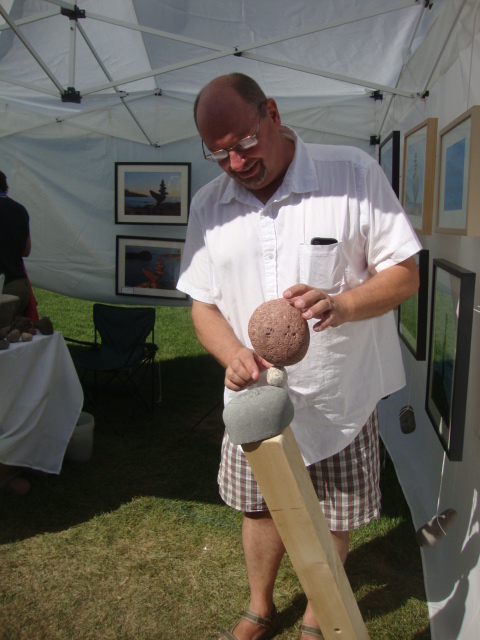
Peter Juhl was back again this year, the rock balancing magician/photographer who last winter shared his insider-information on the secrets of rock balancing in an eBook titled Center of Gravity. This year he is on hand with a printed version which is also now available at Amazon.com. Juhl comes across as easy-going and fun-loving, and will warmly engage everyone who shows interest in what he has become so adept at. Like all magicians, he genuinely enjoys the wonder he sees in others' eyes as they marvel. Unlike magicians, he is happy to share his secrets.

Whether it's fine art you collect or whimsical items to wear like Riki McManus's Sassy Hats, or something new to decorate your garden, this is a worthwhile way to go shopping. There's plenty to see, while you are at it you can actually get to know the artists themselves.

One thing I didn't like was the $5.00 parking fee, but I'm not going to complain too much. It would be nice, though, if the parking money went back toward helping the artists. Oh well... it is what it is.

Monday, August 27, 2012

Six Minutes With Rock Art Magician Peter Juhl

Peter Juhl
I discovered Peter Juhl's photos of rock art two weekends ago at the Bayfront Art Fair. Most of us have seen the growing interest in rock assemblies and sculptures here and there, along a creek in the park or as a decorative piece in a rock garden. What you have never seen are the kinds of rock sculptures Mr. Juhl enjoys making. It was a delight watching people stop in to see his photos and to examine the examples he had balanced there, some which seemed impossible. "There's no superglue" he explained as he disassembled and re-assembled an unusual piece.

EN: What's the story behind your rock balancing photos? How did your interest in rock balancing begin? 
Invert
PJ: I began balancing rocks on vacations to the North Shore of Lake Superior when my children were young. We'd spend hours on the beach hunting for agates and skipping stones. I recalled a kid in my junior-high lunchroom balancing a tilted salt shaker on a little pile of salt, then blowing the excess salt away. That made a big impression on me.

I tried the technique with rocks and little piles of sand, and quickly found out that it didn't translate, but I did discover that I could use any little chip or depression on an outcropping to nestle the end of an oblong rock in and maneuver it around until it balanced. Soon I was trying to get two or three up, and succeeding. I played with simple balancing for about fifteen years and took a few photos to give as gifts. It was always on a kind of back-burner simmer, but I didn't have a lot of time to devote to any of it until my kids were in college.

So about four years ago I decided to take some time during a family vacation to balance a lot of rocks and take a lot of photos with the new digital SLR I had gotten. It didn't really pan out because I was too distracted by all the other fun things like cookouts, hikes, and general socializing that happen on a family vacation. That's when I decided to go up to the shore alone and just work all day for a couple of days. And I discovered the importance of having time to focus. I got some really nice photos from that trip, and now I separate my vacation trips from my working trips.

EN: Were you doing photography before this?
PJ: I've been interested in photography for most of my life. I collected cameras for a long time and actually used the old cameras a lot. I took some of my first balanced rock photos twenty years ago with a 4X5-inch Speed Graphic like the ones used by photojournalists in the nineteen-forties. I still have a darkroom in my house, with a huge enlarger for those 4X5 sheet film negatives. These days I shoot mostly digital, but still haul out the 4X5 from time to time. The photos you can get from a large negative and good lens are really smooth and delicious, and the whole experience of being in the darkroom with the smells of the chemicals and the slower process of "discovering" the photos is good to come back to.

The first requirement for a good photo is an interesting subject, and not being blessed with a very good eye for subjects, I've sometimes fallen into the trap of letting it be all about equipment. Once I got some rock balancing skills, I had subjects I was passionate about, and the photography, while still a struggle sometimes, suddenly had a very specific foundation on which to grow.

EN: Do you have an "artist statement" about your work?
PJ: Here's the statement I've been using:

A good magic trick presents what we know to be a deception and makes us want to believe it’s real. A good balanced rock sculpture does the opposite: We know it’s real, but want to believe it’s a trick.

Drawing on elements of performance art, sculpture, and meditation, I arrange natural stones found on location, using only shape, weight, and friction to create a unique composition. I don’t use glue, magnets, or other artificial supports: The rocks are held up by nothing more than high-school physics and maybe a little karma. The sculptures may last a few minutes, or a few hours – with luck, long enough to be photographed. The photographs provide a kind of second incarnation to the sculptures, which have long since returned to the environment.

Though I try to create sculptures that look implausible, I also strive to elevate the stones in another sense, taking them from objects disregarded under our feet to essential elements in an organized and beautiful structure. My goal is to contrast the simple strength of these individual stones with the complexity and fragility of the work as a whole, which evokes a sense of serenity and comfortable tension.

EN: You appear to be having fun with this. Does part of the enjoyment come from having an audience and from seeing peoples' reactions?
PJ: This art form gives back to me in so many ways. I do love to balance in front of an audience and see the amazement on their faces. It really seems to delight people, and that is always gratifying. But I also love spending a whole day alone on a lovely beach, creating and trying new things. The moment when I give a final twist or nudge and can release a new piece into the world is like a mental "pop" releasing me from the many minutes of focus I put into it and freeing me to relax and enjoy the result. And I really love the thought that my photos are hanging in people's homes, being enjoyed.

To see more of Peter Juhl's beautiful photography and art, visit www.temporarysculpture.com


Tuesday, May 8, 2012

Fruit from a Long Dialogue with Artist Ann Klefstad

Forest Deer by Ann Klefstad
It wasn't long after I came to Duluth in 1986 that I discovered how many interesting people have transplanted themselves here from various parts of the country. East Coast connections included a pair of ad agency folk from Greenwich Village, a photographer from New Jersey and myself... and the West Coast connections seemed equally numerous. 

Actually, artists and writers have been coming here for decades, enjoying the clean air, spectacular views and a city that's easy, for the most part, to call home. (Though it does test one's mettle when we get a minus 30 cold snap.)

One such addition to the community is Ann Klefstad, who was deeply immersed in the L.A. art scene before bringing her sensibilities here to the Midwest. Many of us in the arts noticed her byline in the Duluth News Tribune as she covered the arts for several years, first as a freelance art reviewer and then as the arts and entertainment reporter. She is articulate and a very talented artist herself.

EN: What was your role in creating mnartists.org?

Ann Klefstad: Mnartists was an idea that Neal Cuthbert (who was arts program head at McKnight Foundation) and Steve Dietz (who was then curator of net art for the Walker Art Center) came up with. They soon enlisted Robin Dowden, who headed the programmers at the Walker. After the initial website had been set up as a database of Minnesota artists, they realized that they needed more frontpage content to drive traffic to the site.

They hired me to do that. The initial idea was to run some writing, articles on art. I developed it into a regular online journal, eventually with a ten articles every week. We hired a couple of other people as well, an admin manager and a community manager, and eventually we did, among other things, What Light, the poetry contest, and a monthly print magazine called 10,000 Arts, in partnership with the Rake magazine.

I should tell you the story of my interview for the job of editor at mnartists. I sat in a meeting room at the Walker with Neal, Steve, and Robin and we talked for an hour. It was really fun. I walked down the hall afterward thinking, I really like these people. And before I got to the door my cell phone rang and they offered me the job. It was a good fit.

I was there from 2001-2007, when I quit to take the job of arts and entertainment reporter at the Duluth News Tribune.

EN: How did you become interested in sculpture and what do you like most about this kind of work you that have been doing for schools and public spaces?
AK: I've always done sculpture. My degre
e is in sculpture, writing, and aesthetics, but my primary practice was sculpture. Everything else took the lead from that. I really like designing and making things, not just ideation. I like the way that materials tell you things.

What I like about making public art
, there's a need. People are coming to you saying, we need a work of art and we need it to embody certain things about us, our site, what we do. And l like designing things that will do that. I'm a communicator and an editor ­ I enjoy the voices of others, I like finding form for meaning. I welcome the ideas of the people I work with on public art projects. I find that if I really hear them, they almost always make the work better.

EN: You spent a decade or more in the L.A. art scene. How would you compare what is happening in the Twin Ports to what you saw and experienced there?

AK: That was a long time ago now: I was in LA early '80s to early '90s. We did see a fair amount of the art scene then and there, but LA was at the time struggling to create a more cohesive scene. During those years, New York was very much the center of things in the US and Berlin and Koln were very hot in Europe. LA still thought of itself as a bit of a backwater, at least in the early part of that decade. The gallery district moved from established galleries on La Brea, to more artist-centered spaces downtown (especially after the Temporary Contemporary, an old bus garage refitted by Frank Gehry, opened), to the gallery district that eventually became a more viable scene in Santa Monica.

There were at least 5 fairly important art grad programs in the area, though, and they (especially Cal Arts) became important in supplying young artists who energized the scene—but they tended to leave for New York or Europe after a few years.

Various things became hot and then evaporated: "bad drawing", revivals of painting, Baldessari-derived conceptual uses of photography, invocations of pop culture, reversions to classicism . . . almost all, though, were at least somewhat calculated to sell in the quite heated art market of the time, which really snaffled up very young artists. It was a very fashion-driven scene.

There were, like here, a few artists' collectives, but it was a much more every-man-for-himself scene than here. There was a sense that the stakes were high in terms of individual careers, but low in terms of the broader cultural relevance of artmaking. In other words, artists were making art for arts professionals—gallerists, curators, critics, art departments, other artists. No one else took much notice. Peter Plagens' art criticism was really the only writing on art in the popular media (like newspaper, magazines, etc), in the very large city of millions of people and likely thousands of artists. There was the sense that if you could catch the right eyes, you could be launched, be a fashionable artist whose works sold for tens or hundreds of thousands, and if you didn't, you were nothing. It felt kind of desperate and sweaty.
           
EN: Were you doing public art in L.A.?

AK: I didn't do art publicly in LA. I did ink paintings on paper of plants in my backyard. They seemed massively irrelevant to what was going on in the local artworld. A friend of mine was the curator of contemporary art at LA County Museum, and he kindly looked at this pile of ink drawings and said—I can't remember, exactly, but I think it had to do with establishing a critical context for the work and finding some way of presenting them other than a roll of paper.
           
What is happening here—some similarities with that era in LA in that the former critical contexts that people sort of half-know are not really relevant to what is being made, and there don't seem to be discussions that establish some critical footing for work other than individually.  So there is no sort of stylistic discourse, work doesn't talk to other work, which creates a kind of amateur's paradise in which every man or woman can be his own Dali or Pollack or Salle or Schnabel or Basquiat.
           
Ever since about 1980, it seems, concurrent with the rise of the internet, art history went from being a sort of arrow shot into the future, unraveling a series of styles inhabited in turn by artists who talked to each other, to being a market-driven free-for-all in which artists' works are conceived as individual hopeful gestures, walled away from discourse with the culture and with each other. This could be seen in LA then, and in Duluth now.

THIS INTERVIEW WILL BE CONTINUED THURSDAY

Popular Posts