Showing posts with label solitude. Show all posts

Saturday, January 8, 2022

Watching the Wheels: When John Lennon Sidestepped the Rat Race

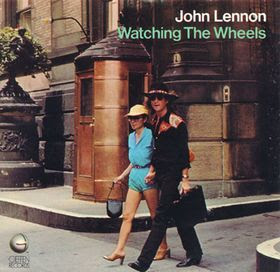
Cover art for the single, released posthumously
In 2015 I wrote about a concept called slow living as an alternative to the rat race. It's another way of describing the concept of mindfulness. Instead of cramming as many things as possible into a day, week or lifetime, mindfulness is a means of slowing down so we can appreciate the experience of living more fully. 

I think this is what the saying, "Stop the world, I want to get off!" is about. It's also the central idea in John Lennon's "Watching the Wheels," the first track on side two of his last album, Double Fantasy, produced in conjunction with Yoko Ono.

* * *

For most of us, it's hard to imagine what it must have been like to "become The Beatles." Not just becoming a group and making records, but becoming a bigger than life symbol of sorts. 

In their early years they were anything but famous as they worked out an identity while playing clubs in Britain and Hamburg. At a certain point in time, with a manager and a record label, it was as if they stepped onto a golden escalator to heaven. Their fame was bigger than life.

When The Beatles broke up, this bigger than life stature did not disappear. They each continued to be public figures, making albums, leveraging the fame they'd achieved. John and Yoko used this fame as a platform to make statements about peace.

Eventually, however, another theme which had been apparent years earlier (eg. "Fool on the Hill," "Across the Universe.") asserted itself and John chose to become a recluse. For a two year period he lived in L.A. and hung out with Harry Nillson, who became a successful pop artist without ever doing road tours to promote his records. Upon completion of his time in L.A. John returned to New York where he assumed the role of father and househusband.
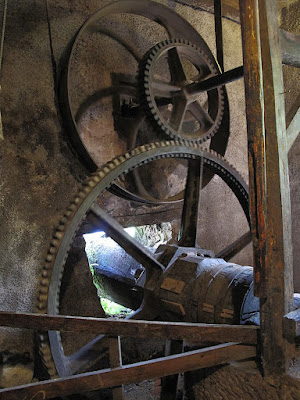
Cog wheels in France. Photo: Tangopaso
Public domain.
Here are the lyrics to "Watching the Wheels." Notice how natural and direct the language is.

"People say I'm crazy doing what I'm doing. Well, they give me all kinds of warnings to save me from ruin. When I say that I'm O.K. well, they look at me kind of strange. Surely you're not happy, boy, you no longer play the game."

It's easy to imagine that this is a direct lift of a conversation he had many times in various forms. And what is going on here?

Other people are confronting him with their expectations of what he should be doing with his life. Their observations may be accurate on one level --"you no longer play the game"--but on another level they're missing the point. "Why play the game which is so ruthless, which demands so much from us, dehumanizes us and pre-defines us?"

After being accused of being crazy for not embracing the values of the culture, they label him as lazy, "dreaming my life away." Their meddling continues with all kinds of advice aimed to enlighten John so he gets back in the game.

Here's the rub. Two sets of values are in conflict, and those who are committed to one view insist that the other is in the wrong. "Wake up, John." 

John, is not convinced. He's seen the pressures of fame. He knows the personal compromises involved, the obligations to show up at events because "it is expected." 

In her book Gift from the Sea, Anne Morrow Lindbergh writes about this very same thing. At some point in life you have to nurture yourself and stop playing the game. It is important to maintain a private life for emotional, spiritual and human reasons. 

Watching the Wheels

People say I'm crazy
doing what I'm doing
Well they give me all kinds of warnings
to save me from ruin
When I say that I'm o.k.
well they look at me kind of strange
Surely you're not happy now
you no longer play the game 

People say I'm lazy
dreaming my life away
Well they give me all kinds of advice
designed to enlighten me
When I tell them that I'm doing fine
watching shadows on the wall
Don't you miss the big time boy
you're no longer on the ball 

I'm just sitting here watching the wheels go round and round
I really love to watch them roll
No longer riding on the merry-go-round
I just had to let it go 

Ah, people asking questions
lost in confusion
Well I tell them there's no problem,
only solutions
Well they shake their heads and they look at me
as if I've lost my mind
I tell them there's no hurry
I'm just sitting here doing time

I'm just sitting here watching the wheels go round and round
I really love to watch them roll
No longer riding on the merry-go-round
I just had to let it go

John Lennon. © Downtown Music Publishing


Sunday, August 21, 2016

On Loneliness: 17 Quotes and an Anecdote

“What should young people do with their lives today? Many things, obviously. But the most daring thing is to create stable communities in which the terrible disease of loneliness can be cured.”
― Kurt Vonnegut, Palm Sunday: An Autobiographical Collage

I was thinking about Swiss psychologist Paul Tournier this weekend, in particular his book Escape from Loneliness which I'd once owned several decades back. Psychologists sit in the privileged position of having people from all walks of life bare their souls to them, and after a long career they have ample fodder for anecdotal material in books and articles.

Thinking about that led to my Googling the word loneliness, followed by quotes on loneliness. This blog post assembles in one batch a few of the many that you'll find if you do the same. What struck me is how many different kinds of people from various walks of life have had something to say on this topic.

And what also hit me was the quote by Kurt Vonnegut that opens this passage today. I interviewed the author once, and to build a rapport I started by stating that in college I'd read all of his books and Herman Hesse's books. He replied, "You must have been lonely." When I asked why he'd make such a comment he said something like, "Anyone who is that into Hesse must be lonely. All of Hesse's characters were lonely."

When he said that my thoughts turned inward. I managed to keep the dialogue going with Mr. Vonnegut but inwardly I wrestled with questions like, "Was I really that lonely? Was I lonelier than I'd realized?"

What I see now is that Mr. Vonnegut himself was well acquainted with this "disease of loneliness" and had I been more astute I may have been able to take a couple minutes to digress on this. Who knows what may have been unearthed?

As for our theme here, there's a difference between loneliness and solitude. I'm guessing that most writers and artists relish their times of solitude. The quotes that follow clarify and amplify what loneliness is in its essence. You can sense a lot of pain in many of these observations.

* * * *

“The loneliest moment in someone’s life is when they are watching their whole world fall apart, and all they can do is stare blankly.” ― F. Scott Fitzgerald

“Let me tell you this: if you meet a loner, no matter what they tell you, it's not because they enjoy solitude. It's because they have tried to blend into the world before, and people continue to disappoint them.” ― Jodi Picoult, My Sister's Keeper

“If you're lonely when you're alone, you're in bad company.” ― Jean-Paul Sartre

“When you have nobody you can make a cup of tea for, when nobody needs you, that's when I think life is over.” ― Audrey Hepburn

“If one's different, one's bound to be lonely.” ― Aldous Huxley, Brave New World

“A great fire burns within me, but no one stops to warm themselves at it, and passers-by only see a wisp of smoke” ― Vincent van Gogh

“It would be too easy to say that I feel invisible. Instead, I feel painfully visible, and entirely ignored.” ― David Levithan, Every Day

“Nothing makes a room feel emptier than wanting someone in it.” ― J

“We're all islands shouting lies to each other across seas of misunderstanding.”
― Rudyard Kipling, The Light That Failed

“To forget a friend is sad. Not everyone has had a friend.”
Antoine de Saint-Exupéry, The Little Prince

“Loneliness is about the scariest thing out there.” ― Joss Whedon

“There are no words to express the abyss between isolation and having one ally. It may be conceded to the mathematician that four is twice two. But two is not twice one; two is two thousand times one.” ― G.K. Chesterton

“Booksellers are the most valuable destination for the lonely, given the numbers of books written because authors couldn't find anyone to talk to.”
Alain de Botton, The Consolations of Philosophy

“In the midst of friends, home, and kind parents, she was alone.”
William Makepeace Thackeray, Vanity Fair

“The worst thing about loneliness is that it brings one face to face with oneself.”
Mary Balogh, No Man's Mistress

“I have been a stranger here in my own land: All my life” ― Sophocles, Antigone

Meantime, life goes on all around you.

Monday, June 29, 2009

For One Night of Love

SHORT STORY MONDAY

Part one of a never ending story. A work of fiction in the classic style.

For One Night of Love

Helmsboro, Minnesota, is a town undergoing change... rural, yet slowly being transfigured by the spread of housing developments and zoning regulations. The farming has always been difficult in these parts, due to the short growing season and the hardscrabble land, hence after scratching out a living for as long as sensible most of the area's farmers have sold out, subdividing their properties and encouraging their sons and daughters to pursue more promising careers in other fields. Many have migrated to the Twin Cities, though others have stayed behind, uncertain what to make of the changes taking place all around them. Because of its low crime and good schools, the area has developed a good reputation, attracting many new families into the community.

Jeremy Tanner lived in a farmhouse on the right-hand side of the Helmsboro Road, often called Old County Two, an old asphalt road that sweeps up and away from the city below. Situated on forty acres, nearly all of it once cleared, his grandfather built the house shortly after the Great War, saying, "First you build the cage, then you catch the bird." His father grew up on the site and imagined that Jeremy would raise a family of his own here one day as well. Since his father's death nine years ago the land has remained neglected, for Jeremy never took an interest in gardening, nor in any other kind of farm labor for that matter.

In the old days, Jeremy's great-grandfather harvested hay for hops for a local brewery. The160 acres the Tanners then owned were some of the best in Helmsboro. His grandparents met at the farmer's market, as did his parents. But it was hard work, and the Tanners were hard on their women.

Jeremy's mother hanged herself in the barn when he was too young to remember so that it has been more than thirty years since the house enjoyed the attentive care of a woman's touch. After his father passed away, Jeremy found employment as a pot washer and kitchen help at the Northview Country Club. The house and land were paid for so that his modest wages suited him fine. He had no career ambitions, preferring instead the cloistered solitude with which he surrounded himself at home.

Jeremy had not been been a bad looking youth and became what some would consider a modestly handsome man. What hindered him socially, and disturbed him deeply, was a nervous condition over which he had virtually no control and which made him quite self-conscious and socially reserved to an extreme. He was plagued with muscle twitches and tics that manifest themselves in a variety of ways that included eye blinking, head jerking and facial grimaces. They had first appeared in his early teens, and no matter how he tried, he could never entirely control them. First it would be a tightness in his shoulder blades and he would roll the blade, and then do it again and, like a persistent itch, would continue the motion until it became a strange elastic jerking movement which took all of his concentration to restrain. Once successful overcoming that tic, the discomfort would show up in his neck, and for several weeks he would jerk his head, or roll his eyes, or make a sniffing noise or clear his throat. The variations on this theme were maddening and made him a victim of cruel jokes in school so that he could hardly bear having to return each day to the ridicule and insults of his peers. Feeling himself a freak, he learned to find comfort in solitude.

Over time the severity of these multiple tics diminished and often he showed no unusual signs at all. However, whenever he experienced stress, the tics would return. They were especially troublesome in his relations with the opposite sex, to an extent that he was embarrassed by them. The facial twitches and grimaces especially shamed him so that he even considered taking his life because of his inability to control them in the presence of a girl whom he wanted to please. Many times he wept bitterly because of his condition until at last, having come to believe that no girl would ever love him as he was, he resigned himself to living alone for the rest of his life. When his father died, it relieved him of the burden of having to find a wife to please his father. He could travel his solitary road in peace.

At thirty-one, he had settled into a routine which more than satisfied him. Life was no longer a burden for him. In fact, he was quite contented with the life he now lived, a life of routines and small pleasures. Though his workday began at noon, he liked to rise early, usually before dawn, to take long walks, weather permitting, and then to return to his home to draw. He spent hours walking, observing the evolving countryside, and even more hours in his room making pictures. Other than his employment, and the few mundane tasks which all single people must attend -- sleeping, bathing, washing clothes, paying bills, etc. -- this was the whole of his life.

On the other hand, he never read the papers, nor listened to the radio, nor did he own a television. (He took his father's TV to the Goodwill two weeks after the funeral.) He never went out to restaurants, shows or bars, and only went to the store when it was an absolute necessity. He was neighborly to his neighbors, but mostly kept to himself and they, knowing well his preference for solitude, left him to himself, an unspoken contract.

But for his walking, the hours he spent with pen and paper were the hours he lived for. So absorbed by his picture making was he that he would set an alarm clock to alert him that it was time to get ready for work. Otherwise he might easily spend an entire day making tiny, hatch markings for a shaded background and forget to report to his job altogether. What might seem boring and tedious to others, Jeremy found relaxing and even stimulating. He was amazed by his own pictures and by the wondrous spatial illusions that could be created by the stroke of a pen.

Jeremy did have other distractions. He enjoyed a good book now and then. And he liked to play a harmonica, especially in the late evening after dusk. Sometimes he would go out behind the barn and sit on some old crates playing lonesome sounding melodies that slid away into the vastness of the night. At one time, too, Jeremy had a dog of which he had been fond, but the dog had been hit by a car and killed and Jeremy could not bring himself to replace her.

CONTINUED

Popular Posts