Showing posts with label John Lennon. Show all posts

Monday, July 7, 2025

There's A Place: Early Beatles Song Foreshadows Lennon's Future Path

One of my first 45s when I began collecting records was The Beatles' "Twist and Shout." It was the flip side of this gem that really struck a chord with me, "There's a Place."  When released on March 2 1964 "Twist and Shout" was an immediate hit, instantly climbing to the #2 position. It would no doubt has achieved #1 but because The Beatles occupied all five of the top slots on Billboard's Top 100 that historic week,
four other worthy tunes had to scuffle for the second thru fifth slots. 

It was only a few weeks earlier that The Beatles had made their first appearances on the Ed Sullivan Show (Feb 9 & 16), whetting the appetite of America's youth for more. Beatlemania had begun. 

The thing is, there must have been hundreds of thousands (millions?) of kids like me who would buy records for the A-side, and then get curious about the reverse side. I still have my original "Satisfaction" somewhere in my things, and what an unusual B-side there: "The Under Assistant West Coast Promotion Man."  

The Beatles' "There's a Place", from their 1963 debut album Please Please Me, was primarily written by John Lennon, with contributions from Paul McCartney. What struck me recently was how the song reflects a theme that runs throughout John's career. Here are several examples.

I don't want to spoil the party so I'll go. I would hate my disappointment to show.

Yer Blues: "Yes, I'm lonely. Want to die."

Fool on the Hill:  "Day after day, alone on a hill...
Nobody seems to know him..."

Nowhere Man: "He's a real nowhere manSitting in his nowhere landMaking all his nowhere plans for nobody"

Lennon's solo albums after the Beatles breakup continued to feature deeply personal, introspective lyrics exploring themes of pain, isolation and identity. And you see the seeds of this all the way back at the beginning.  

John Lennon wrote the song in 1963, purportedly inspired by the Motown sound, and possibly drawing inspiration from the song "Somewhere" from West Side Story (which begins, "There's a place for us...") composed by Leonard Bernstein with lyrics by Stephen Sondheim.  Lennon was drawn to the emotional resonance of the phrase "There's a place," but reinterpreted it in a more introspective way.

As is well documented, Lennon and McCartney were both heavily influenced by American R&B and soul music at the time, and the song reflects their attempt to blend these influences with their own style. Lennon later described it as an attempt to emulate the style of Smokey Robinson and the Miracles.


The song was written in Lennon's childhood home at 251 Menlove Avenue, Liverpool, during a period when the Beatles were rapidly composing songs for their debut album. It 
was recorded on February 11, 1963, at EMI Studios (now Abbey Road Studios) in London during the marathon session for Please Please Me. The Beatles recorded 10 songs in a single day, with "There's a Place" requiring 13 takes (10 for the backing track and 3 for vocal overdubs).


The song features John Lennon on lead vocals with a mournful harmonica intro, Paul McCartney on harmony vocals and bass, George Harrison on lead guitar, and Ringo Starr on drums. Its raw energy and tight harmonies reflect the band's live performance style at the time.


"There's a Place" was one of the Beatles' early originals, written during their pre-fame days when they were still performing in Liverpool and Hamburg. It was included on Please Please Me alongside other originals like "I Saw Her Standing There" and covers of American R&B hits. 


In the U.S., the song appeared on the Introducing... The Beatles album (Vee-Jay Records) and later on The Beatles' Second Album (Capitol Records), showcasing its significance in their early catalog.


The lyrics describe a mental or emotional place , a safe haven where the narrator retreats to escape feelings of sadness or loneliness: “There’s a place / Where I can go / When I feel low / When I feel blue / And it’s my mind / And there’s no time / When I’m alone.”  


Tim Hatfield, in his deep dive into the Beatles catalog, When We Find Ourselves In Times of Trouble, suggests that Brian Wilson's "In My Room"(Beach Boys, 1963) may have been inspired by "There's a Place." Each is about finding a place where you can lock out the world.


The song contrasts with the upbeat, love-centric pop of the era, hinting at deeper emotional struggles. Some biographers suggest it reflects Lennon’s personal experiences with loneliness or insecurity, themes that recur in his later work. Like great poems and songs, the lyrics remain open-ended enough to be universally relatable. I myself totally connected with it. The tight harmonies give it a lively, optimistic feel juxtaposed against a theme that is melancholic. The song also showcases the Beatles' early knack for blending pop accessibility with emotional substance. Its inclusion on Please Please Me demonstrated the band’s ambition to be more than a cover band, establishing Lennon and McCartney as serious songwriters.


In later interviews, Lennon cited "There's a Place" as an early example of his personal songwriting. In a 1980 interview, he noted it was “my attempt at a sort of Motown, black thing,” reflecting his admiration for soul music and his desire to express authentic emotion.

* * * 

While not as famous as other Beatles tracks, "There's a Place" is regarded by fans and scholars as an early gem that hints at the band’s future depth. It’s often cited in discussions of Lennon’s emotional vulnerability in songwriting:


Friday, May 30, 2025

Garbo Documentary Shows Why She Became Legendary and Why She Stepped Away

"There's something strange about the nature of "celebrity." Many young people dream of "making it" in the field of their dreams, but few really understand the hidden cost of being famous. It might be fun at first. But when you read between the lines of many stories, you see that the mystique is also a burden."
--Burden of the Public Eye

This weekend  I watched the Netflix documentary Garbo: Where Did You Go? What intrigued me was learning that at the height of her fame she withdrew from the limelight to live a private life of seclusion. I couldn't help but think of others who similarly pulled back in one way or another. J.D. Salinger came to mind, as did John Lennon in the mid-Seventies.

In his Chronicles: Volume One, Bob Dylan talks about the pre-eminent need to maintain a “normal” family somewhere away from the public eye. That task eventually took a toll on his first marriage. Some Dylan observers have gone so far as to speculate that his famous Woodstock motorcycle accident in the Sixties was staged as a mechanism for getting out of the public eye for a spell, some time to slow down and assess.

Greta Garbo was born in Sweden, 18 September 1905. Her birth name: Greta Lovisa Gustafsson. The youngest of three children, her childhood memories were not happy ones, growing up in a slum, long dark winters, an oppressive atmosphere in the home. 

At an early age she became quite interested in the theater and directed her friends in make believe stories. She finished school at age 13 like other working class girls and found work but when the Spanish Flu swept through Stockholm her father became ill and lost his job. Greta took him to hospital appointments and took care of him, but he died when she was 14, which was very dark time.

Greta's first jobs included soap-lathering in a barber shop, running errands in a department store and modeling hats, which led to her being filmed for a commercial, which then led to being in a silent film. She evidently sensed she's found her calling because she followed up with two years of training in the Royal Dramatic Training Academy.

In 1924 the Finnish director Mauritz Stiller recruited her for a film based on a story by Nobel Prize winner Selma Lagerlof, and she was on her way. She had no idea that in a few years she would end up being the biggest name in Hollywood and one of its biggest international stars.

Illustration by the author.
The documentary showed clips from the numerous film she starred in (28 in all) and it was easy to see why she was such a compelling on-screen presence. In her very. first screen test she was described as "electrifying." The response to her films certified that she had what it takes and the studio milked it for all it was worth.

Many silent screen stars fell out of favor once audiences could hear them talk, but not Garbo. Her husky Swedish accent amplified her desirability and powers. She became the biggest box office draw in Hollywood.

Despite her fame, the human spirit within her was being smothered and strangled by contract pressures and the expectations of Louis B. Mayer. When her sister died, to whom Greta had been immensely close, the studio would not give her permission to fly to Sweden to attend the funeral. She was given two days to grieve then get back to work.

Living life in the public eye took its toll in other ways. Eventually she walked away, still in her early forties. Hollywood repeatedly attempted to coax her back but it was not to be. Nor would she share her reasons for this permanent voluntary hibernation, even with her friends. Four years before her death she opened up to her biographer Sven Broman. "I was tired of Hollywood. I did not like my work. There were many days when I had to force myself to go to the studio... I really wanted to live another life."[1]

The documentary has its flaws, but it does succeed in giving us a deeper appreciation for this artist from Hollywood's early years and the price of fame. It also made me want to see some of those films that catapulted her to the top.

[1] https://en.wikipedia.org/wiki/Greta_Garbo

Thursday, July 25, 2024

Throwback Thursday: John Lennon's "Mind Games" and His Spiritual Quest for Peace

The power of the Beatles' breakup was such that when they each went their own way many of their fans followed all of them. I was one, purchasing all their first solo albums and several that followed from Paul and John. Mind Games was John Lennon's fourth album after the breakup, released in the fall of 1973 while I was on a semester break from college. The captivating cover art was itself memorable. The following year the title song from the album went gold as a single. This single is the topic for this blog post.

In the early 70's John Lennon's songs were very open about his inner struggles, his conflicts with family, relationships and religion. A previous album captured his explorations with primal therapy as one method of dealing with this inner pain. To some extent this candor in his songwriting is what made these albums so riveting.

Songs have hundreds of ways of introducing themselves. Sometimes it's a guitar lick after which each of the other musicians joins in. Sometimes they join in one at a time and build layers to form a backdrop for the vocals. Sometimes it's the snap of a drumstick blast, as in Dylan's "Like a Rolling Stone." Sometimes it's a syncopated drum intro like the Stones' "Honky Tonk Women." In this case, the shimmering, scintillating tapestry of sound is full and flowing from the start, producing the sensation of entering a timeless stream that has no beginning and no end, the wheel of life as it were. Three notes, one sustained and the other two stepping up with a leap to the third, over and over and over. At the song's end this musical backdrop carries on, doing that "ritual dance in the sun."

In 1963 Eric Berne published the best-selling Games People Play, introducing the popular culture to the concept of transactional analysis. A few years later session musician Joe South produced his one and only mega-hit in a song by the same name. "Oh the games people play now, every night and every day now, never meaning what they say, never saying what they mean."

John Lennon offers a different take in this one, foreshadowing a concept that would re-emerge in his song/album Double Fantasy.

In the movie Yellow Submarine we find Lennon quoted as saying, "It's all in the mind, you know." The extreme version of this philosophy embraces the notion that reality as we know it is all in our minds. That is, there is no objective reality but only a projected reality. Lennon's behavior, however, did not affirm this solipsist view but reflected an ongoing concern for the world at large, a commitment to peace and love.

The song "Mind Games" was itself written in the late 60's before the Beatles parted ways, originally titled "Make Love, Not War." The inspiration for the song came from another book about games called Mind Games: The Guide to Inner Space by Robert Masters and Jean Houston.

The line "Yes is the answer" is an acknowledgement of the artpiece by Yoko that originally brought them together. Too often, as Eric Berne documented, the games we play keep us apart. John Lennon's appeal is for us to play a different kind of game that brings us together.

Mind Games

We're playing those mind games together
Pushing the barriers planting seeds
Playing the mind guerrilla
Chanting the Mantra peace on earth
We all been playing those mind games forever
Some kinda druid dudes lifting the veil
Doing the mind guerrilla
Some call it magic the search for the grail

Love is the answer and you know that for sure
Love is a flower
You got to let it, you gotta let it grow

So keep on playing those mind games together
Faith in the future out of the now
You just can't beat on those mind guerrillas
Absolute elsewhere in the stones of your mind
Yeah we're playing those mind games forever
Projecting our images in space and in time

Yes is the answer and you know that for sure
Yes is surrender
You got to let it, you gotta let it go

So keep on playing those mind games together
Doing the ritual dance in the sun
Millions of mind guerrillas
Putting their soul power to the karmic wheel
Keep on playing those mind games forever
Raising the spirit of peace and love

Thursday, December 8, 2022

December 8, 1980: The Day John Lennon Died

"Grief is the response to loss, particularly to the loss of someone or some living thing that has died, to which a bond or affection was formed. Although conventionally focused on the emotional response to loss, grief also has physical, cognitive, behavioral, social, cultural, spiritual and philosophical dimensions."--Wikipedia

"Life is what happens while you are busy making other plans."

"A dream you dream alone is only a dream. A dream you dream together is reality."
 

"Love is a flower, you've got to let it grow."


The death of John Lennon broke a lot of hearts. As Baby Boomers came of age, Beatles music accompanied memories for many if not most of us. When the four broke up at the end of the 60s, the music didn't stop. We had the albums and we were also able to latch on to their individual evolving careers. Each took a different path, and none went immediately into hibernation, and many Beatles fans began collecting the solo albums they each produced. 

Like the assassination of JFK, most of us knew exactly where we were when we heard the news. I was in Mexico City, standing on the Zocalo, also known as the Plaza de la Constitucion, a large central square where proclamations are made. The Zocalo can purportedly hold up to 100,000 people but on December 9 it seemed like I was the only one there.

Surrounding the plaza are magazine stands with newspapers displayed, much like you'd find in New York City in those days. As I walked toward the East I was able to read the headlines. In fact, the headline of each paper was so large it filled the entire area above the fold. All carried the same proclamation: LENNON MUERTE. I stood staring, shocked and disbelieving.

The book by Keith Elliott Greenberg purports to be about that singular day when Mark David Chapman shot and killed John Lennon. It's actually a retelling of John Lennon's life, but in a format that is probably familiar to you. The story opens at the beginning of December 8, creating a context for the events of that day from commuters on subways to the movies currently playing to the mood of New Yorkers heading into the Christmas season and, naturally, the feelings John & Yoko were experiencing as their newly released Double Fantasy album came out.

And then there's Mark David Chapman. 

Here's a summary written by one of the book's reviewers on Amazon.

John and Yoko
In a breathtaking, minute-by-minute format, December 8, 1980: The Day John Lennon Died follows the events leading to the horrible moment when Mark David Chapman calmly fired his Charter Arms .38 Special into the rock icon, realizing his perverse fantasy of attaining perennial notoriety. New York Times bestselling author Keith Elliot Greenberg takes us back to New York City and the world John Lennon woke up to. The day begins with a Rolling Stone photo session that takes on an uncomfortable tone when photographer Annie Leibowitz tries to maneuver Yoko Ono out of the shot. Later Lennon gives the last interview of his life, declaring, "I consider that my work won't be finished until I'm dead and buried and I hope that's a long, long time." We follow the other Beatles, Lennon's family, the shooter, fans, and New York City officials through the day, and as the hours progress, the pace becomes more breathless. Once the fatal shots are fired, the clock continues to tick as Dr. Stephan Lynn walks from the emergency room after declaring the former Beatle dead, Howard Cosell announces the singer's passing on Monday Night Football , and Paul McCartney is lambasted for muttering "Drag, isn't it?" -- his bereavement confused with indifference. The epilogue examines the aftermath of the killing: the considerable moment when 100,000 New Yorkers stood in silence in Central Park, the posthumous reunion of the Beatles in the studio with George, Paul, and Ringo accompanying the recordings of their old friend the unveiling of a bronze John Lennon statue in Fidel Castro's Cuba, and the durable legacy that persists today.

The chief criticism of the book (by those who disliked it) was that they expected more about the day Lennon was killed, but that much of the book was filler with details of John Lennon's life that everyone (they believed) was already aware of. I think these critics are people who have already read everything else about John, so when there was "nothing new" they panned it.
For the rest of us, it's got plenty to like, and when it gets to the shooting itself, the writing does make us breathless as we get a close up view of that tragic night.
The story of James Taylor's experience was brief but tangible. Taylor lived just around the corner from the Dakota where the Lennons lived. He was on the phone talking with a lady friend who was in California when he heard the gunshots. He didn't think much of it since this was New York and police firing guns is not entirely unusual. As they continued talking a news flash crossed the screen and Taylor's friend said, "Someone just shot John Lennon." It was a disturbing revelation and he understood that those were the shots he'd heard.
Earlier this week a friend sent me a link to this interview with James Taylor, who had become friends with John Lennon through his recording experiences with Apple. It's a half hour and you may not have time for all of it, but I found it authentic and worthwhile.

It's been 42 years now. The shooting occurred at a time when Lennon was emerging again. It seemed that things were coming together. But like the proverb says, "Who can tell what a day will bring forth?" It's a reminder to not take our tomorrows for granted.

Saturday, January 8, 2022

Watching the Wheels: When John Lennon Sidestepped the Rat Race

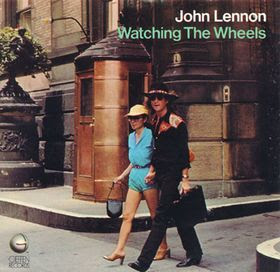
Cover art for the single, released posthumously
In 2015 I wrote about a concept called slow living as an alternative to the rat race. It's another way of describing the concept of mindfulness. Instead of cramming as many things as possible into a day, week or lifetime, mindfulness is a means of slowing down so we can appreciate the experience of living more fully. 

I think this is what the saying, "Stop the world, I want to get off!" is about. It's also the central idea in John Lennon's "Watching the Wheels," the first track on side two of his last album, Double Fantasy, produced in conjunction with Yoko Ono.

* * *

For most of us, it's hard to imagine what it must have been like to "become The Beatles." Not just becoming a group and making records, but becoming a bigger than life symbol of sorts. 

In their early years they were anything but famous as they worked out an identity while playing clubs in Britain and Hamburg. At a certain point in time, with a manager and a record label, it was as if they stepped onto a golden escalator to heaven. Their fame was bigger than life.

When The Beatles broke up, this bigger than life stature did not disappear. They each continued to be public figures, making albums, leveraging the fame they'd achieved. John and Yoko used this fame as a platform to make statements about peace.

Eventually, however, another theme which had been apparent years earlier (eg. "Fool on the Hill," "Across the Universe.") asserted itself and John chose to become a recluse. For a two year period he lived in L.A. and hung out with Harry Nillson, who became a successful pop artist without ever doing road tours to promote his records. Upon completion of his time in L.A. John returned to New York where he assumed the role of father and househusband.

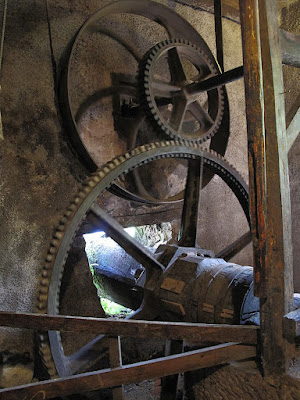
Cog wheels in France. Photo: Tangopaso
Public domain.
Here are the lyrics to "Watching the Wheels." Notice how natural and direct the language is.

"People say I'm crazy doing what I'm doing. Well, they give me all kinds of warnings to save me from ruin. When I say that I'm O.K. well, they look at me kind of strange. Surely you're not happy, boy, you no longer play the game."

It's easy to imagine that this is a direct lift of a conversation he had many times in various forms. And what is going on here?

Other people are confronting him with their expectations of what he should be doing with his life. Their observations may be accurate on one level --"you no longer play the game"--but on another level they're missing the point. "Why play the game which is so ruthless, which demands so much from us, dehumanizes us and pre-defines us?"

After being accused of being crazy for not embracing the values of the culture, they label him as lazy, "dreaming my life away." Their meddling continues with all kinds of advice aimed to enlighten John so he gets back in the game.

Here's the rub. Two sets of values are in conflict, and those who are committed to one view insist that the other is in the wrong. "Wake up, John." 

John, is not convinced. He's seen the pressures of fame. He knows the personal compromises involved, the obligations to show up at events because "it is expected." 

In her book Gift from the Sea, Anne Morrow Lindbergh writes about this very same thing. At some point in life you have to nurture yourself and stop playing the game. It is important to maintain a private life for emotional, spiritual and human reasons. 

Watching the Wheels

People say I'm crazy
doing what I'm doing
Well they give me all kinds of warnings
to save me from ruin
When I say that I'm o.k.
well they look at me kind of strange
Surely you're not happy now
you no longer play the game 

People say I'm lazy
dreaming my life away
Well they give me all kinds of advice
designed to enlighten me
When I tell them that I'm doing fine
watching shadows on the wall
Don't you miss the big time boy
you're no longer on the ball 

I'm just sitting here watching the wheels go round and round
I really love to watch them roll
No longer riding on the merry-go-round
I just had to let it go 

Ah, people asking questions
lost in confusion
Well I tell them there's no problem,
only solutions
Well they shake their heads and they look at me
as if I've lost my mind
I tell them there's no hurry
I'm just sitting here doing time

I'm just sitting here watching the wheels go round and round
I really love to watch them roll
No longer riding on the merry-go-round
I just had to let it go

John Lennon. © Downtown Music Publishing


Saturday, October 30, 2021

Dylan, Lennon and the Working Class

A working class hero is something to be
A working class hero is something to be.
If you want to be a hero then just follow me.

--John Lennon, Working Class Hero 

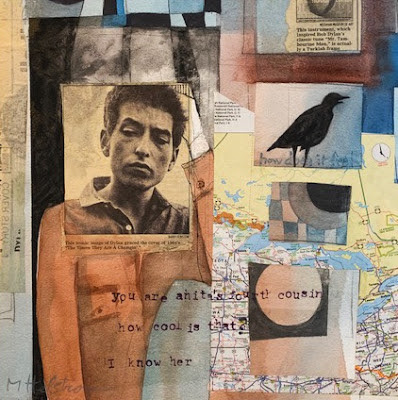
Collage/Mixed Media--Margie Helstrom
One of the songs Andy & Renee played at last Friday evening's concert here in Duluth was Workingman's Blue #2, the sixth track on Dylan's 2006 album Modern Times. When Andy introduced the song, he noted how despite Dylan's wealth and achievements, he had not forgotten his roots. 

As soon has he'd said this along with the title Workingman's Blues #2, I thought of John Lennon's Working Class Hero. I wondered if Dylan were  giving a nod to his old friend who had himself grown up in the blue collar town of Liverpool, but I soon learned this wasn't the case.

According to Wikipedia, Dylan toured with Merle Haggard the previous year and one of Haggard's hits was Workin' Man Blues. This shoots a hole in my initial thesis that Lennon's song was equivalent to a Workingman's Blues #1. One of the lines in Dylan's song is a direct lift from Haggard's 1969 hit, "Sing a little bit of these workingman's blues." 

It's a big job just gettin' by with nine kids and a wife
But I've been workin' man, dang near all my life but I'll keep workin'
Long as my two hands are fit to use
I'll drink my beer in a tavern
Sing a little bit of these working man blues

Nevertheless, both Dylan and Lennon pay tribute to the working man, the common man. Both had roots in working class communities--the Iron Range and Liverpool.

The mutual respect between Bob Dylan and John Lennon is evident in a number of ways, even though much has been made of how Dylan's Fourth Time Around was a barbed poke at John and a response to The Beatles' Norwegian Wood. As time went by Lennon saw it less as a barb and more a reflection of Dylan's playfulness.

On the album Tempest we find Dylan eulogizing John Lennon in the heartfelt Roll On, John with its repeating chorus:

Shine your light
Move it on
You burned so bright Roll on, John

* * * 

Dylan's tribute to the working man is laconic and layered. It's told from the point of view of the working man in the story. It's not Dylan's life, but a portrayal of life from the commoner's perspective.

There’s an evening’s haze settling over the town
Starlight by the edge of the creek The buying power of the proletariat’s gone down Money’s getting shallow and weak The place I love best is a sweet memory It’s a new path that we trod They say low wages are a reality If we want to compete abroad
My cruel weapons been laid back on the shelf Come and sit down on my knee You are dearer to me than myself As you yourself can see I’m listening to the steel rails hum Got both eyes tight shut I’m just trying to keep the hunger from
Creepin’ its way into my gut
Meet me at the bottom, don’t lag behind
Bring me my boots and shoes You can hang back or fight your best on the front line Sing a little bit of these workingman’s blues

* * * 

John Lennon's "Working Class Hero" is especially grim. Things are not all jolly for the working class in this world. Like Dylan, it's the manner in which the songs are articulated that lends them their power. 

As soon as you're born, they make you feel small
By giving you no time instead of it all
'Til the pain is so big you feel nothing at all
A working class hero is something to be

They hurt you at home and they hit you at school
They hate you if you're clever and they despise a fool
'Til you're so f---ing crazy you can't follow their rules
A working class hero is something to be
The song is sung by a man who has seen much and it's left a bitter taste in his mouth.
When they've tortured and scared you for 20 odd years
Then they expect you to pick a career
When you can't really function, you're so full of fear
A working class hero is something to be
* * * 
Others have written more comprehensively about Dylan's song. You can find this story on Seth Bushnell's
"Definitive Interpretation"  on Medium, which makes note of Dylan's Woody Guthrie references as well as John Steinbeck, two men who put in words  and imagery the challenges of the working class. By the end Bushnell calls Dylan's song "heartbreakingly romantic," and ends with this summing up: "
The song is an elegy to Dylan’s heroes and to his own past and a reaffirmation of his love for the common men and women he inspired."
After I've spilled a few words on the page, I usually take a peek at what Tony Atwood has had to say about a song. For this one he has much. He doesn't feel that this song measures up to "Tell Ol' Bill" (one of my favorite 21st century Dylan songs.) If you're up for more about this song, I recommend Tony Atwood on Workingman's Blues #2.
Visit this page for full lyrics for Dylan's "Workingman's Blues #2." 
And here is one last link to an article titled "What Bob Dylan Taught Me About the Working Man's Blues." What I liked about it was that it begins with a reference another song that I immediately linked to this one when I first heard WMB#2, which is "Union Sundown from Infidels. The article sifts through several other songs from the Dylan catalog with similar lessons.
Much more can always be said, but with that I shall close out. Thanks for taking a few minutes to visit. Comments welcome.

Tuesday, April 13, 2021

The 10 Most Expensive Vinyl Records Ever Sold

TUESDAY TRIVIA

What gives goods value? When Twitter CEO Jack Dorsey's first Tweet sold as an NFT for $2.9 million dollars, that was an eye-popping event. That it was auctioned off as a way of raising money for charity helped build the kitty, for sure. I recall Eric Clapton auctioning an assortment of guitars he owned and played for $6 million a decade or two ago. And original lyrics by major songwriters have fetched a pretty penny or two. Dylan's handwritten lyrics for "Like a Rolling Stone" garnered two million big ones in 2014, surpassing "A Day in the Life" by more than a million. And, I believe it's now been surpassed. 

Which brings us to today's diversion. Can you name the 10 most expensive vinyl records ever sold? 

It's apparent than vinyl has made a comeback in recent years. There's nothing quite like the fidelity of a clean album on a primo stereo system. Analog is warmer, richer and more real. 

That being said, we return to value propositions. It's not just the fact that they are vinyl that gives these 10 records value. If I perfectly reproduced 100 copies of Dylan's lyrics for "Like a Rolling Stone" you will not see any of them fetch the price the original captured. As much was we love the song, the lyrics, and the memories it evokes, it's not going to be what generates stratospheric value.

The operative word in this game is rare. Hence, the album that captured the #10 slot on this list is one in which only 250 vinyls were produced, and of these 245 were destroyed in a fire. Five exist and one of these sold in Britain for 25,742 pounds.

The article we're using as our "final authority" here was published at hmv.com in 2019, so it may be possible that the leaderboard has been penetrated by a newcomer or two. If this is so, leave a comment and link below in the comments so we can become the trivia know-it-alls that we deserve to be in this esoteric space.

One more caveat. I am not going to share the full list here. That might diminish your motivation to go check out the details of each entry that the editor of hmv.com worked so hard to assemble. Instead, I will talk briefly about the five Beatles-related discs on this list. 

Yes, four of the top ten are Beatles vinyls and one other is the John Lennon/Yoko Ono album Double Fantasy, probably the last one he signed before he was shot and killed outside the Dakota in New York Upper West Side. This album came in #5 on this list of most expensive vinyls and sold for $150,000. I've written elsewhere about how I was in Mexico City that day on December 8, 1980 when he was shot. This album was signed that same day, a few hours earlier.

The three Beatles albums on the list are The Beatles: Yesterday & Today, Sgt. Pepper Lonely Hearts Club Band signed by all four ($290K), and the first pressed Beatles White Album, which Ringo had owned and auctioned off for $790K. #7 on the list was not an album, but rather a rare acetate of the beautiful crooner  "Till There Was You".

What's striking to me about the album pictured to your right here is that someone actually decided that this would make a good album cover. It shows The Beatles with beheaded dolls and slabs of meat. The album was a compilation of hits that had been released in North America only, but was quickly withdrawn. 

There's more to the story, though. When The Beatles White Album, which featured an all white cover with nothing else but the name embossed on it, the effect generated all kinds of rumors, including a rumor that there was a photo of The Beatles with dismembered babies on it, and if you soak it in water the image will appear. I vividly recall hearing that, but did not proceed to dunk my album in water to see if an image would appear in the manner of invisible ink. I did, however, play Revolution #9 backwards numerous times to find clues about the death of Paul.  

A mint condition sealed original of the "Beatles as Butchers" cover fetched $125,000 at auction, which placed it at #6 on most expensive vinyls ever sold as of 2019. Instead, the album cover we ended up with on our store shelves was this one pictured to the left.  

#4 on the Top Ten Most Expensive list forever seems to appear as one of the "greatest albums" of all time on Rolling Stone's lists, as well as one of the coolest album covers of all time. We're talking about Sgt. Pepper here, of course. The reason this one sold for $290K is because it was signed by all four of The Beatles. 

It was the original acetate for "Till There Was You" that placed it on this list. If acetates are worthy of being included with the albums, I'm curious what some of the Dylan acetates in Bill Pagel's archives are worth.  

If you're into music and nostalgia, then head over to the website and see what other rare gems are there. You'll see an Elvis's first test pressing at #3 on the list. Can you guess the song? And the #1 has a story behind it that you will think, "What? Huh?" Yet it sold for a cool two million. It is neither British nor American. That's your last clue.

Meantime life goes on...  Listen to the music.

Related Link

The Beatles White Album Goes On Tour

Tuesday, December 8, 2020

40 Years Ago Today: Remembering John Lennon

Foto courtesy Gary Firstenberg
"Yes, I'm lonely. Wanna die."
--John Lennon, "Yer Blues"

The amazing thing about the amazing Beatles was how amazing each one was as individuals. When they finally broke up and went their separate ways after Let It Be, it became apparent that The Beatles of the Sixties was just a launch pad for each of their different futures. 

There was a sense in which I related to each of their paths. Paul formed Wings because he enjoyed the performance of his art. George was freed to allow his spiritual quest to continue to flower. Ringo must have enjoyed being celebrity because we soon saw him in Hollywood. 

John went further inward, seeking treatment for his inner pain through Primal Therapy, and outwardly expressing the themes he found there, Yoko by his side. "Give Peace a Chance" became a mantra for all who were weary of the Vietnam War. He asked us to "imagine all the people living life in peace" in another of his songs that became an anthem.

* * * 

40 years ago today I was in Mexico City standing on the Zócalo, the plaza or main square at the center of Mexico City. Even before the Colonial period this was the central meeting place for the Aztecs. At the time, there were magazine and newspaper stands all around the perimeter of the spacious plaza. I was sauntering across the the plaza in a leisurely manner taking it all in when ahead of me a newspaper headline caught my attention. All of the newspapers screamed the same news. "LENNON MUERTE."

Muerte is the Spanish word for death. I was stupefied.

* * * 

John would have been 80 this past October. Any hope of a Beatles reunion concert was permanently quashed that day. 

John was not a Beatle any more. Yet he remained a man who had played a role in a lot of peoples' lives, who wrote songs that many could relate to. When I was in high school I found comfort in "Yer Blues" blues because it expressed some of my own feelings after the loss of my closest friend. Confusion. Pain. Alienation. 

Nevertheless, life goes on and somehow we have to work it out. 

* * *

Related Stories

Dylan's Tribute to John Lennon on the album Tempest 

John Lennon Would Have Been 80 Today

Mind Games: John Lennon Makes Another Appeal to Come Together

A Leadership Lesson from John Lennon


Monday, October 19, 2020

Scratching Below the Surface of Mary Bue's Latest Album: The World Is Your Lover

Have you ever tried to write an original tune? OK, maybe you can, but can you keep writing them month after month, year after year? And not just original, but something that connects with listeners and sticks with them?

Writing music, creating it out of nothing, is much like looking at a blank sheet of paper and combining batches of words into a poem or story or novel. It's done every day, but not always effectively.

I've spent a lot of years contemplating the variety of expressions Bob Dylan's muse has expressed itself through him as a conduit. In a similar manner, artists like Mary Bue likewise seem to capture something original and evocative--maybe even magical--in their songwriting. 

Her latest album--I believe this is her sixth--is titled The World Is Your Lover, and the tracks are rich with emotion and energy.  

In a story titled Transcendental Bue a Minneapolis Star Tribune music critic subtitled the story, Mary Bue’s journey from Duluth to Minneapolis, New Mexico and India culminated in her best album yet, “The World Is Your Lover.”

Her best? I thought her last -- Holy Bones --was pretty good. Now I have to compare so I can decide whether I agree or not.

* * * *

I like the album cover and overall design. On the album itself (if you have the vinyl) there's a photo of Mary Bue embracing the globe. Upon seeing this visual I couldn't help but think of Woody Allen in Sleeper and the scene involving the Orb. Whether this is an intentional play on imagery or not I wouldn't know. It is certainly intriguing.

* * * *

The opening track on the album, titled "Sh*t Storm," is one powerful song. The closest thing I can compare it to is John Lennon's "Cold Turkey." Both songs have a story, but end in a turbulent whirlwind instrumental that replicates the feel. In Lennon's case it captures the feelings associated with heroin withdrawal. In Bue's, it's the apocalyptic whirl of our time in history. 

I walked for miles
On this parched earth
Once flowed with lava
Then a river birthed
And now the snow
Falls on the sage
When that shit storm comes
The earth’s gotta rage

I had a vision
The Great Lakes were drained
Superior Desert
Was her new name
Eagles cry
Barn owls shriek 
When that shut storm comes
It’s not gonna be good

Chorus:
Oh my god
Have you forsaken me?
All the gods
Are laughing now
As the earth starts cracking
And her bones start snapping
And the walls come crashing down

Oh my love 
He’s a brutal force
You can hear him coming 
On his big black horse
And he’s got friends
High and low
But when that shit storm comes
They all gotta go

I pray to Ganesha 
To tear down the walls
I pray in Chimayo
Protect those I love
I bow to the East
I bow to the west 
When that shit storm comes
Nobody’s gonna be left
Copyright 2020 Mary Bue

You can listen to this song and Purchase Album Here:
https://marybue.bandcamp.com/album/the-world-is-your-lover

* * * *

I've been itching to write about Mary Bue's latest album since last month and today is as good a time as any. Why? Because this coming Friday night there will be a livestream show from the Hook & Ladder Theater with special guests Turn Turn Turn and Alan Sparhawk. Here are the details:

MARY BUE CELEBRATES NEW ALBUM WITH FULL-BAND LIVESTREAM
with special guests Turn Turn Turn & Low's Alan Sparhawk!

THE WORLD IS YOUR LOVER RELEASE SHOW
Friday, October 23, 8 pm CDT
Livestream from Hook & Ladder Theater
Tickets: $15 | Pre-Sale Tickets: $10 (through Oct. 16)
Ticket holders can watch the show live or any time over next week.

* * * *
Related Links

EdNote: There is some language on a couple songs that some people will find offensive, though no more so than a majority of cable television series offerings.

Friday, October 9, 2020

John Lennon Would Have Been 80 Today

On this day in 1940 John Lennon was born. Rather than add more words to everything that has already been said about this man whose life was cut short, here are links to some of the other blog posts I have written about John. The paintings and photo are mine as well.


John Lennon Slits a Vein and Unburdens His Soul in "Yer Blues"

Mind Games: Lennon Makes Another Appeal to Come Together

A Leadership from John Lennon

John Lennon Notes and Quotes to Start Your Week

John Lennon: Notes and Quotes  
(same article as it originally appeared on my blog)


"We're only trying to get us some peace."

Monday, August 26, 2019

John Lennon Notes and Quotes to Start Your Week

Illustration by the author.
"I've always considered my work one piece and I consider that my work won't be finished until I am dead and buried and I hope that's a long, long time."
John Lennon Interview with RKO Radio on the day of his murder (8 December 1980)

* * * *

This past couple weeks I've been reading Philip Norman's Paul McCartney: The Life. Although some of the reviewers give it rather harsh scores on Amazon, I've personally found it a rewarding read because I've not read many books about The Beatles and thus there are more new insights and anecdotes than I was familiar with.

I still listen to The Beatles after more than half a century, and also internalized some of their individual post-breakup albums by repeated listenings.

There's no question that Lennon & McCartney were one of the greatest songwriting teams of all time. There's also little doubt that extreme fame has to do a number on your head. Finding personal equilibrium after the flume ride of Beatlemania took years and was real work.

One of the things that surprised me was how much abuse Linda Eastman received in marrying Paul. I was aware that Yoko was despised for extricating John from the Fab Four, and blamed for the breakup of The Beatles. I was pretty much unaware that Linda was often physically assaulted by Paul's female fans for making him "unavailable" and dashing their own hopes.

Fab 4 arrive in NYC, Feb 7, 1964.
Photo: Library of Congress. Public domain.
The book goes into detail about the context of their emergence as superstars. A good comparison might be the forest fires that raged in California last year. Conditions were right for an exceptional year for destructive blazes. Similarly, with Elvis in the army, Buddy Holly dead, and Jerry Lee Lewis out of favor for marrying his 13-year-old cousin, conditions were ripe for a super talented, outgoing supergroup to set hearts ablaze across the universe... or at least, across the seas.

When their solo careers began, after the breakup, it surprised me how harsh the critics were on Paul's first two albums. I had all those early solo efforts and enjoyed them all, including All Things Must Pass (Harrison) and especially Lennon's Mind Games.

John Lennon features prominently in the book, as it would be near impossible to tell any of their stories without their symbiotic others. The quotes that follow are Lennon's. When I read the quote at the top of this page it set me on a search for other Lennon remarks and observations.

John Lennon Quotes

"The thing the Sixties did was to show us the possibilities and the responsibility that we all had. It wasn't the answer. It just gave us a glimpse of the possibility."--John Lennon

"It's better to fade away like an old soldier than to burn out."--John Lennon

"Nor do I think we came from monkeys, by the way...That's another piece of garbage. What the hell's it based on? We couldn't've come from anything--fish, maybe, but not monkeys. I don't believe in the evolution of fish to monkeys to men. Why aren't monkeys changing into men now? It's absolute garbage. It's absolutely irrational garbage, as mad as the ones who believe the world was made only four thousand years ago, the fundamentalists.
"That and the monkey thing are both as insane as the other. I’ve nothing to base it on; it’s only a gut feeling."--John Lennon

Photo: Jack Mitchell. Free public use via Creative Commons.
"These critics with the illusions they've created about artists — it's like idol worship. They only like people when they're on their way up … I cannot be on the way up again. … What they want is dead heroes, like Sid Vicious and James Dean. I'm not interested in being a dead (expletive) hero. … So forget 'em, forget 'em."--John Lennon

"Everything is as important as everything else."--John Lennon

"I don't mind people putting us down, because if everybody really liked us, it would be a bore."--John Lennon

"Above all else never let people know how physically unattractive they actually are. Everyone deserves to believe they are beautiful."--John Lennon

"We're trying to sell peace, like a product, you know, and sell it like people sell soap or soft drinks. And it's the only way to get people aware that peace is possible, and it isn't just inevitable to have violence. Not just war — all forms of violence."--John Lennon

"It's just natural, it's not a great disaster. People keep talking about it like it's The End of The Earth. It's only a rock group that split up, it's nothing important. You know, you have all the old records there if you want to reminisce."--John Lennon

"Our society is run by insane people for insane objectives. … I think we're being run by maniacs for maniacal ends and I think I'm liable to be put away as insane for expressing that. That's what's insane about it."--John Lennon

"Life is what happens to you while you're busy making other plans."--John Lennon


Related Links
Dylan's Tribute to Lennon Keeps Rolling On
A Leadership Lesson from John Lennon
Tomorrow Never Knows: The Beatles' Turning Point?
Mind Games

Popular Posts