Showing posts with label fame. Show all posts

Friday, May 30, 2025

Garbo Documentary Shows Why She Became Legendary and Why She Stepped Away

"There's something strange about the nature of "celebrity." Many young people dream of "making it" in the field of their dreams, but few really understand the hidden cost of being famous. It might be fun at first. But when you read between the lines of many stories, you see that the mystique is also a burden."
--Burden of the Public Eye

This weekend  I watched the Netflix documentary Garbo: Where Did You Go? What intrigued me was learning that at the height of her fame she withdrew from the limelight to live a private life of seclusion. I couldn't help but think of others who similarly pulled back in one way or another. J.D. Salinger came to mind, as did John Lennon in the mid-Seventies.

In his Chronicles: Volume One, Bob Dylan talks about the pre-eminent need to maintain a “normal” family somewhere away from the public eye. That task eventually took a toll on his first marriage. Some Dylan observers have gone so far as to speculate that his famous Woodstock motorcycle accident in the Sixties was staged as a mechanism for getting out of the public eye for a spell, some time to slow down and assess.

Greta Garbo was born in Sweden, 18 September 1905. Her birth name: Greta Lovisa Gustafsson. The youngest of three children, her childhood memories were not happy ones, growing up in a slum, long dark winters, an oppressive atmosphere in the home. 

At an early age she became quite interested in the theater and directed her friends in make believe stories. She finished school at age 13 like other working class girls and found work but when the Spanish Flu swept through Stockholm her father became ill and lost his job. Greta took him to hospital appointments and took care of him, but he died when she was 14, which was very dark time.

Greta's first jobs included soap-lathering in a barber shop, running errands in a department store and modeling hats, which led to her being filmed for a commercial, which then led to being in a silent film. She evidently sensed she's found her calling because she followed up with two years of training in the Royal Dramatic Training Academy.

In 1924 the Finnish director Mauritz Stiller recruited her for a film based on a story by Nobel Prize winner Selma Lagerlof, and she was on her way. She had no idea that in a few years she would end up being the biggest name in Hollywood and one of its biggest international stars.

Illustration by the author.
The documentary showed clips from the numerous film she starred in (28 in all) and it was easy to see why she was such a compelling on-screen presence. In her very. first screen test she was described as "electrifying." The response to her films certified that she had what it takes and the studio milked it for all it was worth.

Many silent screen stars fell out of favor once audiences could hear them talk, but not Garbo. Her husky Swedish accent amplified her desirability and powers. She became the biggest box office draw in Hollywood.

Despite her fame, the human spirit within her was being smothered and strangled by contract pressures and the expectations of Louis B. Mayer. When her sister died, to whom Greta had been immensely close, the studio would not give her permission to fly to Sweden to attend the funeral. She was given two days to grieve then get back to work.

Living life in the public eye took its toll in other ways. Eventually she walked away, still in her early forties. Hollywood repeatedly attempted to coax her back but it was not to be. Nor would she share her reasons for this permanent voluntary hibernation, even with her friends. Four years before her death she opened up to her biographer Sven Broman. "I was tired of Hollywood. I did not like my work. There were many days when I had to force myself to go to the studio... I really wanted to live another life."[1]

The documentary has its flaws, but it does succeed in giving us a deeper appreciation for this artist from Hollywood's early years and the price of fame. It also made me want to see some of those films that catapulted her to the top.

[1] https://en.wikipedia.org/wiki/Greta_Garbo

Saturday, March 29, 2025

Seeking Fame? Have You Got the Right Stuff?

The Mercury spacecraft Friendship 7
launching John Glenn, the first America
to orbit the earth.
While sifting through notes from an old journal (circa 1984) I came across a few observations that I extrapolated from Tom Wolfe's The Right Stuff. The book is a compilation of stories about the test pilots who put their lives on the line during those early experiments with rocket-powered, high-speed aircraft.

In The Right Stuff, Wolfe chronicles the grueling process those pilots (and later astronauts) went through. Testing comes first: pushing planes past Mach 1, Mach 2, 2.5, flirting with the sound barrier and beyond, risking death to prove they’ve got the guts and skill. Selection follows—only a few, like Chuck Yeager or the Mercury Seven, make the cut. For the astronauts, assignment comes next: strapped into a capsule, blasted into orbit, riding a controlled explosion into the unknown. The order’s rigid—Testing --> Selection --> Orbit. Each step is necessary to prove you’re worthy of the next.


The other night I watched a documentary about Eric Clapton, focused specifically on the Sixties, the first ten years of his career. While watching, the thought entered my mind that those early years before Clapton became famous were all part of a process that determines who is capable of handling success and fame, and who is not. 


Testing could be the grind—years of work, auditions, failures, bad decisions, or whatever crucible someone endures to stand out. Not all pass; most wash out. Selection is the moment of recognition—picked by the crowd, the industry, or sheer luck. Then orbit: the launch into stardom, confined in a pod, hurtling through a surreal space where normal rules don’t apply. Like test pilots, those chasing fame push barriers—convention, obscurity, self-doubt—hoping to break through. [EdNote: I think here of the "27 Club" that sadly includes Jimi Hendrix, Janis Joplin, Jim Morrison, Brian Jones, Kurt Cobain and Amy Winehouse.]


Wolfe’s pilots didn’t just chase speed; they chased mastery over fear and physics. Fame’s seekers do the same with ambition and exposure. Mach 1, Mach 2, Mach 2.5—each milestone ups the stakes, and the “barrier” shifts. But here’s the kicker: in both, you don’t know if you’ve got the right stuff until the test’s over, and even then, the ride’s never fully in your control.


We've often heard it said, "Be careful what you wish for, you just might get it." My observation has been that when we get what we want, we usually get more than we bargained for. 


Related Link 

Magnificent Desolation: Buzz Aldrin's Moonwalk and Its Aftermath


Thursday, March 14, 2024

The TikTok Saga Illustrates How Andy Grove Was Right: Only the Paranoid Survive

"Do you want to hear one more?
This one's a real knee-slapper."
The House of Representatives has approved a bill to cut off TikTok in the U.S. The bill, titled Protecting Americans from Foreign Adversary Controlled Applications Act (H.R.7521), will be signed by President Joe Biden as soon as the Senate approves it. 

This brief blog post is not about the pros and cons of TikTok, nor is it aboutthe pros and cons of our government shutting it down. Rather, it is about a lesson I learned the hard way on Facebook a couple years ago.

At some point in time I was monetizing my blog with Google ads, and even though the revenue stream was mainly a trickle, there were monthly deposits made to my credit union account. It was daily habit to write, publish, then share on other social media, primarily Twitter and Facebook. Because I wrote frequently about the local arts scene, a large percentage of my readers came through the Facebook platform.

Suddenly, without explanation, I was unable to share my blog on Facebook. And since the Zuckerberg-founded enterprise also owns Instagram, my blog was also restricted there as well. 

The lesson is this: if you do not own the digital real estate where you have established your business, you're vulnerable to having everything you've built get dismantled.

This experience prompted me to see who are currently the biggest financial beneficiaries on TikTok. So I asked Google, which replied:

According to explodingtopics.com, the highest-paid TikTok influencers in 2024 are:

  • Charli D'Amelio: Estimated earnings of $17.5 million
  • Dixie D'Amelio: Estimated earnings of $10 million
  • Addison Rae: Estimated earnings of $8.5 million
  • Khaby Lame: Estimated earnings of $5 million
  • Bella Poarch: Estimated earnings of $5 million
  • Josh Richards: Estimated earnings of $5 million
I never heard of any of these people but superficial skim on Google shows that the top three are all young women. Addison Rae has 88 million followers.

If you wonder how they make their money, it varies. Once they have become established as influencers, they can get ad revenue or payment for promoting other companies. Some become a brand themselves and profit from selling their own products. And many profit by sharing their videos on other platforms.

Not everyone is making the big bucks the six names above are pulling in, but if Congress pulls the plug I'm guessing that a lot of these social media personalities will take a financial hit, as will many of the smaller fish swimming in this cyber-sea of social media enterprises.

According to Wikipedia the Senegal-born Khaby Lame has surpassed Addison Rae in number of followers and as of June 2022 had 142 million followers just by being an "everyman." You can read Khaby Lame's story here.  Or watch him do his comic antics here

142 million followers? Wowzer.

Lesson #2: When it's going good, don't take it for granted. Only the paranoid survive.

RELATED LINK:

Saturday, January 8, 2022

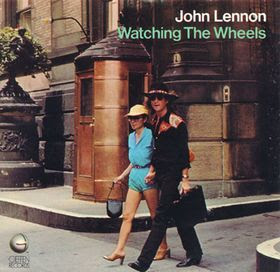
Watching the Wheels: When John Lennon Sidestepped the Rat Race

Cover art for the single, released posthumously
In 2015 I wrote about a concept called slow living as an alternative to the rat race. It's another way of describing the concept of mindfulness. Instead of cramming as many things as possible into a day, week or lifetime, mindfulness is a means of slowing down so we can appreciate the experience of living more fully. 

I think this is what the saying, "Stop the world, I want to get off!" is about. It's also the central idea in John Lennon's "Watching the Wheels," the first track on side two of his last album, Double Fantasy, produced in conjunction with Yoko Ono.

* * *

For most of us, it's hard to imagine what it must have been like to "become The Beatles." Not just becoming a group and making records, but becoming a bigger than life symbol of sorts. 

In their early years they were anything but famous as they worked out an identity while playing clubs in Britain and Hamburg. At a certain point in time, with a manager and a record label, it was as if they stepped onto a golden escalator to heaven. Their fame was bigger than life.

When The Beatles broke up, this bigger than life stature did not disappear. They each continued to be public figures, making albums, leveraging the fame they'd achieved. John and Yoko used this fame as a platform to make statements about peace.

Eventually, however, another theme which had been apparent years earlier (eg. "Fool on the Hill," "Across the Universe.") asserted itself and John chose to become a recluse. For a two year period he lived in L.A. and hung out with Harry Nillson, who became a successful pop artist without ever doing road tours to promote his records. Upon completion of his time in L.A. John returned to New York where he assumed the role of father and househusband.

Cog wheels in France. Photo: Tangopaso
Public domain.
Here are the lyrics to "Watching the Wheels." Notice how natural and direct the language is.

"People say I'm crazy doing what I'm doing. Well, they give me all kinds of warnings to save me from ruin. When I say that I'm O.K. well, they look at me kind of strange. Surely you're not happy, boy, you no longer play the game."

It's easy to imagine that this is a direct lift of a conversation he had many times in various forms. And what is going on here?

Other people are confronting him with their expectations of what he should be doing with his life. Their observations may be accurate on one level --"you no longer play the game"--but on another level they're missing the point. "Why play the game which is so ruthless, which demands so much from us, dehumanizes us and pre-defines us?"

After being accused of being crazy for not embracing the values of the culture, they label him as lazy, "dreaming my life away." Their meddling continues with all kinds of advice aimed to enlighten John so he gets back in the game.

Here's the rub. Two sets of values are in conflict, and those who are committed to one view insist that the other is in the wrong. "Wake up, John." 

John, is not convinced. He's seen the pressures of fame. He knows the personal compromises involved, the obligations to show up at events because "it is expected." 

In her book Gift from the Sea, Anne Morrow Lindbergh writes about this very same thing. At some point in life you have to nurture yourself and stop playing the game. It is important to maintain a private life for emotional, spiritual and human reasons. 

Watching the Wheels

People say I'm crazy
doing what I'm doing
Well they give me all kinds of warnings
to save me from ruin
When I say that I'm o.k.
well they look at me kind of strange
Surely you're not happy now
you no longer play the game 

People say I'm lazy
dreaming my life away
Well they give me all kinds of advice
designed to enlighten me
When I tell them that I'm doing fine
watching shadows on the wall
Don't you miss the big time boy
you're no longer on the ball 

I'm just sitting here watching the wheels go round and round
I really love to watch them roll
No longer riding on the merry-go-round
I just had to let it go 

Ah, people asking questions
lost in confusion
Well I tell them there's no problem,
only solutions
Well they shake their heads and they look at me
as if I've lost my mind
I tell them there's no hurry
I'm just sitting here doing time

I'm just sitting here watching the wheels go round and round
I really love to watch them roll
No longer riding on the merry-go-round
I just had to let it go

John Lennon. © Downtown Music Publishing


Friday, April 16, 2021

The Lictors Bring to Brutus the Bodies of His Sons: A Psychological Study

The Lictors Bring to Brutus the Bodies of His Sons
There is a drivenness in pride that becomes the impetus for our neurotic search for glory. Psychologist Karen Horney identifies this tendency in her book Neurosis and Human Growth, zeroing in on our insatiable quest for the self-actualization of our idealized self. This theme, one might say, is central to our understanding of Jacques-Louis David's painting The Lictors Bring to Brutus the Bodies of His Sons.

David spent two years painting this massive work which measures more than 46 sq. ft. It was completed in the first year of the French Revolution.

What's the story it depicts?  Brutus, seated in the shadows on the left foreground, was a founder of the Roman Republic that replaced the monarchy around 509 B.C. He was also one of the assassins of Julius Caesar, referenced in the famous line, "Et tu, Brute?" (Pronounced Bru-tay and meaning, "You also, Brutus? I thought were were friends.")

The painting here depicts another chapter in the life of Brutus. His two sons had conspired to overthrow the young Republic, therefore Brutus ordered them executed. The act of sacrificing his sons for the higher glory of Rome became Brutus' legacy. He wife, with grieving daughters in her arms, reaches toward the slain bodies of her sons which have just been carried in by the servants of the magistrate (lictors). Brutus sitting in the shadows looks away from the corpses with disdain or consternation.

Did David paint this to inspire French revolutionaries to be willing to sacrifice all for the glory of France? Or as a warning in response to the undercurrents that were broiling?

* * * 

Brutus killed his sons for the sake of Rome. It was his way of showing that his love for Rome was greater than his love for his children, for which he should be honored. By another standard of reckoning, this act would be condemned and repudiated. Is the painting endorsing Brutus? 

What happens when the thing that you do today for the sake of glory becomes something you're ashamed of later? Male machisimo is the first thing that comes to mind for me. Men really can be beasts. The quest for power is at odds with the spirit of servanthood, for example. Fame can be a devious seducer of hearts as well. 

A contemporary theme where two different views are colliding has to do with how we protest. Mahatma Gandhi and Dr. Martin Luther King, Jr. come to mind. Their emphasis on non-violence as a mechanism for change is now being repudiated by radicals who say that pacifism doesn't work, that non-violence is fruitless, that action alone gets attention that results in change. 

Is that true? Or will this, too, be repudiated in a future where there is more room for civil discourse? The call to arms scares me. What happens when the heroes calling for violent action later have a change of heart, after unleashing forces of destruction? 

* * *  

Jess Feist in his Theories of Personality amplifies Karen Horney's ideas about the search for glory. "In addition to self-idealization, the neurotic search for glory includes three other elements: the need for perfection, neurotic ambition, and the drive toward a vindictive triumph." In simplest terms: "Pride goes before a fall."

* * * 

Related Links

Thursday, August 27, 2020

Rocketman Reveals Elton John's Audacity and the Aching Loneliness That Contributed to His Powers

Finally saw Rocketman the other night, the Elton John biopic that is part Broadway musical, part psychiatric study. The film-maker's attempt to create a movie as audacious and over-the-top as the subject himself failed for me, but my appreciation of Elton John's music remains undiminished.

The film begins in a group therapy session with a dozen people seated in chairs in a circle as you might expect to find in an AA meeting. The people are all in ordinary street clothes, and then this guy walks in wearing a bright orange outfit with horns and wings. He begins by listing all his addictions. The, using flashbacks, we learn the story of his life.

Despite my dislike of certain aspects of the film, it triggered a number of thoughts that I kept reflecting on afterwards. First, though I need to clear the air about what I did not like. The choreographed dance numbers.

When the Coen Brothers re-created these over-the-top scenes with dancers or sea-swimmers in Hail Caesar, it felt like it was intended to be a satirical re-creation of those 30's Hollywood musicals, which actually worked in films like The Wizard of Oz and Oklahoma. In this instance it felt out of place. Or maybe it's just that I dislike musicals and the problem is me. I know people who are wowed by this kind of choreography. If you like that kind of thing, I will accept that I am the odd man out. This did not kill my appreciate for the story.

That being said, the film did a fantastic job of revealing the challenges of success and that well-worn adage, "It's lonely at the top."

When the movie was over, a haunting line from Hendrix reverberated through me: "Loneliness is such a drag." Along with that came the chorus of Eleanor Rigby: "Ah look at all the lonely people." Followed by a remark that Kurt Vonnegut made to me when I said how much I liked Hesse: "You must be lonely."

* * * *

In show business people frequently assume a stage name for various reasons. I'd always assumed it was to protect their families, which is a noble motive, or to put on a more glamorous identity. Thus, Henry John Deutschendorf Jr. became John Denver and Frances Ethel Gumm became Judy Garland. For Elton John his name change emerged from an ice cold childhood that he simply felt compelled to escape, and a self-hate that bound him in chains.

In becoming Elton John, he could become anything he wanted. Elton was someone quite different from Reginald Dwight, and he would keep it that way.

Audacity
In the past I have written about audacity in show business, specifically as regards its usefulness as a marketing tool. 

The new thought I had about audacity, though, is this. It's not audacity alone that makes greatness. Instead, audacity only works when the thing you are drawing attention is golden to begin with.

What I mean here is this. Muhammed Ali recited poetry and made outrageous claims, but he delivered the goods in the ring, taking out Sonny Liston in two successive fights and become a legendary boxer. Bob Dylan likewise was audacious, but he backed it up with incomparable songwriting.

In Rocketman we early on get a glimpse of how remarkably talented young Elton John was as a pianist. Had he been an average talent who dressed in over-the-top attire show after show all those years, he would not have captured the audiences he captured in concerts. Nor would he have sold over 300 million records.

The Real Elton John & Bernie Taupin
Bernie Taupin
I first heard of Elton John in the spring of 1970. Your Song was getting air time and when I saw his album at the Farmer's Market in Bound Brook, NJ I purchased it instantly. These were the days when you absorbed liner notes, and this was the first time I saw the name Bernie Taupin. I vaguely recall someone commenting that Elton John was a homosexual and Bernie Taupin his partner, as if this were a negative against their music. "So what?" I remember thinking. The songs were great. The music was great.

As it turns out Taupin was a lyricist, and in Elton John he found the perfect vehicle for what he'd been writing. Theirs was a mutual admiration society type of thing. A gifted writer meets a gifted song-score creator who is likewise a compelling performer. Each proved to be impossibly valuable to the other. Rodgers and Hammerstein come to mind here.

"Take Me To The Pilot" and "Border Song" and "The King Must Die" on that first album I bought showed that Elton John was going to be more than a one hit wonder. The hits kept coming.

Taron Egerton as Elton.
Taron Egerton
One of the bright spots in this film had to be the acting of Taron Egerton, who played the Elton John character. He not only acted the role, he sang the songs. Many reviewers at imdb.com said Egerton deserved an Academy Award for the role, and even though he didn't grab the Oscar there, he did receive the nod at the Golden Globes for Best Performance as an Actor.

The Magic of His Music
As noted earlier, Elton John's tunes, the music with which he clothed Taupin's lyrics, we so often effective because it channeled his inner loneliness with an ethereal quality you just can't capture in words alone. Hence the power behind "I Guess That's Why They Call It The Blues." And again, that loneliness theme leaps out with these aching lines:

Loneliness was tough
The toughest role you ever played
Hollywood created a superstar
And pain was the price you paid

The power isn't simply the lyrics, but the haunting melody that carries these words on wings. Along with a delivery that comes from someone intimately acquainted with the emotion.

When all is said and done, it's a "big" film about a man who has been a very big star, one of many whose careers were birthed in the Sixties.

Here's something to take you away.

Thursday, November 4, 2010

Fame: It's Not All It's Cracked Up To Be

Fame, makes a man take things over
Fame, lets him loose, hard to swallow
Fame, puts you there where things are hollow
Fame

Fame, it's not your brain, it's just the flame
That burns your change to keep you insane
Fame*


As you walk through the hallways of the Hilton and Las Vegas Convention Center you will see countless photos revealing our culture's affection for celebritydom. (Affection or affliction?) Here is a photo of the Rat Pack, and there The Beatles getting off a plane at McCarron Airport. Here's Lucy, and a little further down the hall there's Marilyn. And naturally a whole lot of Elvis, since the Hilton was his home away from home when in Vegas, which he bellowed should live forever.

I don't know about you, but because of the ways they died many of these famous people do not bring the warm fuzzy feelings these images seem intended to inspire. For so many the lasting impression I have is of the persons concealed inside this straitjacket of fame and the often pathetic ways in they lived their last days.

Read Bob Woodward's Wired and see John Belushi's demise. Marilyn Monroe's whole life was splattered with tragic. Elvis, whose ghost still haunts the Hilton, became a fat, bloated, impotent who had difficulty remembering the lyrics to his own hits and ultimately was too ashamed to let his fans see what he had become.

The elevator ride to the top is sweet for those whose charm and talents open that door, but then where do you go?

The bad behavior and rumors of bad behavior that celebs get into are what make the cash machines ring. And why all these insane, self-destructive escapades in the first place? Janis Joplin sang, "Freedom's just another word for nothing left to lose..." before she lost her life.

Jimi's gone. Jim Morrison is gone. Curt Cobain's gone. Brian Jones, Keith Moon, Michael Jackson... the list is long.

The excessive drug abuse combined with the pressure to perform can lead to a strange brew of consequences. Maybe fame itself is like a drug. I have heard it said that LSD doesn't make people insane, it only reveals the insanity that is already there. Maybe fame has the same effect. Not every famous person becomes a cokehead (Drew Barrymore, Whitney Houston), heroin addict (Courtney Love, Keith Richards), philanderer (too numerous to name)...

Anyhow, these are some thoughts that were rattling through my head as I prepare for leaving Las Vegas tomorrow. The images everywhere are of smiling faces, but all I can see is the inner pain.

Fame, what you like is in the limo
Fame, what you get is no tomorrow
Fame, what you need you have to borrow
Fame

Fame, "Nein! It's mine!" is just his line
To bind your time, it drives you to, crime
Fame

* David Bowie, Fame

Sunday, January 20, 2008

Definiteness of Purpose

Napolean Hill calls Definiteness of Purpose a critical key to success in life. Watched Chariots of Fire last night. Definiteness of Purpose is once again illustrated. Gold medal winners have a clarity of aim that enables them to surpass their peers. ~May 25, 1998

A prerequisite to achieving "great things" (it would seem) is a conviction that one is able to achieve or accomplish great things. This notion is accompanied by a desire to do great things, which flies in the face of current cultural beliefs that it is wrong, even elitist, to suppose oneself different from the herd. But it is not elitism that propels us to strive to do more and be more. It is not a belief that we're better... rather, it is a concern that we each, should strive to fulfill our full capacity. ~ May 30, 1998

These journal notes should not be taken to suggest that everyone should make their aim to be president of the U.S. or a world famous musician. There are actually two important matters outined here. The first is that without a definitie purpose or aim, our lives will drift, and that people who accomplish great things or even lesser things (providing for one's family, sending a child to college) do so by eliminating distractions and doing whatever it takes to accomplish the goal.

An example: Albert J. Amatuzio, the founder of AMSOIL, spent more than a decade learning all he could about lubrication before finally achieving his lifelong dream of producing a new product for the auto industry. This man's determination and definiteness of purpose was directly responsible for the synthetic motor oil market.

There is a flip side to this matter, however. Be sure your aim corresponds to who you are. That is, if you are middle aged and not particularly athletic, don't imagine that you will set a new world record for the hundred yard dash. Or if you have shaky hands and poor eye-hand coordination, it is not the time to pursue a career as a brain surgeon. The point being that self awareness is also useful.

I am reminded of the Aesop's Fable about the Monkey and the Camel.

THE BEASTS of the forest gave a splendid entertainment at which the Monkey stood up and danced. Having vastly delighted the assembly, he sat down amidst universal applause. The Camel, envious of the praises bestowed on the Monkey and desiring to divert to himself the favor of the guests, proposed to stand up in his turn and dance for their amusement. He moved about in so utterly ridiculous a manner that the Beasts, in a fit of indignation, set upon him with clubs and drove him out of the assembly.

It is absurd to ape our betters.


This in no way implies that camels are inferior to monkeys. Quite the contrary. There are many things monkeys can not do that camels are utterly equipped for.

So it is that our dreams should correspond with who we are. Though I'll add yet one more caveat. When we're young, we really don't know very well who we are. We can be so influenced by a bad experience or peers that we have a misguided picture of ourselves in our heads. Or, we see a barrier to achievement that is really no barrier at all. So perhaps our first definite purpose should be to find out who we are. From this starting point, we really can make a difference.

Sunday, October 7, 2007

Woody Allen

Reading portions of Woody Allen’s book Side Effects & reflecting on his movies. Allen addresses and incorporates the serious questions of life & meaning, and while making humor/jokes, etc. Although some find it irreverent, is he not, at least, raising the questions? The “heavy question” or “profound thought” is a regular feature of his humor, as are his countless references to classic literature.

Perhaps this is the only way modern man can toy with these ideas. Allen, then, is the genius who has managed, more successfully than many preachers, to confront modern man with a true sense of his situation. Why am I here? Why do we do the things we do?
August 1, 1993

A few Woody Allen quotes to give a taste of his flavor:
"Eternal nothingness is fine if you happen to be dressed for it."

"If only God would give me some clear sign! Like making a large deposit in my name at a Swiss bank."

"Money is better than poverty, if only for financial reasons."

"I'm astounded by people who want to 'know' the universe when it's hard enough to find your way around Chinatown."

"It is impossible to experience one's death objectively and still carry a tune."

"There are worse things in life than death. Have you ever spent an evening with an insurance salesman?"

"I'm not afraid to die, I just don't want to be there when it happens."

"I don't believe in the after life, although I am bringing a change of underwear."

Monday, September 17, 2007

The Natural

"My life didn't turn out the way I expected." ~ Roy Hobbs

Watched The Natural last night with Robert. A number of good lines. "I believe we all have two lives... the life we learn with and the life we live with after that." Good line. But what about now? When does "the life we live with after that" begin?

Another interesting statement. "I didn't see it coming. I should have seen it coming." Some things that happen to us seem to have no foreshadowing even when in fact they do.

Interesting, too, that the movie ends with an upbeat heroic end and altogether differently from the book.

Why do people want to be famous? Roy Hobbs wanted that... to be the best that ever was. Why? Iris challenges him: "Why does that matter so much to you? Isn't it good enough to know you were good?"
Oct 1, 2000

Too often we chase treasure at the ends of the earth when there are acres of diamonds right here at our feet. Open your eyes and see where true value lies.

Popular Posts