Showing posts with label Einstein. Show all posts

Monday, September 29, 2025

IdeaSpotting

"Curiosity is one of the most permanent and certain characteristics of a vigorous mind." ~ Samuel Johnson


When I read Sam Harrison's IdeaSpotting in 2008, it was as good as I anticipated. His approach to the material is itself handled creatively. The pages are designed in an original manner. It is not a typical "book" in the sense of having only words on the pages. Every page is a new layout, appealing to the eye, though thematically it holds together and the design does not interfere with the message.


On page 25 the heading is, "Open your mind, and people will show you what's on their minds." He quotes Clint Eastwood: "Once you feel you know everything, you're done. You're either repetitive or boring, or both."


This notion reminded me of my college days when we'd sit or lie around on the college green at Ohio University talking about the meaning of life. There was this one fellow there who always said the same thing. "We're born, we procreate, and then we die." The first time he said it was cool, it seemed sort of a nugget to chew on. He had a professorial attitude, deep voice, beard and avant garde dark shades with turtleneck look. On another occasion we were discussing something and he was there. The only words he spoke were, "We're born, we procreate, and then we die." Months later, again the same.


Evidently he had had a profound LSD experience and "figured out the universe" and knew all he needed to know, because he'd definitely become repetitive and boring. The "cool" mystique that we originally saw in him never went beyond being a veneer. He was a guy you couldn't get to know. And he wasn't interested in getting to know us. He became as captivating as a broken record.


If we want to learn new things, we need to explore the world around us, and inside others... to listen and hear and see in new ways. Ask questions. Pay attention. And "maybe even eavesdrop." There are new things to discover all around you. This is the fodder for new ideas. And underneath it all you may even hear gentle rumbles of the voice of God.


BONUS TRACK

Three Quotes about Curiosty


"I am neither especially clever nor especially gifted. I am only very, very curious." Albert Einstein 


"The cure for boredom is curiosity. There is no cure for curiosity." 
Dorothy Parker 


 “Old age begins when curiosity ends.”Saramego


Friday, May 5, 2023

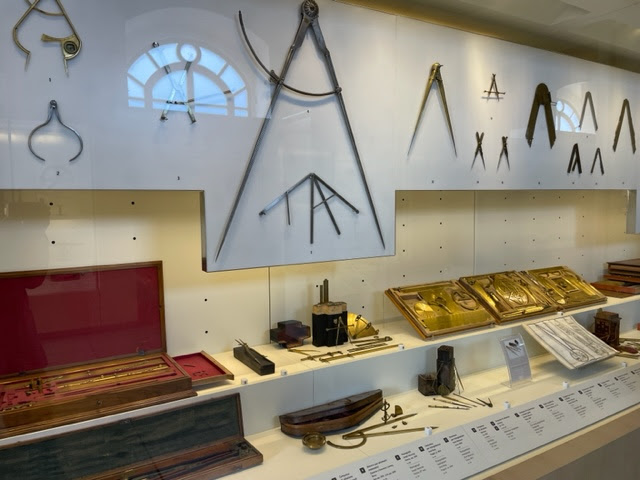
The Galileo Museum in Florence Is Worthwhile Destination

Operations of the Compass: Geometric and Military
Dedication to D Cosimo Medici
The Galileo Museum in Florence offers keen insights into the incredible advances in science, astronomy and geometry more than 400 years ago. The museum showcases microscopes, telescopes, lenses, barometers, globes, models of planetary movements and even medical devices. 

Galileo Galilei (15 February 1564 – 8 January 1642) was an Italian physicist, astronomer and engineer. Born in Pisa, an hour to the west, his family moved to Florence when he was eight. He joined them when he was ten.

If you go to Florence, you might consider a day-trip by train to Pisa. The leaning tower is a letdown to some people, but there is plenty more to see than that. Here in Florence, though, you can get a focused picture of the period in which Gallileo made his way. 

I was surprised to discover that Galileo did not start out in astronomy or geometry, but had gone to school for a medical degree. Doctors, even then, made more money than the average tradesman. Nevertheless, his other interests propelled him into a wide range of explorations into the natural world.

Galileo wasn't the first person to use a telescope to look at the moon, but he was the first to map what he saw. He was also the first to observe moons orbiting Jupiter.


His ceaseless curiosity about the stars and earth's place in the universe got him embroiled in religious wrangling at a time when such conflicts were unhealthy for one's career. The Roman Inquisition was active at this time. His writings countered the then-current narrative that the sun
travelled around the earth, an Aristotle proposition that had not yet been discarded due to the works of Copernicus. (EdNote: And idea can be erroneous even when it is believed by the majority.)

After a trial Galileo was placed under house arrest for the rest of his life. His book was banned and he was forbidden to publish anything else for the rest of his life. He disregarded this, continuing research in new directions. His book The Two Sciences was published in Holland, a book about kinematics and the strength of materials. Three centuries later Albert Einstein would praise this early work in the field of physics.

The Galileo Museum is just around the corner from the Uffizi Gallery, and a stone's throw from the Arno. 


And much, much more.

Monday, November 22, 2021

Seven Quotes About Stupidity and a Few Examples

Yes, I have done some stupid things 
in my life. How 'bout you?
The annual Darwin Awards were initiated in 1993. The idea of the awards has been a way to spotlight examples of behavior that eliminates stupidity from the gene pool. The most spectacular examples are given Darwin Award recognition. The stories would be humorous if they weren't real. 

We've probably all done many stupid things in our lives. I know that I have. For example, I once jumped out of a moving car thinking I would impress the girl across the street. No one was impressed. Fortunately, my stupidities haven't cost me my life.

The trigger for this blog post was having recently heard the song "Something Stupid" which was a hit in the Sixties, sung as a duet by Frank Sinatra and his daughter Nancy. I was in high school and didn't really didn't "get" the meaning of the song til l I was a little further down the road.

I know we're not supposed to call other people stupid. There's a difference between being stupid and doing something stupid. People don't need lifelong labels for momentary lapses of good judgment. As I already stated, I have done my share of stupid things, and it didn't end with that jump from a convertible coming home from a Little League game.

Here are a few quotes about stupidness. Some are a little mean. Others insightful. 

Think of how stupid the average person is, and then realize half of them are stupider than that. 
— George Carlin

Life is hard. It’s a whole lot harder if you’re stupid. 
— George V. Higgins

Men are born ignorant, not stupid; they are made stupid by education. 
— Bertrand Russell

Only two things are infinite; the universe and human stupidity, and I’m not sure about the former. 
— mis-attributed to Albert Einstein

Against stupidity the gods themselves contend in vain.
 — Friedrich Schiller

“Remember, when you are dead, you do not know you are dead. It is only painful for others. The same applies when you are stupid.” 
— Ricky Gervais.

“Stupid is as stupid does.” 
— Forrest Gump

* * * 

The Darwin Awards folk tell their grim tales in a light-hearted manner. The lessons are serious, of course. Here are a few links, if you're interested.

Double Darwin Award! Sports Training

Soaked to the Bone in Yellowstone

Smokin' Hot Sauce!  

One Way Ticket

The last two above seem to show what happens when you underestimate how explosive gasoline can be. 

Mind the Cone Zone

Low Flying Drunks 

This last one has a few real life lessons for each of us. First off, beer may not always make you stupid, but drinking and stupidity do quite frequently accompany one another. Also, it's good to be aware of what you don't know. A lot of our confidence is simply a lack of awareness regarding the risks of some behaviors. Alas.

Related Link

It Happened One Night

11 Things You May Not Know About Me

Monday, June 4, 2018

The Volstead Act: What Did We Learn from Prohibition?

Prohibition only drives drunkenness behind doors and into dark places, and does not cure it or even diminish it. --Mark Twain

Nothing is more destructive of respect for the government and the law of the land than passing laws which cannot be enforced.
--Albert Einstein

Alcohol didn't cause the high crime rates of the '20s and '30s, Prohibition did. And drugs do not cause today's alarming crime rates, but drug prohibition does.
--James Carriger Paine

For every prohibition you create, you also create an underground.
--Jello Biafra

* * * *
The past several days I have been watching Ken Burns' disturbing documentary on Prohibition. It's impossible to watch this without thinking of its contemporary applications. (i.e. the war on drugs).

The cost of the drug wars is far more than simply financial. Tens of thousands of lives have been wasted (i.e. people killed) in Mexico alone by the gangs that have risen to power as a result of the drug trade.  It's a strange world we live in.

I keep trying to understand what makes it different this time. Maybe one difference is that nearly every politician and rich person drank some form of alcohol in those days. (Teetotaler John D. Rockefeller was likely an exception.) It is probably less likely that all our congressional reps are smoking weed, though I wouldn't be surprised to learn there's been recreational drug use in the Capitol. (Only speculation, of course.)

Maybe another difference is that pot has been portrayed as a gateway to more addictive substances. I'm guessing that not every beer drinker advances to gin and tonics.

* * * *
Communism is like prohibition, it is a good idea, but it won't work. --Will Rogers

* * * *
Several states have legalized marijuana now, and the push for legalization continues to extend to other states, so it will no doubt be a political issue for years to come. For this reason here are a handful of articles worth reviewing.

Prohibition Then and Now. (Constitution Center, 2012)

Prohibition: A Parallel to Modern War on Drugs (Seattle Times, 2011) Due to its proximity to Canada, Seattle featured prominently in the alcohol trade during Prohibition.

Though the Temperance movement began before the Civil War, it came to fruition only after the First World War settled. From the beginning there were leaders who had issues with this cause, including Abraham Lincoln who said, “Prohibition... goes beyond the bounds of reason in that it attempts to control a man's appetite by legislation and makes a crime out of things that are not crimes... A prohibition law strikes a blow at the very principles upon which our government was founded.”

Nevertheless, in January 1919 the 18th Amendment was ratified prohibiting the manufacture, sale, transportation, import, or export of intoxicating liquor. Woodrow Wilson vetoed the amendment, but was overruled that fall by Congress.

Across the Atlantic Winston Churchill said he believed Prohibition was "an affront to the whole history of mankind."

* * * *
There was no late night television in those days, but we can assume that Dave Letterman/Johnny Carson equivalents were poking fun of the situation. Here are some comments related to the evils of drinking:

Once, during Prohibition, I was forced to live for days on nothing but food and water. --W.C. Fields

When I read about the evils of drinking, I gave up reading. --Henny Youngman

Without question, the greatest invention in the history of mankind is beer. Oh, I grant you that the wheel was also a fine invention, but the wheel does not go nearly as well with pizza. --Dave Barry

Related Links
The Price of Prohibition (Reason Magazine)
Prohibition-Era Detroit
Read my 2009 commentary on this issue: Prohibition and the Drug Trade
Illustrations by Ed Newman

Meantime, life goes on all around you... 

Friday, December 12, 2014

A Recycled Blog Post On Rambling

"I have no special gift. I am only passionately curious." ~ Albert Einstein

What was it that made men like Einstein and Newton and Copernicus and Aristotle stand out from the herd? Einstein puts his finger on the nub of it right there. They were inordinately curious. They asked questions. They wanted to understand how the world worked. They didn't just accept things as they were.

For some reason, when we're kids we're taught that "curiosity killed the cat." This is repeated ad nauseaum in our childhood so as to make curiosity something bad, like lying. In reality, curiosity is part of the fabric of who we are. And it is essential to learning.

Making art is a thrill for creative personalities because it employs curiosity in the process of creation. What will happen if I do this? What happens if I do that? There is a sense of being an audience to one's own creations.

By way of contrast, many artists I know hate the way our culture wants "products" which can be reproduced. There's nothing more boring for an artist than mass production. It stunts this natural desire to see what will happen if I color it this way or that. Business people may like mass production for its efficiencies and the revenues generated. But I don't know many artists who want to make 1,000 identical baskets of flowers, teddy bears and ribbons.

According to our friend Merriam-Webster, the word ramble is an intransitive verb of 15th century Middle English origin which means to move aimlessly from place to place or to explore idly. I like the second part of that first definition: "To explore idly."

When we allow our minds to ramble and roam, amazing things happen. We discover gems. We find connections between new ideas and past experiences. There's a therapeutic aspect to it as well.

Every once in a while it's OK for our minds to drift, our thoughts to ramble. I don't know if it's healthy to keep our thoughts tightly coiled all the time. This might be a facet of music's wonder in that as we lose ourselves in the rhythms and harmonies and contours of sounds, whether sweet or discordant, we find a measure of freedom from our inward tyrannies.

Rambling as a lifestyle is also energizing for some. I know a few writers who travel the world, writing articles about what they see here, there and everywhere. I'm sure it's fascinating to meet so many interesting people, become engaged in so many cultures, to see so many scenic wonders.

But books can do a lot for us, too. And you can add surfing the net, idly rambling across an uncharted sea of URLs... There really are marvels out there.

Relax. Enjoy the view. Ramble on.

NOTE: THIS IS A RECYCLED BLOG POST FROM JANUARY 7, 2009


ALL ART AND IMAGES ON THIS BLOG ARE MY OWN CREATIONS UNLESS OTHERWISE NOTED. FEEL FREE TO BORROW WHAT YOU SEE HERE SO LONG AS ATTRIBUTION IS GIVEN. COPYRIGHT ED NEWMAN

Monday, April 16, 2012

Rubber Chicken Theater Presents Steve Martin's Picasso at the Lapin Agile

I remember going through a rough patch many years ago, my mood dragging me down a bit. I called a friend to see if he'd like to catch a movie. Dirty Rotten Scandals was in town, Steve Martin's latest send-up to the silver screen. Whatever was getting me down that day has been long forgotten because the only thing I remember is how much my cheeks hurt from laughing so hard.

That's the effect Martin has on an audience, one of the funniest writers of our generation. I say writers because his fame isn't about antics and sight gags, it's about wit. His imagination travels through subterranean corridors of unbounded imagination and re-combines the ideas he finds there to transform them into treasures full of memorable lines.

His book Pure Drivel, a collection of essays that mostly appeared in the New Yorker, is a hilarious diversion. But he's written more serious prose, including his own very revealing life story Born Standing Up.

I don't always connect with his every bit, but most of his salvos hit home with me. And for this reason I'm looking forward to the Rubber Chicken Theater's performance of Picasso at the Lapin Agile. Greg Anderson approached Brian Matuszak a couple years ago wanting to direct it for Rubber Chicken and it's finally come to pass. The cast is Quentin Roth, Nick Elias, Amanda Sjodahl, Jonathan Manchester, Laura Grieme, Tony Barrett, Pat Carroll, Stephen Bock, and Aaron Jordan-Peterson and the venue is the intimate Play Ground Theater in the Tech Village, downtown Duluth with shows at 7:30 p.m. Thursday thru Saturday both this week and next.

Nearly all stories by Steve Martin have a set-up that offers a range of possibilities and opportunity for thought-provoking insanity. Examine if you will Roxanne (Cyrano de Bergerac as a 20th century fire chief) or L.A. Story (a traffic sign in Los Angeles plays matchmaker.) And so it is that we meet Picasso at the Lapin Agile, a bar in Paris circa 1904 where a young Albert Einstein makes an appearance. It's the kind of situation where you can't help but say, "I'd like to be a fly on the wall of that meeting of the minds." And that's what Martin offers us.

According to a Vincent Canby New York Times theater review in 1995, "The situation is this: on a night in 1904, Albert Einstein, 25 years old, wanders into the Lapin Agile, a small, rather dingy Paris bar hospitable to painters, writers and other eccentrics who are giving direction to the new century's avant-garde. Einstein is waiting for a woman friend, but in the course of the evening he also meets the future in the person of Pablo Picasso, 23.

"Having already perceived the future in himself, Einstein is far more fascinated by the arrogant young Picasso than the painter is by him. At least at first. Einstein, after all, is a drone in a patent office by day; he's still a year away from the publication of his seminal work, 'The Special Theory of Relativity.' He's a nobody. And as a physicist, he's of a different species."

You get the picture. As soon as I saw that Rubber Chicken was bringing it to town I made a mental note to find a way to see it. My only hope is that you won't take my seat.

For the record, this week is another great one for the Twin Ports arts scene. There will be a Duluth Art Institute/Twin Ports Gallery Group sponsored night of gallery openings and parties Thursday evening involving something on the order of 16 or 18 art galleries. You can begin at The Depot (5:00 p.m. Thursday) and then march off in any direction you want. Be sure to stop in at Goin' Postal in Superior to see some of my new and old work. Yes, I found a few lost pieces from my college days which I recently framed to accompany this special event including my mixed media piece titled, "Do Something with 14 Slides That Would Be More Interesting Than Throwing Them Away."

Saturday the 21st will be an all day gallery hop celebrating Earth Day and the arts. If you really aren't going to be doing the art gallery thing, then fill up the Play Ground Thursday because that's one evening I will be busy....

Have a great week. The best is always yet to come.

Top right: Picasso and Einstein

Wednesday, January 7, 2009

Ramble On

"I have no special gift. I am only passionately curious." ~ Albert Einstein

What was it that made men like Einstein and Newton and Copernicus and Aristotle stand out from the herd? Einstein puts his finger on the nub of it right there. They were inordinately curious. They asked questions. They wanted to understand how the world worked. They didn't just accept things as they were.

For some reason, when we're kids we're taught that "curiosity killed the cat." This is repeated ad nauseaum in our childhood so as to make curiosity something bad, like lying. In reality, curiosity is part of the fabric of who we are. And it is essential to learning.

Making art is a thrill for creative personalities because it employs curiosity in the process of creation. What will happen if I do this? What happens if I do that? There is a sense of being an audience to one's own creations.

By way of contrast, most artists I know hate the way our culture wants "products" which can be reproduced. There's nothing more boring for an artist than mass production. It stunts this natural desire to see what will happen if I color it this way or that. Business people may like mass production for its efficiencies and the revenues generated. But I don't know many artists who want to make 1,000 identical baskets of flowers, teddy bears and ribbons.

According to our friend Merriam-Webster, the word ramble is an intransitive verb of 15th century Middle English origin which means to move aimlessly from place to place or to explore idly. I like the second part of that first definition: "To explore idly."

When we allow our minds to ramble and roam, amazing things happen. We discover gems. We find connections between new ideas and past experiences. There's a therapeutic aspect to it as well.

Every once in a while it's OK for our minds to drift, our thoughts to ramble. I don't know if it's healthy to keep our thoughts tightly coiled all the time. This might be a facet of music's wonder in that as we lose ourselves in the rhythms and harmonies and contours of sounds, whether sweet or discordant, we find a measure of freedom from our inward tyrannies.

Rambling as a lifestyle is also energizing for some. I know a few writers who travel the world, writing articles about what they see here, there and everywhere. I'm sure it's fascinating to meet so many interesting people, become engaged in so many cultures, to see so many scenic wonders.

But books can do a lot for us, too. And surfing the net, idly rambling across an uncharted sea of URLs... There really are marvels out there.

Relax. Enjoy the view. Ramble on.

NOTE: ALL ART AND IMAGES ON THIS BLOG ARE MY OWN CREATIONS UNLESS OTHERWISE NOTED. FEEL FREE TO BORROW WHAT YOU SEE HERE SO LONG AS ATTRIBUTION IS GIVEN. COPYRIGHT ED NEWMAN

Friday, November 14, 2008

By What Measure?

"So far as I can remember, there is not one word in the Gospels in praise of intelligence." ~ Bertrand Russell

It's an interesting comment. On one level it reveals a value system that is common among many intellectuals. Intelligence has high value.

But in the Gospels, there are other values of importance. Being good, for example. Or being compassionate. Or being wise. There are so many educated fools that the very expression has become a byword.

I remember listening to a mean spirited diatribe by Andy Rooney against Mel Gibson and his film Passion of the Christ a few years back on Imus in the Morning. Rooney essentially dissed Gibson and the film because "the smartest man of the last century, Bertrand Russell" was an atheist.

So there you have it. A smart man's ideas are more valid than a holy man's. What do we do, then? Give everyone I.Q. tests to decide who gets to declare what we should all believe? It's nonsense. Newton was a smart man, and a Christian.

Sir Isaac Newton has been near universally ranked as the greatest mathematician of all time. Of Newton, Einstein said, "Nature to him was an open book, whose letters he could read without effort."

So?

This only proves that smarts does not bring us all into agreement. One difference between Newton and Russell, however, might be that Newton was quite humble about his smarts. Before his death he remarked, "I do not know what I may appear to the world; but to myself I seem to have been only a boy playing on the seashore, and diverting myself in now and then finding a smoother pebble or a prettier shell than ordinary, whilst the great ocean of truth lay all undiscovered before me." I doubt either claimed to have perfect knowledge. And maybe Russell would have been embarrassed to have Andy Rooney put him on a pedastal like that.

There was a time when I thought being smart was the thing to be. I looked down on people who couldn't spell. Then, in college I met a guy who was valedictorian in his high school and lo, he was an atrocious speller. He wanted to co-write a play with me because I was an excellent speller and he felt I could communicate his message more effectively than he.

This threw a monkey wrench into my notion of smarts. And later when I learned he raped (at the time it was "heavy coercion") a friend of my girl friend, more head spins were occurring for me. Personal character has to be part of the equation.

By what measure, then, should we be measured? I can't recall anyone saying Mother Teresa, St.Francis of Assisi or Gandhi's significance had something to do with I.Q. Where did this strange measure come from?

There are other faulty measures of value, too. But it's getting late, and before too much fog settles in I'm going to pass on that.

Popular Posts