Showing posts with label Games. Show all posts

Wednesday, January 28, 2026

Dan Hansen's Wall Street Wrangler Graphics

Dan Hansen loved games, both board games and video games. Sometimes when we met together he'd propose that we collaborate on creating a game ourselves. Wall Street Wrangler was one concept we'd return to from time to time. We'd white board ideas, list concepts we'd aim to integrate and give assignments to one another. Often I would do research, he would do design.

Dan's vibrant game board and mobile app were always stunning—intricate maps, whimsical characters, and layered worlds. These are examples of how he made everything richer.

For the game boards we would discuss layouts. Should they be basic,
like Sorry or Monopoly. Dan favored hexagon designs and complexity.
These are examples he produced using the DALL-E AI app.


Click game board images to enlarge.

One of the board games Dan created was called Nations at Play. His aim was to create a game that would teach economics. The game mechanics incorporated adjustable income tax, interest rates, inflation and the debt of competing nations the players are rulers of.  Using ChatGPT he developed a system that takes heavy calculations out for the players by means of representative tokens or place markers which have easy to understand protocols.

Objective: To grow and prosper your nation, while managing your economy through the challenges of income tax, interest rates, inflation, and debt. The player with the most Prosperity Points (PP) at the end wins.


The ultimate aim was always to have fun, but playing these games would also teach you how the world really works.


Another game we worked on was called The Game of Influence. But that's another story.

* * * * * 

RELATED LINKS

The Wit and Wisdom of Dan Hansen (Part 1)

Saturday, March 12, 2022

SimCity Should Be A Requirement For City Leadership

Photo by Chris Ensminger on Unsplash
When I got my first Mac in 1987, the Mac community was much like a fraternity. There was so much creativity going on, and all of it was being shared rather than commercialized. It was a new world and a community of disc swappers. 

Whether it was on my first Mac or second, one of the discs I received was an interesting "game" called Foxes and Rabbits. It wasn't a real game, but it did teach lessons about the relationship between predators and prey. When you set it in motion you could watch it play out based on the parameters you set. 

You would select a number for how many rabbits you wanted to start with, and another number for the foxes. Suppose you started with four rabbits and ten foxes. In short order the rabbits would be devoured and the game would be over as the foxes starved to death. But if you started with 76 rabbits and five foxes, you would initially see the rabbits multiply (like rabbits) and the foxes devouring them but multiplying at a slower pace. At a certain point when there were lots of foxes the rabbit population would decline and when it was in serious decline some of the foxes would starve, too.

The lesson here was that you could change the variables and visually observe the consequences.

Two years later the game SimCity (Simulated City) was created based on a similar concept. Originally developed by Will Wright, the game player (called the Mayor) would begin with a blank map that he or she would begin to develop. The goal of the game is to create a city that attracts citizens and businesses, then continues to grow.  

The player would soon learn about budgeting, as well as the various tradeoffs that need to be made to create a successful community. For the city to grow, citizens must be provided with utilities (electricity and water) and services like health care, education and parks, as well as relevant infrastructure and transportation.

This blog post was generated by a comment that a friend of mine made recently. He said, "It should be a requirement of everyone on city counsel and in city leadership to excel at SimCity 2000 and or the current version of this game, City Skyline. They need to excel at these games before they’re allowed to be on the council, in order to understand the inter-relatedness of all facets of the big picture involving power, people, and revenue... and most importantly the economics."

Having never played the game, I decided to search online for a few articles about lessons learned from playing. One of these was titled "Obsessively Playing SimCity 2000 Taught Me a Vital Lesson in Money Smarts." (1)

The author wrote, "There are all kinds of tweaks you can make to attract more citizens, from building roads to planning green space into your city to offering an attractive tax rate. But there's one factor that, unless addressed, will mean you attract zero new citizens to your growing town: utilities."

The author begins by noting the importance of understanding cities as systems. In this case he applies it to our personal finances by suggesting we view our whole life as a system.

Another article was titled "Learning with SimCity: Valuable Lessons Kids Can Learn Playing Mayor." (2) This article outlines numerous lessons gained by playing. The relationship of supply and demand, budgeting, urban planning, managing the environment, transport systems, and how utilities and services impact your city. To be successful in the game, children need to learn how to plan ahead. One outcome you don't want is urban decay. Another is bankruptcy.

One of the most powerful lessons kids can learn, this writer says, is how a society works as a whole system. Like the foxes and rabbits in my intro, changing one variable will have an impact in other areas. And, of course, there is always the law of unintended consequences waiting in the wings. 

Here are examples highlighted in the article:

If you provide decent living conditions with good employment and plenty of schools, crime rates drop, so you need fewer police stations. Good education systems also lead to richer Sims that work in high-tech industries, reducing pollution in your city.

If you create a good-quality health care system with plenty of hospitals and clinics then you improve the health of your citizens. This makes them work more effectively and brings more business to your city, which in turn increases tax revenue.

If you’re running short of cash, you can up your tax rates, but this may drive people away from your city. Alternatively you can choose to legalize gambling; however, this can push your city’s crime rate up.


* * * 

All these "ifs" sound great when you're starting with a clean slate. Most city leaders today find themselves inheriting a long history of well-meaning decisions with consequences that are only now coming to roost. Unlike SimCity and other games, you can't scrap it and start over. 

I have concerns about some of what's happening in our town. But that's a topic for another day.

Here are links to the stories cited above.


Wednesday, March 9, 2022

Wordle Gives Game Making Programmers a Shot in the Arm

Do you play Wordle? It's really quite an amazing phenomenon.

Here's what my Wordle for Tuesday,
March 8, looked like.
If you already play, then you know what it is. It's an online word game in which you try to guess the word of the day within six tries. With each guess, you can learn something. A letter tile will be grey when it is not in the word, orange when it is in the word but not the right location, and green when it appears in its correct spot.

Most game makers try to create games so addictive that you can't stop playing them. Wordle is indeed addictive, but different. You can only play once a day. And it probably drives some Wordle players crazy to have to wait till the next time they can play. In fact, the game actually has a little timer that lets you know how long you'll have to wait. To me, that's brilliant.

The creator of the game was a Brit named Josh Wardle. Before creating Wordle he was into New York Times crossword puzzles (and may have worked on some of my daughter's crosswords there) and the Spelling Bee. Evidently he was a programmer and he created a game for he and his partner to play. After perfecting it, they shared it with friends and relatives. In October 2021 the decided, because they saw how much everyone enjoyed it, to make it available to anyone and everyone.


At the beginning of November only 90 people were playing. On January 2, 2022, 300,000 people played Wordle. One week later, two million people were playing. Tow THAT is what "going viral" means.

Official NYTimes logo for Wordle
These things don't go unnoticed. Today the New York Times owns the game, and John Wardle has pocketed a cool nine million dollars.


The web page where it resides is clean and uncluttered, fast loading and responsive. Many players are incentivized by the fact that it requires brain work, but is not impossible. Other players are motivated by competition. For this reason, the “Share” button was a brilliant addition. 


One day in February I guessed the word of the day on the First Guess. Had I understood that I could share my triumph I would have used that Share button. A week or two ago I noticed that someone was on television for solving it in two. 


Actually, solving it in one, or probably two, is pretty much luck. It takes a little more skill to solve it in three, which is a fun target to aim for.


I'm sure that the brushfire speed at which the game spread has incentivized countless other programmers to try their hand at bringing other new games to market. What's the name of the game you're working on?


Learn More

https://en.wikipedia.org/wiki/Wordle

* * * 

Here's one I got in two!

Wordle 259 2/6

🟩🟩🟩⬜🟩

🟩🟩🟩🟩🟩

Monday, August 9, 2021

Excitement Reigns! The Mummy's Curse™️ Board Game

While visiting fine artists Frank Holmes and Jill Mackie last week I was introduced to a unique board game called The Mummy's Curse™️. It has all the elements you want in a game, including that undefinable "cool" factor. I mean, who hasn't been fascinated by the Sphinx and Great Pyramid at one time in their lives?

The Mummy's Curse is a family board game that has been designed to be easy enough for kids yet interesting enough for adults. As you can see in the photos here there's a Sphinx, a Pyramid, a Golden Mummy, and a Curse. 

The goal, if you want to play, is to break the Curse by taking the Mummy from its Burial Chamber in the Pyramid, then get back safely to the Start/Finish with it. To achieve this players must equip themselves with Supplies and Answer a Question from the Sphinx.

Whereas the game is an entirely new entity, it has some traditional elements, such as moving pieces around the outside rim as in Sorry or Monopoly. As in Monopoly, which has Community Chest and Chance cards, this game has a number of cards as follows.

The Sphinx's Questions are on cards (all different) that each player receives. The answer to a Question is on two other cards that rhyme with each other and with the Question. (The Sphinx is very clever.) The cards are drawn as players roll a die and move around the outer path. Answering the Question is a primary objective.

It is equally important to gather Supplies, which you can do by landing on a Supply square and rolling a certain number. When a player has Answered the Question and gathered the necessary Supplies, the player gets to present him or herself to the Sphinx, receive Amulets and proceed to the Pyramid.

While all this is going on, Eye cards are being drawn as well. Eye cards are valuable and allow players to do many things. For example, the Freeze card allows you to stop another player for two turns. The "Go Where You Want" card lets you do just that. The "Wild Card" let's you move one to six spaces without rolling the die. And then there's the "Help Yourself" card, a nasty little maneuver that allows you to take an Answer card or Answer Rhyme from another player. Finally there's a "Supply Grant!" card, which will assist you in getting the Supplies you need the most. 

The first player to reach the Pyramid lifts it from its place and sets it on its side. Underneath is a chart which is now visible. The Chart shows which supplies are required to traverse a labyrinth-like network of paths to reach the Burial Chamber. (Who doesn't like labyrinths?) Once there, the two sarcophagi must be removed to expose the Golden Mummy. Whoever lifts the inner sarcophagi gets to take the Mummy, as well as the special Blue Amulet it rests on... and heads for the Start/Finish.

This last dash, however, is not so easy. Other players want it and may take it by landing on whoever has it. (Don't despair. You can get it back.) The Mummy can also be lost to the Curse if a certain number, established in the Burial Chamber, is rolled. Amulets, including the special one, offer protection but it's a treacherous time. The Mummy is almost certain to change hands in this final phase of the game. You may be assisted by Eye cards here, if you have held on to them. Oftentimes players who thought they were without hope come back an win. 
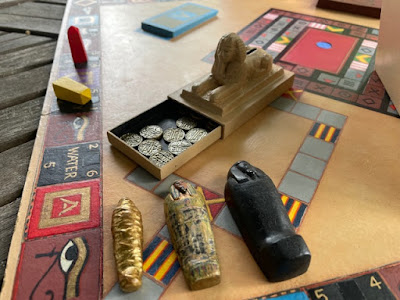
Created and perfected in Narrowsburg, New York
To quote Sir Winston Churchill here: "Never, never, never, never give up." 

* * * 

One of my earliest published articles, and the first for which I was paid, was titled Make a Game of It. My theme was that teaching can be fun when we use a little creativity to make a game of it. Over the years I created a number of games, and it was fun to see the intriguing project Frank Holmes and Jill Mackie had concocted as you can see here.

"We've played it hundreds of times," Jill said, the primary aim being continuous improvement. 

If you're a board game publisher, this is a game that's ready for prime time. 

THE STORY

Frank and Jill get the ball rolling. 1988.
Long ago in very ancient Egypt, there ruled a pharaoh who cared more for gold than anything else in the world. He put a terrible curse of greed on his people, from which they suffered greatly, fighting amongst themselves for wealth and power. When he died his mummified body was wrapped in bands of gold and buried deep within a massive pyramid--to be guarded forever by an all-knowing sphinx.

Now, many centuries later, the dreadful curse still emanates from the pharaoh's tomb and greed has enveloped the entire world--you may have noticed it yourself! The only way to end this plague of avarice is to find the golden mummy and to take it from its chamber of evil power, away from the pyramid to, according to legend, the very place the curse began.

So, players, an exciting and ennobling experience awaits you. Prepares well and honor the sphinx's demands, which will allow you to enter the pyramid. Your task is not an easy one and pitfalls await--any or all of you may succumb to the debilitating effects of greed. Whatever happens, remember your one and only goal is to break the curse!

Related Links

Veteran Painter Frank Holmes Discusses His Prix de Rome and Life as an Artist

"Paintings Now & Before: Figures, Flowers, Landscapes" and an Introduction to Jill Mackie

Wednesday, July 15, 2020

Wayback Wednesday: A Quick Post from 12 Years Ago This Month

You only live once, but if you do it right, once is enough. — Mae West

If you bathroom scale broken, turn it into art.
This post from 25 July 2008 was originally titled Disclaimer.

Please note... I do not have my philosophy/world view all of one piece. I am inconsistent, both in my life and in my statements. For example, I do not believe in violence, but do believe that it was necessary to oppose Hitler with arms. The U.S. could not have remained isolationist and survived the 20th century. Or so it would appear to me. Ultimately, one does the best one can.

Ennyman's Territory may likewise contradict itself at times. My aim has been to help people think, and to offer insights, information and new angles for viewing information, events and other cultural phenomenon. I welcome dialogue, and thereby hope to refine and clarify our mutual understanding.

Knowing how few readers there are here, I realize that I am standing on a very small soap box. It's my aim to use the process of putting my ideas into words as a tool to better understand myself, and in some small way you as a reader will benefit as well.

Many issues are presented to us as Either/Or which I believe are better considered as Both/And. Here, for example, is one of them.

LINAG
Life Is Not A Game.

LIAG/PTW
Life Is A Game. Play To Win.

Namaste.
I am... your humble servant.

Friday, February 21, 2014

Oh The Games We Played

The first published article for which I received payment was titled "Make a Game of It." The concept had to do with using a more creative approach to teaching. By means of games, creatively crafted, we can sink home insights, ideas and facts in a manner that is both entertaining and engaging.

What brought this to mind was our recent snowstorm that has smothered the Northland. As adults we see these storms as inconvenient at best and troublesome or even dangerous at worst. More than a few older men have had heart attacks while shoveling snow. When we were boys, however, fresh snow meant either making some extra cash shoveling driveways for the neighbors, or just having fun.

There are plenty of games with widespread popularity that young people across the country were familiar with in my day such as Spud,
Kick the Can, Freeze Tag and the like. But I'm willing to guess there are places where a creative kid invented a few new games which, even if not widespread in popularity, were tremendously fun for the kids in that neighborhood. The two I'm thinking of here tonight were of my invention. Based on the buy-in from other kids in my New Jersey neighborhood they were pretty good games.

My family lived in one of the new mid-Sixties housing developments in Bridgewater Township. If you look at the topography of the Eastern United States you'll see the foothills of the Allegheny Mountains begin here in Central New Jersey. Our home abutted the Public Service Grounds where power lines climbed up and over the foothills which would eventually become mountains further west.

As a teen I was big-time into sports and had a subscription to Sports Illustrated. I read an article about a sled dog race in Alaska and the idea of racing through the snow down the side of the mountain seemed really cool to me. Somehow I talked a bunch of the neighbors into the idea and we headed up to Washington Valley Road and huffed our way up the Public Service Grounds. It took about fifteen to twenty minutes or so to climb to the top, and one minute to race back to the bottom, many of us losing control, flying through the air only to land in deep snow. Occasionally someone would lose a boot. Even when we landed on rocks it seemed we were so padded with winter gear that no one ever go hurt. And once at the bottom we'd all look at one another and say, "One more time?" It was a blast.

The second original game we came up with was more psychological in nature. This is the game that came to mind as I blew the driveway and shoveled walkways today. For lack of a better name we'll call it Manhunt.

Manhunt was a game we could only play when there was freshly fallen snow that no one had yet marred. It went like this. One of us would become the hunted. The others became the hunters.

Out of fairness, we always rotated who the hunted would be because this was a game of wits and it was tremendously fun to see if one could outwit one's hunter friends.

Here are the rules as I recall them. The hunted was given a head start of fifteen or twenty minutes, and the rest of us would begin our pursuit. There were boundaries outside which the hunted was not permitted to go, but the area was quite large. The hunted was handicapped by the size of the area, and the hunters were handicapped by the amount of time designated to find their prey.

Whether hunted or hunter, it was a thrill. I remember trying to hide my tracks by swinging through trees, or walking through a creek with several exit points to delay the hunters. Even with nothing at stake -- no one was going to beat me or arrest me or shoot me -- it was an adrenaline rush striving to escape, to not be caught or found.

Today, the fresh fallen snow may be beautiful, but it's getting a bit tiresome having to move it off the roof and the driveway. Maybe I need to think up a new game to make it more invigorating.

What kind of games did you play?


Monday, November 5, 2012

Adam Pankratz and his Super WOW Exciting Fun Time!!

The name of the company is Stunned Turtle. Saturday's Facebook invitation read like this:

For anyone in Duluth today: "If you're up in Duluth today, come say hello! I'll be doing a STUNNED TURTLE promo at Dungeon's End from about 11am-2pm and then at Rogue Robot Comics and Games from 330-5pm. Special appearances by Wally Mahnke Jr. and Patricia Mahnke!"

I was intrigued by the invitation because I myself created a few games when I was young. As a teen I created an NFL football card game which I played every morning before going to school. My mother encouraged me to submit my idea to Milton Bradley, but that's another story.

So on Saturday I decided to sneak in to Dungeon’s End, across the street from Beaners, and sneak a peek at what was up. It wasn’t my intent, but I ended up playing a round and imagined it could be a fun way for friends to pass the time. Afterwards I interviewed Adam Pankratz, the co-creator of the card game Super WOW Exciting Fun Time!!

EN: When did you first start creating games?
AP: I think it was about 15 years ago that I made a card game based on my favorite TV show. The reason I started STUNNED TURTLE this year was to hopefully be able to build up a reputation as a reliable game developer and get the license for that TV show and release that card game sometime within the next 5 years. Besides that, I've always had the creative itch. I've made short films, non-fiction books, clothing designs, poetry, screenplays, digital art, and a baby - my son and greatest creation!

EN: How did your game Super WOW Exciting Fun Time come about?

AP: My creative partner, Walter Mahnke, Jr., and I had been developing a few games together when he called me one night and explained his idea for the basis of Super WOW Exciting Fun Time with giddy excitement. We wanted our first card game release to be something that was simple to learn, fun to play, had mass appeal, and showcased our sense of humor. Super WOW fit that criteria perfectly!

EN: What kind of costs are involved in making a card game like this?
AP: Producing a simple card game like this requires three things. 1 - Money. 2 - Passion 3 - Time.

MONEY.  We wanted our first game to look cool! Artists like to get cash for their efforts so they can buy clothes and food and pay their rent and such, so we wanted to make sure we paid our artists so they wouldn't be running around naked and hungry.

PASSION. You truly need to dedicate yourself to your product. We wanted to make sure this game was replay-able and kept being fun even after the 40th or 50th game. It takes a certain level of passion to fine-tune a game throughout the play testing process.

TIME.  Many, many hours have been devoted to Super WOW Exciting Fun Time. I'm somewhat obsessive cumpulsive and I've found myself tweaking the game at all hours of the day in my head. It's almost become a second child for me in the amount of time I spend working on and analyzing it.

EN: Who did all the artwork on the cards?
AP: We've been blessed with an amazing group of artists. They are Michael Beachy, Brandie Hanson, Alisha Williams and Corey Kramer. They all have a varied backgrounds and live in Minnesota.

EN: Can you briefly summarize the rules and what Super WOW is about?
AP: Super WOW Exciting Fun Time is a fast paced card game based on the life and death of TV shows. Players take the role of a TV producer and try to earn the most rating points by playing episode cards on each show. Watch out for the shark, though! Once the shark is played, the show can only go downhill towards its inevitable cancellation. After three rounds, the player with the highest rating score wins! The other players feel shame.

EN: What kind of people are going to be most interested in Super WOW? Who is your target audience?
AP: Super WOW Exciting Fun Time is for the family or social gamer. People are encouraged to get together with loved ones and converse, laugh, and create memories while playing our game. The box will say the game is for 2-5 players who are 12+, however, if you can read and count, you're old enough to play our game.

EN: How does the kickstarter aspect of this work? Where do people go to help bring your vision to market?
Adam Pankratz and Patricia Mahnke. Patricia won, Adam and I lost.
AP: We chose to fund the production of our first game through kickstarter.com. "Kickstarter is a funding platform for creative projects. Every project creator sets their project's funding goal and deadline. If people like the project, they can pledge money to make it happen. If the project succeeds in reaching its funding goal, all backers' credit cards are charged when time expires. If the project falls short, no one is charged. Funding on Kickstarter is all-or-nothing."

STUNNED TURTLE's Kickstarter page can be found here at Kickstarter.com.

EN: Where will Super WOW be available when people wish to purchase and play it?
AP: The game's production is dependent on a successful kickstarter campaign. As long as we raise our financial goal before November 18th, Super WOW Exciting Fun Time will go into full production with a slated release of March 2013. At that time, anyone will be able to go to gamecrafter.com and purchase the game. We've also had three gaming stores who have agreed to stock the game upon its release: Source Comics and Games in Saint Paul, Minn, Dungeon's End in Duluth, Minn., and Rogue Robot Comics and Games, also here in Duluth. We're hoping to add several more stores to this list within the next few months.

EdNote: The game concept for Super WOW evolved from the way television shows are produced, but does not require any knowledge of television trivia in order to play, so don't be intimidated if you're not a big TV watcher. The game is fun.

CLICK IMAGES TO ENLARGE

Friday, March 20, 2009

Layoff... Anybody Want To Play

“Freedom’s just another word for nothing left to lose.” ~ Kris Kristofferson

Yesterday I noticed that there’s been a lot of buzz about a new game called Layoff. So much so that it was numero uno on the Yahoo! Buzz chart.

If you aren’t familiar with it, it is evidently a variation of a number of similar video games where you try to line up circles or spheres of the same color, which then causes them to ignite and disappear. In this case, instead of random colors, the game pieces represent employees with varying responsibilities. Theoretically (and I have only read about it, not played because it took too long to download) you, the game player, are a person in management who is downsizing his or her company by eliminating duplicate positions.

Like the other games, when you line up three or four of the pieces of the same color, they disappear. Unlike the other game, each individual marker is a real person with a real set of financial and familial needs. You didn’t just make a game piece go poof. That was George, the financially strapped disabled vet.

Several thoughts come to mind simultaneously at this point, but I’ll elaborate on one.

Is it an educational experience or is it exploitation? If the people in the game are not “real” real people but only examples of people in different types of circumstances, that might soften the jaundiced edge here a bit. Still, there is something a bit perverse about a game in which “winning” means getting as many people laid off as possible so that you only have the bankers left.

Arundhati Roy, in her essay Public Power in the Age of Empire notes how Hollywood and the U.S. news media specialize in exploiting the suffering of others. For profit. From her vantage point in India, it seems to her that when tragedy strikes our news cameras are Johnny-on-the-spot to keep ratings up so they networks can sell those commercial spots that fuel these infosystems with dollars. And Hollywood is seldom far behind.

Two powerful films about horrors in Africa that have won awards in recent years include Hotel Rwanda and The Last King of Scotland. Both films were powerful. Both films gave Americans a brief glance at the hard realities of the suffering that has taken place in two places in our lifetimes. It would be very easy to defend these films as informational, but I can also see Ms. Roy’s point of view: exploitation for entertainment purposes, and profits.

On the other hand, if writers don’t tell their stories, who will hear? It takes money to publish books like The Last King of Scotland. The publisher spends money to promote it because it is a story worth telling, in fact, remarkable. Selling film rights to the book motivates others to tell their stories, which increases our understanding. Life is hard. There is much suffering in our world.

I myself don’t know what to think. I once knew a man who survived Idi Amin’s brutal slaughter by hiding under a pile of dead bodies that once was his family. What would he have thought of the Forrest Whitaker film based on these selfsame events? Where is the line between informing and exploiting?

If you think I’m being too serious here, feel free to send me a note: Ed, lighten up.

VACATION PICTURE OF THE DAY
Since last weekend I've been blogging while on vacation. We flew to a wedding in Dallas initially. Wednesday we rented a car and have been heading west toward the Grand Canyon. Yesterday we spent time in Old Town Albuquerque, where this shot was taken. Today, it will be Old Route 66 to Holbrook.


Popular Posts