Showing posts with label Sinclair Lewis. Show all posts

Friday, December 31, 2021

Books I Read in 2021: It Was Another Good Year

"I have always imagined Paradise as a kind of library."
--Jorge Luis Borges

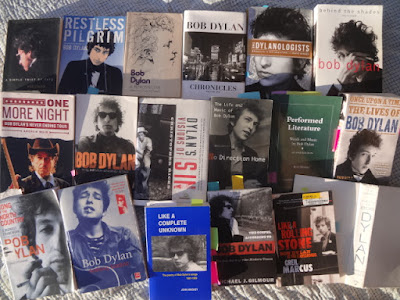
A portion of my collection of Dylan books. Photo 2018
Books. Over the years I've shared many a quote about books. With the exception of Poilu, all the books below were completed in 2021. I'm only halfway through Poilu and A World Undone, which I got for Christmas.

The first half of this list has links to the reviews I wrote about each. The latter half of the list are books that I checked out from the library, many of which were audio books I listened to while commuting to town or running errands.

The saying "too many books, too little time" is absolutely true. There's little in this world more rewarding than a good book. Equally rewarding is having friends to share your treasures with. That's part of my motivation for writing about the books I've been reading. 

What was your favorite book you read in 2021? 

Poilu, A Grisly WW1 Memoir from the Trenches, by Corporal Louis Barthas

Where Are You Tonight? by Jochen Markhorst

Bob Dylan: On A Couch & Fifty Cents a Day, by Peter McKenzie

H.R. McMaster's Dereliction of Duty

Homage to Catalonia, by George Orwell

The Great Divorce, by C.S. Lewis

Klara and the Sun
, by Kazuo Ishiguro


Jack London: A Life, by Earle Labor

Kingsblood Royal, by Sinclair Lewis


Coach: Lessons on the Game of Life,
by Michael Lewis

C.S. Lewis, A Life: Eccentric Genius, Reluctant Prophet, by Alister McGrath
Churchill and Orwell: The Fight for Freedom, by Thomas E. Ricks
Bob Dylan's Malibu, Martin Newman
Facing Unpleasant Facts, Orwell Essays
Ocean Prey, John Sandford
Brave New World, Aldous Huxley
Ethan Frome, Edith Wharton
The Trial of the Chicago 7: The Screenplay, Aaron Sorkin
Jurassic Park, by Michael Crichton (quite different from the film)
Experiencing the Trinity, by Darrell W. Johnson
Several Jack Reacher novels by Lee Child. (Interestingly, John Sanford has one of his characters reading a Lee Child novel in Ocean Prey.) 

The list above doesn't include the numerous books I started or read partially in order to get a taste for flavor. As already noted... there are too many books and such a shortage of time. Alas... it's time to turn the page.

Today is the last day of 2021. Here's a toast to 2022. 
May it reward you in ways you never expected.
HAPPY NEW YEAR

Sunday, March 14, 2021

Nobel Laureate Sinclair Lewis Wrote About Race Relations While Living In Duluth

When Bob Dylan won the Nobel Prize for Literature in 2016, a lot of the news focused on whether he was the best choice to win that year. No doubt many of those who questioned were earnest but simply unaware of the breadth and depth of his catalogue, and global influence. 

One story that did not get much play, however, was this one. The first American Nobel Laureate, Sinclair Lewis, also lived in Duluth for a season--at the same time as young Bob Dylan. That's right. Bobby Zimmerman was born here in 1941. Six years later the family moved to Hibbing. During that same time period Sinclair Lewis lived in Duluth (1944-1946) and wrote an important novel about race relations which he titled Kingsblood Royal.  

What's of interest to me isn't simply the matter that both the first and latest Nobel Prize-winning authors lived in Duluth at the same time. Rather, it's that each of them had undoubtedly been influenced by an event that occurred here, an event that made each more acutely aware of justice issues and race relations in America. I'm referring to the lynching of 1920.

Nearly every Dylan fan is keenly aware of the opening lines of "Desolation Row": "They're selling post cards of the hanging..." Fewer by far are the number of people who know the story of Kingsblood Royal, which was published in 1947 after Lewis left Duluth.

The storyline was inspired by actual events, not here but in Detroit. An African American doctor, Ossian Sweet, purchased a house in a white section of town. A hostile white mob gathered to protest his having moved into their neighborhood. Rocks were thrown at his house, windows broken. When shots were fired from an upper window two whites were struck, one killed. Dr. Sweet, his wife and nine others were arrested and charged with murder.

Sweet, who was born in Florida, had headed North to escape the Jim Crow South. After having earned his medical degree at Howard University in 1924, Sweet moved to Detroit to set up his practice there. His success enabled him to purchase a middle class home. In the South blacks could be openly treated as second class citizens. In the North, the Sweets learned -- like others before them -- that these unjust rules were not as explicit, but still applied. 

After the arrests, the NAACP acquired Clarence Darrow to represent the Sweets. Detroit prosecutors (yes, this is their argument) said that the Sweets, having moved to a white neighborhood, "violated social norms." 

There were two trials, with the second resulting in an acquittal. The NAACP celebrated this as a victory, but the story had no happy ending. The family never lived in that house. Both his wife and daughter died shortly after. After several decades of frustration Dr. Sweet himself committed suicide.

* * *

Though Sinclair Lewis worked on Kingsblood Royal 25 years after the Duluth lynchings, it is a near certainty that the memory of that terrible event still wafted about in the air here. Lewis himself was a Minnesotan (Sauk City) and no doubt had been aware of what transpired here in the Northland. Perhaps the details of that mob's behavior helped add authenticity to the race riot that takes place at the end of Kingsblood Royal.

Here's an overview of the story's premise from Goodreads:

A neglected tour de force by the first American to win the Nobel Prize in literature, Kingsblood Royal is a stirring and wickedly funny portrait of a man who resigns from the white race. When Neil Kingsblood, a typical middle-American banker with a comfortable life, makes the shocking discovery that he has African blood, the odyssey that ensues creates an unforgettable portrayal of two Americas, one black, one white.

As timely as when it was first published in 1947, one need only open today's newspaper to see the same issues passionately being discussed between blacks and whites that we find in 
Kingsblood Royal, says Charles Johnson. Perhaps only now can we fully appreciate Sinclair Lewis's astonishing achievement.

* * * 

Those who have read the books state that it was miles ahead of its time. Unfortunately, the insights it offers will probably never be read nowadays because--like Huckleberry Finn and To Kill A Mockingbird--he uses the N-word.

You can read Goodreads Reader Reviews here.

* * * 

Related Links

The Ossian Sweet Story at BlackPast.com

Sinclair Lewis In Duluth

The Lynchings In Duluth


Wednesday, November 30, 2016

Nobel Echoes: Bob Dylan Is Second Writer From Duluth to Receive Nobel Prize in Literature

Gabe Rubin in front of Dylan's boyhood home in Duluth.
This week a journalist from the Wall Street Journal flew into town to gather material for a story on Bob Dylan's home town's, to appear next week on the day the Prize is to be officially awarded, December 10. Dylan fans come from all walks of life, from knighted university professors to Pulitzer Prize winning authors so it should not have been a surprise to find WSJ's Gabriel Rubin to be so thoroughly enthused by the assignment he acquired, to do a first-hand research on Dylan's roots here in the Northland.

Before heading to Hibbing, Mr. Rubin met with several members of the Duluth Dylan Fest committee and long-time Duluthians Steve Goldfine and Craig Grau. The latter two shared several stories and insights I'd not heard before, so I took notes and did a lot of listening. Afterward, we gave Mr. Rubin a tour of the various points of interest related to our theme.

One of the items that came from the encounter was a new realization about a Sinclair Lewis-Bob Dylan connection I'd never recognized before. It's only natural that I'd not previously had this thought because up until this fall Bob Dylan had not yet been honored with a Nobel Prize.

What Mr. Grau highlighted for our guest was that Duluth was not only the home town for Bob Dylan for a season, but was also home town for another Nobel Prize winner, Sinclair Lewis, who lived here in the mid-1940s. Once you recall that Dylan was born in Duluth in 1941, it doesn't take much figgerin' to notice that Lewis -- the first American to win a Nobel Prize for Literature -- was here in the Zenith City at the very same time.

When Sinclair Lewis won the Nobel Prize for Literature in 1930, he was the first American ever to do so, the award mainly a result of his novel "Babbitt" (1922) set in the fictional city of Zenith, which happens to be a popular nickname of our Northland home town.*

Lewis was born in Sauk Centre, Minnesota in 1885. He received his accolades from the Nobel Prize committee in 1930 at the age of 45. Many people are unaware that in his fifties Lewis moved to Duluth and lived here at 26th Avenue East and 2nd Street for a few years in the 1940s. The book he wrote while living here, Kingsblood Royal, happened to be a book about race.

A book about race while living in Duluth in the 1940s? Only 25 years earlier Duluthians broke into the jail and lynched three black workers from a travelling circus that was in town that summer. This incident, is re-painted in Dylan's haunting Desolation Row's opening lines, "They're selling post cards of the hanging.... the circus is in town." Anyone else hearing an echo?

* * * *
The Wikipedia entry on Sinclair Lewis begins...

Harry Sinclair Lewis (/ˈluːɪs/; February 7, 1885 – January 10, 1951) was an American novelist, short-story writer, and playwright. In 1930, he became the first writer from the United States to receive the Nobel Prize in Literature, which was awarded "for his vigorous and graphic art of description and his ability to create, with wit and humor, new types of characters." His works are known for their insightful and critical views of American capitalism and materialism between the wars. He is also respected for his strong characterizations of modern working women. H. L. Mencken wrote of him,"[If] there was ever a novelist among us with an authentic call to the trade ... it is this red-haired tornado from the Minnesota wilds."

A little further down Wikipedia describes the nature of Lewis' writings.

In 1930, Lewis won the Nobel Prize in Literature, the first writer from the United States to receive the award, after he had been nominated by Henrik Schück, member of the Swedish Academy. In the Academy's presentation speech, special attention was paid to Babbitt. In his Nobel Lecture, Lewis praised Theodore Dreiser, Willa Cather, Ernest Hemingway, and other contemporaries, but also lamented that "in America most of us—not readers alone, but even writers—are still afraid of any literature which is not a glorification of everything American, a glorification of our faults as well as our virtues," and that America is "the most contradictory, the most depressing, the most stirring, of any land in the world today."

And in this description of the novelist I hear echoes of Dylan's "It's Alright, Ma (I'm Only Bleeding)" and other songs, which is why so many disenfranchised young people of the Sixties so resonated with Dylan's music.

* * * *
Dylan tribute on the elevator doors in the lobby of the downtown Holiday Inn.
History is about people, times and places. The people in this instance are Nobel Prize winners from Duluth who shared this town for a brief space of time. The houses where they lived remain, even if the now famous residents have moved on.

If you're taking notes, be sure to review them next May before Duluth Dylan Fest. At least one detail here will be the answer to a question in our Trivia Contest on the first evening of the week.

EdNote: The Hibbing Dylan Project wants everyone to know that Will Call tickets are still available for the December 10 Nobel Laureate Reception at the Androy Hotel. Details here.

EdNote 2: Be sure to pick up a Wall Street Journal, December 10. It might make for a good collectible if you're a Dylan fan.

EdNote 3: Breaking News. The info in EdNote 2 is incorrect. Due to a schedule change, the article will go online tonight and appear in print in tomorrow's Wall Street Journal.

Meantime, life goes on all around you.

*A silly aside: Whether you look at history backward or forward, these two American Nobel Prize for Literature winners are first and last to receive it, and both from Duluth. 

Saturday, June 28, 2008

This Is My Best

Somewhere along life’s way I managed to acquire the 1180 page compilation of stories called This Is My Best in which Dial Press assembled over 150 self-chosen masterpieces by 93 of America’s greatest living authors. Published in 1942, the book is as interesting for its choices regarding authors as for the authors’ own decisions regarding their work.

The book not only has stories, there are also essays, drama, poems, history, reportage and profiles. Theodore Dreiser, Ernest Hemingway, John Steinbeck, H. L. Mencken, Sinclair Lewis, Willa Cather, William Faulkner, Dorothy Parker – these are names one might expect to see here.

Upton Sinclair offered up a selection from his novel The Jungle, with these sentences as introduction. “Anyone who reads these five thousand words will have his imagination stimulated, his sympathies widened, and his understanding of the world he lives in increased. At least, that is why the book (from which this excerpt was taken) was written, and it doesn’t happen there is something wrong with either you or with the author.”

There were surprises in the list though. Steven Vincent Benet, for example, who here offers The Devil & Daniel Webster. For some reason I’d associated him with the post-Civil War period of the previous century.

The book is a good reminder that American prose had more breadth and depth than just the big names of Fitzgerald, Faulkner and Papa Hemingway. I have always found books like these to be useful for ferreting out new territories to explore, hence the large number of anthologies on my book shelf.

The down side of all this good literature is that one becomes aware there’s just too much to read and not enough time.

As a short story writer myself, I find the short form exhilarating. But there’s not enough “public” to really motivate publishers to produce the works of unknowns. It’s a celebrity culture, so mags that pay money want a name on the cover that will lead to sales. Unknowns don’t have the clout.
For the record, Hemingway selected “The Short Happy Life of Francis Macomber.” Mencken selected his autobiographical “The Days of the Giants.” Dreiser chose “The Hand.” Katherine Anne Porter gave us “Flowering Judas.”

Steinbeck was indifferent as to what was selected from his body of work, an attitude I understand. Every piece has been crafted with the highest aims in mind, and either reflects this or one doesn't attach one's name to it.

As for me, I’m hoping you’ll read everything I write, but I know you don’t have time. So I’ll point you to a story and a poem. The story is long, the poem short, and both hopefully entertaining while thought provoking. And if I'm lucky you'll rejoin me here on my blog again tomorrow.
Popular Posts