Showing posts with label Jack London. Show all posts

Saturday, October 19, 2024

A Child of the Lab

Forty years ago, when I first became serious about a writing career, I envisioned being a writer of short stories like Hemingway (In Our Time), F. Scott Fitzgerald or Jack London. Yes, they all wrote novels but I found that writing stories and articles while working full time was within my grasp and a novel was simply to massive of a project in those circumstances.

For the first four years after our return from a year in Mexico Susie and I painted apartments. There were two things I especially liked about it. First, wherever we went looked nicer after we'd been there than before we arrived. Second, there is a mindlessness about painting white on white so it was an opportunity to let my imagination run free. As a result my mind conceived of countless concepts for stories, some which became outlines and others which were completed. (Years later I assembled many of these into books like this short volume, Unremembered Histories.)  

The story below was conceived sometime during the 1980's I believe. Or rather, the concept for this story was birthed and a few notes jotted down. Over the years since that time I've thought about fleshing it out and turning it into something I could share. 

This past week I decided to do something different. I fed my story concept to ChatGPT to see what an AI would generate. Here's what we came up with as a story beginning. For a much longer story it has real possibilities. What do you think?

A Child of the Lab

In the dry heat of the Negev desert, deep within the secure walls of a state-of-the-art laboratory, Dr. Yitzhak Baram and Dr. Leah Mendel spent their days peering into the mysteries of the human genome. Theirs was no ordinary research—after years of studying ancient texts, theological debates, and genetic data, they began to suspect a tantalizing possibility. Buried within the intricate code of human DNA, they believed they had found a signature, a remnant of a primordial flaw, a genetic marker shared by every living human being. They called it "Eve's Mark."


For months, the pair wrestled with the implications of their discovery. Could this genetic trait be a trace of what religious traditions called Original Sin, a fundamental imperfection passed down through generations since humanity's mythical fall from grace? If so, could they remove it? And if they did, would the result be a human being untainted by the imperfections that had shaped human history?


Leah's voice trembled as she proposed the unthinkable: "We could create a new embryo... without Eve's Mark. A human being, like Adam and Eve, before the fall. Imagine the purity, the potential for good."


Yitzhak's skepticism melted away over nights of whispered conversations, and they resolved to do what no one else had ever dared—build a genome devoid of this flaw. In the dimly lit lab, they synthesized the embryo, painstakingly editing the genetic code until "Eve's Mark" was no longer present. Nine months later, the child was born in secret, far from any official record. They named her Miriam, for she was to them a new beginning.


As the months passed, Miriam grew with a vitality that stunned her caretakers. The scientists documented everything—her rapid development, her serene temperament, her uncanny way of absorbing the world around her. She did not cry like other infants; instead, she observed, her eyes, an almost startling shade of blue, scanning her surroundings with preternatural awareness. They began to believe they had succeeded beyond their wildest dreams. Yet, beneath their excitement, fear gnawed at them—would others, especially those who might see this as heretical or dangerous, accept what they had done?


Their fears were well-founded.


One summer evening, as the sun dipped behind the hills, a missile struck the lab. It came without warning, an attack from across the border, shattering the building with a force that set the desert ablaze. Yitzhak and Leah died in the chaos, caught beneath the collapsing walls. But as the fire spread, a nurse named Ayla, who had cared for Miriam like a mother, cradled the child to her chest and ran through the smoke and flames, her only thought to save this miraculous little being.


She stumbled through the desert night, following the faintest paths through the dark, driven by some instinct stronger than fear. In her arms, Miriam remained silent, her wide eyes fixed on the stars as if understanding their brightness. The next morning, Ayla reached the outskirts of a small village, exhausted but alive, the child untouched by the horrors that had unfolded behind them.


* * * 


Thursday, May 19, 2022

Man Was Made To Mourn: Wisdom from the Pen of Robert Burns

It's a common literary device. A story is told in which the wisdom of an elder is contrasted or shared with a younger person. One of my favorite Jack London stories, A Piece of Steak, is about an old, used up boxer named Tom King. As he fights his young opponent Sandel, he reflects on his own career in which he was once the young tough pummeling old boxers like himself on their way to hoped-for future glory. By the story's end Sandel is a symbol of Youth, ever rising.

Jorge Luis Borges has a very interesting story, called The Other, about an older man who sits on a park bench and comes to realize that the young man seated at the other end of the bench is he himself when he was younger. Borges's style of magical realism draws you in as the older realizes they are in two different but intersecting moments in space and time  What would you say to your younger self if you were given the chance. I think of this often.

Robert Burns' poem Man Was Made To Mourn uses a similar device in which an older man strives to communicate something to a younger man who is walking along life's way. I discovered the poem because it contains a line that I have quoted many times since first hearing: "Man's inhumanity to man makes countless thousands mourn."

The poem begins with the narrator out for a walk noticing an older man walking in a heavy-laden manner. In the second stanza the old man is curious about the young man's purpose. Are you out for a walk to pursue pleasure and excitement or are you beginning, too young, to walk because you feel pressed down by woes?

We then learn that the old man is now 80 years old, and his singular refrain at the end of each stanza is "man was made to mourn." The rest of the poem is the older man's explanation of how things are in this world.

The poem was written in 1784, long before the advent of modern medicine. Children often failed to reach adulthood, so there were many broken hearts of parents who buried their children, just one of the many ways we suffer. Ironically, the author of this poem, Robert Burns, died in his late thirties and never came close to 80.

Man Was Made to Mourn

When chill November's surly blast 
Made fields and forests bare, 
One ev'ning, as I wander'd forth 
Along the banks of Ayr, 
I spied a man, whose aged step 
Seem'd weary, worn with care; 
His face was furrow'd o'er with years, 
And hoary was his hair. 

"Young stranger, whither wand'rest thou?" 
Began the rev'rend sage; 
"Does thirst of wealth thy step constrain, 
Or youthful pleasure's rage? 
Or haply, prest with cares and woes, 
Too soon thou hast began 
To wander forth, with me to mourn 
The miseries of man. 
"The sun that overhangs yon moors, 
Out-spreading far and wide, 
Where hundreds labour to support 
A haughty lordling's pride; - 
I've seen yon weary winter-sun 
Twice forty times return; 
And ev'ry time has added proofs, 
That man was made to mourn. 

"O man! while in thy early years, 
How prodigal of time! 
Mis-spending all thy precious hours- 
Thy glorious, youthful prime! 
Alternate follies take the sway; 
Licentious passions burn; 
Which tenfold force gives Nature's law. 
That man was made to mourn. 

"Look not alone on youthful prime, 
Or manhood's active might; 
Man then is useful to his kind, 
Supported in his right: 
But see him on the edge of life, 
With cares and sorrows worn; 
Then Age and Want - oh! ill-match'd pair - 
Shew man was made to mourn. 

"A few seem favourites of fate, 
In pleasure's lap carest; 
Yet, think not all the rich and great 
Are likewise truly blest: 
But oh! what crowds in ev'ry land, 
All wretched and forlorn, 
Thro' weary life this lesson learn, 
That man was made to mourn. 
"Many and sharp the num'rous ills 
Inwoven with our frame! 
More pointed still we make ourselves, 
Regret, remorse, and shame! 
And man, whose heav'n-erected face 
The smiles of love adorn, - 
Man's inhumanity to man 
Makes countless thousands mourn! 

"See yonder poor, o'erlabour'd wight, 
So abject, mean, and vile, 
Who begs a brother of the earth 
To give him leave to toil; 
And see his lordly fellow-worm 
The poor petition spurn, 
Unmindful, tho' a weeping wife 
And helpless offspring mourn. 

"If I'm design'd yon lordling's slave, 
By Nature's law design'd, 
Why was an independent wish 
E'er planted in my mind? 
If not, why am I subject to 
His cruelty, or scorn? 
Or why has man the will and pow'r 
To make his fellow mourn? 

"Yet, let not this too much, my son, 
Disturb thy youthful breast: 
This partial view of human-kind 
Is surely not the last! 
The poor, oppressed, honest man 
Had never, sure, been born, 
Had there not been some recompense 
To comfort those that mourn! 

"O Death! the poor man's dearest friend, 
The kindest and the best! 
Welcome the hour my aged limbs 
Are laid with thee at rest! 
The great, the wealthy fear thy blow 
From pomp and pleasure torn; 
But, oh! a blest relief for those 
That weary-laden mourn!"
 * * * *

I hear echoes of Psalm 73 when I read this, a psalm contrasting haves and have nots. M. Scott Peck's The Road Less Travelled similarly comes to mind with its opening sentence stating so plainly, "Life is difficult." The premise here is that when difficulties come along, we ought not be surprised. 

Which brings to mind this stanza from Christina Rosetti's poem, Up-Hill.

Does the road wind up-hill all the way?
   Yes, to the very end.
Will the day’s journey take the whole long day?
   From morn to night, my friend.

If you like poetry, here is another favorite of mine:

Related Link
Robert Burns Biography 

Friday, December 31, 2021

Books I Read in 2021: It Was Another Good Year

"I have always imagined Paradise as a kind of library."
--Jorge Luis Borges

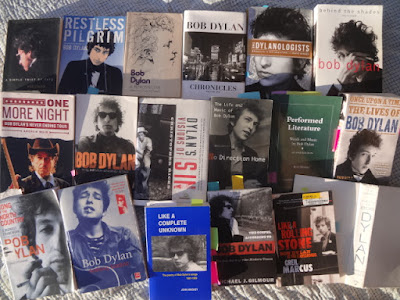
A portion of my collection of Dylan books. Photo 2018
Books. Over the years I've shared many a quote about books. With the exception of Poilu, all the books below were completed in 2021. I'm only halfway through Poilu and A World Undone, which I got for Christmas.

The first half of this list has links to the reviews I wrote about each. The latter half of the list are books that I checked out from the library, many of which were audio books I listened to while commuting to town or running errands.

The saying "too many books, too little time" is absolutely true. There's little in this world more rewarding than a good book. Equally rewarding is having friends to share your treasures with. That's part of my motivation for writing about the books I've been reading. 

What was your favorite book you read in 2021? 

Poilu, A Grisly WW1 Memoir from the Trenches, by Corporal Louis Barthas

Where Are You Tonight? by Jochen Markhorst

Bob Dylan: On A Couch & Fifty Cents a Day, by Peter McKenzie

H.R. McMaster's Dereliction of Duty

Homage to Catalonia, by George Orwell

The Great Divorce, by C.S. Lewis

Klara and the Sun
, by Kazuo Ishiguro


Jack London: A Life, by Earle Labor

Kingsblood Royal, by Sinclair Lewis


Coach: Lessons on the Game of Life,
by Michael Lewis

C.S. Lewis, A Life: Eccentric Genius, Reluctant Prophet, by Alister McGrath
Churchill and Orwell: The Fight for Freedom, by Thomas E. Ricks
Bob Dylan's Malibu, Martin Newman
Facing Unpleasant Facts, Orwell Essays
Ocean Prey, John Sandford
Brave New World, Aldous Huxley
Ethan Frome, Edith Wharton
The Trial of the Chicago 7: The Screenplay, Aaron Sorkin
Jurassic Park, by Michael Crichton (quite different from the film)
Experiencing the Trinity, by Darrell W. Johnson
Several Jack Reacher novels by Lee Child. (Interestingly, John Sanford has one of his characters reading a Lee Child novel in Ocean Prey.) 

The list above doesn't include the numerous books I started or read partially in order to get a taste for flavor. As already noted... there are too many books and such a shortage of time. Alas... it's time to turn the page.

Today is the last day of 2021. Here's a toast to 2022. 
May it reward you in ways you never expected.
HAPPY NEW YEAR

Sunday, March 21, 2021

Jack London Bio Offers New Insights While Raising Old Questions

At one time Jack London was the highest paid writer in America. There were two things that gave his writing such force. First, the stories he told were drawn from experiences he’d lived, adventures that transcended the norm. Second, and equally important, was his skill at storytelling.

His fame, however, came as the result of two other qualities. He was extremely persistent and incredibly prolific. Once he’d determined to be a serious writer he purportedly produced a minimum of 1000 words a day, every day, till the day he died.


The title of the biography I read this week is Jack London: An American Life by Earle Labor. Although this is the first biography of London that I’ve read, I’ve been quite familiar with much of his life story because two of his novels — Martin Eden and John Barleycorn — are autobiographical.


For the record, Earle Labor is the acknowledged major authority on the novelist Jack London, serving as the curator of the Jack London Museum and Research Center in Shreveport. What makes Labor’s labors so authoritative is that he’s read every piece of correspondence that exists, to or from London, as well the diaries of the women London’s life story.


* * * 


Like many schoolchildren I’d read “To Build a Fire” and “Call of the Wild” during my youth. My intro to Martin Eden came years later at the first writers’ conference I’d attended. One of the instructors, who by his early 30’s had published over 3000 articles, stated that young writers would glean much of value from reading that book, and indeed I did.


Earle Labor begins the story of Jack London’s life by noting his accomplishments: fifty books and international fame by the time he died at age forty. The first half of those forty years included delivering newspapers starting at 3:00 a.m. before going to school at age eight; dropping out of school at age thirteen to to work twelve to eighteen hours a day as a child laborer; becoming an oyster pirate at age fifteen, working as a sailor on a seal hunting schooner, riding the rails as a hobo, serving time in prison for something he didn’t do, searching for gold in the Klondike and more.


In some ways London’s adventures reminded me of Hemingway. Both were the kind of “man’s man” that seemed drawn to violence. (London wrote many stories about pugilists, Hemingway wrote about bullfighting.) Both seem to have had short fuses and personalities that would put them out of favor in our contemporary world.


London's ship, The Snark. He loved the open sea.
London’s first successful story was something he wrote for a contest, in part because he needed the money. Despite being a school dropout, he won the $25 prize against competition that included Stanford journalism students and the like. Getting from first base to fame took a little more time, but he was determined. To expand his vocabulary he learned a new word every day, writing it on a piece of paper, placing it in his pocket and using it in conversations until it was totally embedded.


That’s exactly the kind of thing I look for in young writers today, not just making an effort to expand one’s vocabulary but deliberately and consciously striving to improve the various aspects of their craft.


* * * 


There are aspects of Jack London’s life that are less than flattering. To his credit, Labor did not attempt to sugarcoat London’s story. I was appalled by some of the letters he wrote to his daughter. They were cruel and unwarranted., which raises the age old question as regards the relationship between an artist and his or her art. Should we think less of the art when we discover that the artist was a jerk or was a fiend?


* * * 


Three decades ago, I had a writer friend who was a big Jack London fan. I must have been discussing Martin Eden with him which opened the door to another fact of London’s life, London the Socialist. His experiences in sweat shops and other early life indignities obliged him to speak out for the underdog.


In the latter part of his life he acquired land and planned to build his dream home on a thousand acre spread in Sonoma, California. Two weeks before he and his second wife were to move into the home London called Wolf House, it was destroyed by fire. Was it arson? Had he made too many enemies advocating for socialism? My friend believed so.


Earle Labor makes a case for an alternate explanation. In 1995 some forensic scientists visited the ruins of Wolf House. The fire occurred on a day when the interior of the structure had been rubbed down with linseed oil. It was an extremely hot day and combustible fumes were in the air as the oil dried. They believe the rags ignited due to spontaneous combustion and the disastrous fire was the result.


“A good joke will sell quicker than a good poem.”


London made his mark because he learned early the kinds of stories that would sell. Here’s some advice for writers that was published in The Editor in 1903. It is an excerpt from an article titled “Getting Into Print.”


Fiction pays best of all, and when it is of a fair quality is more easily sold. A good joke will sell quicker than a good poem, and, measured in sweat and blood, will bring better remuneration. Avoid the unhappy ending, the harsh, the brutal, the tragic, the horrible — if you care to see in print things you write. (In this connection don’t do as I do, but do as I say.) Humor is the hardest to write, easiest to sell, and best rewarded… Don’t write too much. Concentrate your sweat on one story, rather than dissipate it over a dozen. Don’t loaf and invite inspiration; light out after it with a club, and if you don’t get it you will nonetheless get something that looks remarkably like it.


Reading Labor’s London biography has prompted me to follow up with a return to reading some of the author’s other books and stories. How about you?


Related Links
My review of London's short story A Piece of Steak
Jack London: An American Life

Sunday, July 26, 2020

What Would You Say to Your Younger Self if You Could? (When Youth and Age Converge.)

Variations on a Theme: Two Short Stories

THE OTHER
Photo by Mark Timberlake on Unsplash
One of my favorite stories by Jorge Luis Borges is called The Other. (Really, Borges for me is like Dylan. The "favorites" list is very, very, very long, and The Other happens to be one of many on the list.) In this story, the author sits on a park bench upon which a younger man is seated further down. He suddenly has a premonition that this younger man is he himself and manages to confirm this as they begin to dialogue.

Borges frequently creates impossible scenarios and writes about them as if they could have really happened. Several of my own stories were germinated in this manner including Two Acts That Saved the World and The Empty Space, both of which are included in my volume of short stories titled Unremembered Histories: Six Stories with a Supernatural Twist.

So, what would you say to your younger self if you were able to do so?

Unfortunately, you only go around once in life, and I am certain that I could have prevented a lot of pain had I been able to clunk that younger self on the side of the head with a two-by-four a few times. As I reflect on my life, there are quite a few instances of stupid and careless decisions.

A PIECE OF STEAK
Once upon a time short story writers could make very good money. In the days before movie theaters and television, magazines like The Saturday Evening Post offered some of the best entertainment around. These publications paid well to feature marquis writers on their covers.

A century ago the highest paid of these scribes was, for a period of time, a writer named Jack London. London was no artsy fartsy powderpuff sitting on hillsides waiting for inspiration to strike. For Jack London writing was a craft and a discipline. Day in, day out he slammed out one thousand words of prose. By the time his life was cut short at age forty, his output had been immense – as many as fifty volumes of stories, novels, plays and essays.

This story made a major impression on me when I first read it perhaps 36 or 38 years ago. I've written about it a few times since then, one of them being this 2011 blog post about the story.

What I wanted to focus on here, though, was the manner in which Tom King, the battle weary veteran boxer, recalls his own life while fighting a an up and comer from New Zealand named Sandel. London does a masterful job of painting the picture of youth vs. age, simultaneously placing Tom King's older, wiser self side by side with his own youthful, exuberant self.

I won't give away the ending, but t packs a punch. Pun intended.

* * * *
I'm curious, when you look back on your own life, what do you see? Have you ever wished you could played some of those scenes differently? What advice would you be giving your younger self if you'd had the opportunity?

Here are links to the two stories. Above is the link to my review of the latter. Dig in.

Links to these two rewarding reads:
The Other
A Piece of Steak

Thursday, March 19, 2020

Throwback Thursday: The Monkey's Paw by J.J. Jacobs

ORIGINALLY PUBLISHED IN 2014

One evening my daughter's former English teacher asked if I'd ever read The Monkey's Paw. I forget the trigger event, though it may have been discussing my story The Nonsense Room from my book Unremembered Histories, short stories with a supernatural twist. I'd read it perhaps half a century ago when I was in school, but remembered nothing about it. After revisiting this story I now recommend it here to you.

The Monkey's Paw is essentially a variation of the traditional genie in a bottle genre in which a person can get three wishes. But it's three wishes from the dark side. Not only do the wishes come true, when they do they have unanticipated shocking consequences. The manner in which the tale is told is what grips you. As with all good stories, the reader plunges forward because he or she is eager to see what will happen next.

It begins on a dark, dreary night as the White family waits for a visitor to their out of the way home.  The father and son are playing chess in the parlor while white-haired Mrs. White sits knitting by the fireplace.

The second paragraph, a single sentence, foreshadows the sum total of the story: "Hark at the wind," said Mr. White, who, having seen a fatal mistake after it was too late, was amiably desirous of preventing his son from seeing it.

Chess provides a great variety of life lessons. Decisions must be made all throughout. Consequences of decisions aren't always readily recognizable. All too often they are made with unnecessary haste and dire consequences.

Thus we are conveyed into the story as the White's visitor arrives, a sergeant-major who has spent 21 years abroad in what the Whites believe to be exotic and adventurous places. As they talk, and splash down a few drinks, the topic turns to a monkey's paw that the visitor had mentioned to Mr. White a few days earlier.

The soldier attempts to divert the conversation, though against his better judgment he acknowledges that there is something magical in the matter. He is actually carrying the thing on him at that very moment, but in an effort to be done with it he throws it on the fire.

Mr. White takes fast action and rescues it. The grim visitor is solemn and says, "Better let it burn."

White's impulsiveness becomes the stories turning point, cementing the family's doom.

Like many such stories there's a moral: don't mess with fate. Stephen King's 1000-page 10/23/63 has essentially the same moral, except in a much more massive form. King's story is about a man who goes back in time in an effort to keep JFK from being assassinated.

Hollywood, of course, loves this kind of magical lore in films, in part because the public craving for it seems endless. I half wonder if the Robin Williams film Jumanji had some of its ideas stimulated by The Monkey's Paw. Kids find a magical game board and start to play, but soon learn that there are unexpected consequences to each move. Sound familiar? There is even a connection to India and other exotic places here.

If you go back to the beginning of the 20th century you can see lots of fascination with "exotic places," which must have been a portion of this story's appeal, in addition to the creepiness of its premise. Writers like Jack London and Joseph Conrad, among others, capitalized on this interest in all things foreign.

Meantime, as noted earlier, I encourage you to take a few minutes to read The Monkey's Paw. It's an unusual and very compelling story, and a good read.  

Wednesday, June 19, 2019

Twelve Great Quotes by Ten Great Writers... On Writing

Photo by Art Lasovsky on Unsplash
While looking for a quote to embellish my recent blog post on The Murders in the Rue Morgue, I came across this first quote below by Edgar Allen Poe. It was so true and so intriguing that I decided to scrounge around to find eleven siblings to accompany it. If you're a writer I'm certain you will enjoy these.

How many good books suffer neglect through the inefficiency of their beginnings!
--Edgar Allen Poe

Writing is a form of therapy; sometimes I wonder how all those who do not write, compose or paint can manage to escape the madness, the melancholia, the panic fear which is inherent in the human condition. --Graham Greene

A petty reason perhaps why novelists more and more try to keep a distance from journalists is that novelists are trying to write the truth and journalists are trying to write fiction.--Graham Greene

Photo by Andrew Perfetti Photography
There are two ways of spreading light: to be the candle or the mirror that reflects it.
--Edith Wharton

Fiction pays best of all and when it is of fair quality is more easily sold. A good joke will sell quicker than a good poem, and, measured in sweat and blood, will bring better remuneration.--Jack London

Don't loaf and invite inspiration; light out after it with a club, and if you don't get it you will nonetheless get something that looks remarkably like it.--Jack London

Ideas are like rabbits. You get a couple and learn how to handle them, and pretty soon you have a dozen.--John Steinbeck

In plucking the fruit of memory one runs the risk of spoiling its bloom.--Joseph Conrad

There is a sort of man who pays no attention to his good actions, but is tormented by his bad ones. This is the type that most often writes about himself.--Somerset Maugham

“Don’t tell me the moon is shining; show me the glint of light on broken glass.”--Anton Chekhov

“Your intuition knows what to write, so get out of the way.”--Ray Bradbury

“Everybody walks past a thousand story ideas every day. The good writers are the ones who see five or six of them. Most people don’t see any.”--Orson Scott Card

To my writer friends....write on! 
To all the rest, make the most of your day and,,,  
Thanks for reading. 

Thursday, August 23, 2018

An Essential Truth for Writers: Writing On Demand

THROWBACK THURSDAY

One of the biggest myths about writing is that you need to wait for inspiration from your muse. Honestly, if that is your method, you will drink yourself to death before that muse shows up.

While it's true that inspiration can strike at any time and you need a butterfly net in your head to capture those sparkling but elusive special illuminations, for the most part writing is a craft and a discipline. Hemingway's aim was 500 good words a day. Jack London wrote a thousand words a day. Whatever your target, you're more likely to reach it by discipline than by hopes, whims and the winds of chance.

It was Dorothea Brande's Becoming a Writer that sank this lesson home for me. She pointed out that by setting an established time and place to write each day we can harness our unconscious, our intuitive powers, train it to join us as we approach the allotted time. The unconscious, says Brande, is shy, elusive, and unwieldy, but it is possible to learn to tap it at will, and even to direct it. The conscious mind, on the other hand, is meddlesome, opinionated, and arrogant, but it can be made subservient to the inborn talent through training. (These last two sentences were borrowed from a review at Amazon.com, but they capture the essence of my thought so very well.)

Written in the early 1930's Brande taught writing and was a keen observer of the creative process. Brande may not have been the origin of the notion of left brain/right brain thinking, but I first encountered it here, decades before it was popularized in the self-help rage of the nineties.

It's my opinion that if you want to master the craft of writing, here are three things you can do. First, get into the habit of writing every day. When I was young I used do what I called "limbo exercises." At a specific time each evening I would place a sheet of paper into my typewriter and fill it with words, single spaced, as fast as I was able. It was a great exercise for getting the juices flowing, especially since you were not aiming for publication or fame, but just learning how to produce good copy quickly. (Note: No one that I know of skips the editing step that must follow. Do not aim for perfect prose. Perfection happens when you tighten and revise afterwards.)

Second, go to the library and read as many books on writing that you can possibly find. Buy the best ones for your personal library.

Third, read great writers and study how they do what they do. You'll never be a great writer if you can't tell the difference between Hemingway and Danielle Steele.

For what it's worth, Amazon.com has 190 used copies of Brande's book on sale starting at under two dollars. Might be a good place to start if you're a beginning writer or young writer seeking to move it up a notch.

Have a great, great day. And write on.

Sunday, December 9, 2012

Short Stories

“Short fiction seems more targeted - hand grenades of ideas, if you will. When they work, they hit, they explode, and you never forget them. Long fiction feels more like atmosphere: it's a lot smokier and less defined.” ― Paolo Bacigalupi

There's nothing quite like a good story well told. The appeal of many of Dylan's songs is the story telling. Songs like Fourth Time Around, Tangled Up In Blue and Lily, Rosemarie and the Jack of Hearts have as their key feature the essence of a good story: the reader or listener's anticipation. "What happens next? Every line transports you into the unknown and you go with it.

At one time short story writers could make very good money. In the days before movie theaters and television, magazines like The Saturday Evening Post offered some of the best entertainment around. And they paid well to get marquis writers like Jack London and F. Scott Fitzgerald on their covers.

Another master of the short story form was Anton Chekhov, whose output was remarkable considering he made his living as a physician and was dead by age 44. Of this dual career he once wrote, "Medicine is my lawful wife and literature my mistress; when I get tired of one, I spend the night with the other." Three years ago I shared here one of my favorite short stories of all time, Chekhov's The Bet.  

What gave Chekhov's stories such impact was his recognition of the importance of every line, every detail. He is famously cited as stating, "If there is a gun hanging on the wall in the first act, it must fire in the third." (Chekhov was also a playwright.)

Jorge Luis Borges is another great short story writer whose influence was considerable. A number of my own stories drew inspiration from this Argentine magician who brought Minotaurs to life and resurrected the roots of forgotten worlds through literary sleight-of-hand. My Duel of the Poets (translated into Croatian in 1996) and Unremembered History of the World were germinated from Borges' seeds.

All this to say that I'd been wrestling with the development of two characters in a new short story I've been working on called The Echo. Friday night's Valtari Experience proved to be just the jolt I needed, smashing inner barricades and releasing new flashes of light that might help guide me through the next portion of my inward maze.   

What will happen next in this series of dreams? Field upon field or the destination of a lifetime?

Featured eBook of the Day: Unremembered Histories

Sunday, January 9, 2011

A Piece of Steak

Once upon a time short story writers could make very good money. In the days before movie theaters and television, magazines like The Saturday Evening Post offered some of the best entertainment around. And they paid well to feature these marquis writers on their covers.

A century ago the highest paid of these scribes was a writer named Jack London. London was no artsy fartsy powderpuff sitting on hillsides waiting for inspiration to strike. For Jack London writing was a craft and a discipline. Day in, day out he slammed out one thousand words of prose. By the time his life was cut short at age forty, his output had been immense – as many as fifty volumes of stories, novels, plays and essays.

Many of us know him for the short story “To Build a Fire,” an intense, tightly woven man vs. nature chiller that takes place up in the Klondike. Or perhaps we remember his “Call of the Wild.” And while there are many great London books and stories I could recommend, my all time favorite has to be “A Piece of Steak.”

First published in The Saturday Evening Post, Volume 182, November 1909, “A Piece of Steak” is the tale of an aging boxer. London places a lens on a single fight in boxer Tom King’s life and reveals the motivations, dreams and disappointments of this man’s entire life. It is a study of determination and will. It is also, by extension, a potent picture of the eternal struggle between youth and age, all of it hinging on a piece of steak.

Steak

Nothing makes the mouth water like a well-prepared cut of beef. Perhaps that’s why Americans eat more beef than any other meat. Indeed, no meat is more popular than steak. Whether Porterhouse, rib eye, T-bone or top sirloin, we know a good thing when we taste it.

For food value steak contains many nutrients needed by the human body. The vitamins you get from eating steak include niacin, riboflavin, and thiamine. Steak is an excellent source of protein, which is needed to build and maintain body cells. Iron and phosphorous are also important minerals our body requires. Plus it’s an excellent source of energy. Which brings us back to our story.

SPOILER ALERT

The opening sentence of “A Piece of Steak” not only tells the whole story, it foreshadows the end as well. “With the last morsel of bread Tom King wiped his plate clean of the last particle of flour gravy and chewed the resulting mouthful in a slow and meditative way.” Tom King is a professional prize fighter who has fallen on hard times. His wife looks on in silence as he wipes his plate clean, a meal of bread and gravy. That morning he’d wakened with a longing for a piece of steak but it was not to be. And for want of this one morsel of nourishment Tom King will later fail.

Tom King’s opponent was a young boxer from New Zealand named Sandel. Since nobody in Australia knew what this kid Sandel was capable of, they were feeding him one of the “old uns.” That was King’s role, and King knew it because he had once been the up and comer, the hungry young fighter seeking fame and fortune.

As Tom King walked the two miles to the arena he reflected on his life as a boxer -- the big money, the sharp, glorious fights, the following of eager flatterers, the slaps on the back “and the glory of it, the yelling houses, the whirlwind finish, the referee’s ‘King wins!’ and his name in the sporting columns next day.”

But King now understood that it was the old ones he had been putting away. He had been Youth, rising. They were Age, sinking. This time, it was King who stood in the way of another young man’s dreams. Sandel was the aspiring young heavyweight. King was the barrier that Sandel would have to pummel his way through.

“And as Tom King thus ruminated, there came to his stolid vision the form of youth, glorious youth, rising exultant and invincible, supple of muscle and silken of skin, with heart and lungs that had never been tired and torn and that laughed at limitation of effort. Yes, youth was the nemesis.”

London’s vivid portrayals of what goes on in the ring are probably unmatched in fiction. In fact, another of Jack London’s boxing stories was so powerful that Gene Tunney, after reading it, announced his retirement. Lest you be kept wondering, in “A Piece of Steak” Sandel puts the older man away. Tom King fought a good fight, careful, deliberate and determined. But youth continually renews itself while the old un’s strength is expended.

This one, on my short list of favorite short stories, is a recommended reading.

EdNote: This is a midly revised reprint of a 2008 post.

Wednesday, March 11, 2009

The Big Read Does Gatsby

In my younger and more vulnerable years my father gave me some advice that I've been turning over in my mind ever since.

"Whenever you feel like criticizing anyone," he told me, "just remember that all people in this world haven't had the advantages that you've had." ~ Nick's opening lines in F. Scott Fitzgerald's The Great Gatsby

My last post mentioned I'd been listening to a CD series called The Big Read, produced with grant money from the National Endowment for the Arts. Yesterday my commute included a listen to commentary and an overview of F. Scott Fitzgerald's The Great Gatsby.

I'd also mentioned that someone in the Steinbeck program said Grapes of Wrath was the quintessential Great American Novel. It was amusing to hear the same statement with regards to Gatsby. One critic mentioned that he reads it twice a year.

Jack London was the highest paid short story writer of his time, in the period leading up to World War I. Fitzgerald became heir to that pop throne during the Jazz Age, a phrase he apparently coined. His stories garnered a pretty savory three grand each, which was good money in those days. Unfortunately, despite being the rage in the short story scene, this book failed to catch the wave. The Great Gatsby received little more than a yawn from the public, selling about 25,000 copies over the next fifteen years.

By comparison, London's Call of the Wild sold out the first printing almost immediately, and the second, and has been translated into more languages than nearly any book by an American author, ever.

Pop adulation is apparently not necessarily the mark literary acclaim. Nobel Prize winner Alan Paton's Cry, The Beloved Country sold 3,000 copies the first year. It's a beautiful book and worthy of the recognition it later achieved. But it was hardly a bestseller. And many of Nobel Prize winner Andre Gide's 80 books had print runs of only a thousand copies or less, distributed amongst friends and a few loyal readers. By way of contrast, some of today's best selling authors see opening print runs in the hundreds of thousands, due chiefly to our era of mass distribution.

So why is it that Fitzgerald gets the adulation from the critics, and London a courteous nod? It might be that London, who came up through the ranks from the working poor, simply didn't have the appropriate color of blood, as in blue. Or maybe, being an outspoken socialist who took the side of the working class in some of his books, he was politically out of step in his time. Or... maybe... he tweaked too many peoples' noses and stepped on too many toes of persons in high places.

Yet it is evident that London knew how to reach an audience with his gritty stories written as if he had lived them, which in many cases he had, from the Klondike to the high seas. And for this he was well paid. edNote: if you are serious about making it as a writer, be sure to read Martin Eden.

I admit that I have enjoyed reading The Great Gatsby several times over the years, but for some reason the book felt a little sappy to me in my latest read. Maybe the film spoiled it. Some of the lines felt more dreamy when written, but when spoken were clearly stilted and almost corny. Am I being too harsh here? It may be that I'm more jaded than I used to be.


Review additional comments on Fitzgerald and Gatsby here

Monday, February 2, 2009

Borges, The Bet and A Piece of Steak

SHORT STORY MONDAY

In a departure from the usual fictions I share here on Mondays, I thought I'd share a couple of my favorite short stories and one of my favorite authors.

Fourteen years ago, when I built my first website, I included a page of lists of my favorite things, including favorite movies, favorite writers, favorite music... and favorite short stories.

Because tastes change and we change, I am sure that any list of favorite things will develop new contours as it morphs with our own personal evolutions. And I am certain that were I to assemble a new list from scratch, it would probably include some alternates to these here.

Nevertheless, for the sake of this Short Story Monday I will leave the original list unaltered. And, a special feature of this list is that now, fourteen years hence, the first two stories on the list are also available in total on the web. So, instead of my own story today, please take a few minutes to visit with these masters.

The Hemingway story made this list because I had to tip the hat to Mr. Hemingway for his impact on modern literature. I chose The Doctor and the Doctor's Wife because of the incredible tension he was able to create with such spare use of language. It's mystifying how deftly he works emotional wonders with such simple words. Pow! Slam.

You will also see three stories here by Borges, who influenced me mightily as a younger writer. Click on his name to find a website of labyrinthine wonderment devoted to these remarkable creative genius. Or click here for a fascinating essay which originally appeared in Christianity Today on this Argentine luminary.

Enjoy!
1. The Bet by Anton Chekhov
2. A Piece of Steak by Jack London
3. The Lagoon by Joseph Conrad
4. The Secret Sharer by Joseph Conrad
5. The Book of Sand by Jorge Luis Borges
6. The Aleph by Jorge Luis Borges
7. There Are More Things, again by Borges
8. The Harness, by John Steinbeck
9. Here We Are, by Dorothy Parker
10. The Doctor & the Doctor's Wife, by Ernest Hemingway

The End

EVERY ENDING IS BUT A NEW BEGINNING

Thursday, August 7, 2008

A Piece Of Steak

Once upon a time short story writers could make very good money. In the days before movie theaters and television, magazines like The Saturday Evening Post offered some of the best entertainment around. And they paid well to get these marquis writers on their covers. Around a century ago the highest paid of these scribes was a writer named Jack London.

London was no artsy fartsy powderpuff sitting on hillsides waiting for inspiration to strike. For Jack London writing was a craft and a discipline. Day in, day out he slammed out one thousand words of prose. By age forty, though his life was cut short, his output had been immense – as many as fifty volumes of stories, novels, plays and essays.

Many of us know him for the short story “To Build a Fire,” an intense, tightly woven man vs. nature chiller that takes place up in the Klondike. Or perhaps we remember his “Call of the Wild.” And while there are many great London books and stories I could recommend, my all time favorite has to be “A Piece of Steak.”

First published in The Saturday Evening Post, Volume 182, November 1909, “A Piece of Steak” is the tale of an aging boxer. London places a lens on a single fight in boxer Tom King’s life and reveals the motivations, dreams and disappointments of this man’s entire life. It is a study of determination and will. It is also, by extension, a potent picture of the eternal struggle between youth and age, all of it hinging on a piece of steak.

Nothing makes the mouth water like a well-prepared cut of beef. Perhaps that’s why Americans eat more beef than any other meat. Indeed, no meat is more popular than steak. Whether Porterhouse, rib eye, T-bone or top sirloin, we know a good thing when we taste it.

For food value steak contains many nutrients needed by the human body. The vitamins you get from eating steak include niacin, riboflavin, and thiamine. Steak is an excellent source of protein, which is needed to build and maintain body cells. Iron and phosphorous are also important minerals our body needs. Plus it’s an excellent source of energy. Which brings us back to our story.

The opening sentence of “A Piece of Steak” not only tells the whole story, it foreshadows the end as well. “With the last morsel of bread Tom King wiped his plate clean of the last particle of flour gravy and chewed the resulting mouthful in a slow and meditative way.” Tom King is a professional prize fighter who has fallen on hard times. His wife looks on in silence as he wipes his plate clean, a meal of bread and gravy. That morning he had wakened with a longing for a piece of steak but it was not to be. And for want of this one morsel of nourishment Tom King will later fail.

Tom King’s opponent was a young boxer from New Zealand named Sandel. Since nobody in Australia knew what this kid Sandel was capable of, they were feeding him one of the “old uns.” That was King’s role, and King knew it because he had once been the up and comer, the hungry young fighter seeking fame and fortune.

As Tom King walked the two miles to the arena he reflected on his life as a boxer -- the big money, the sharp, glorious fights, the following of eager flatterers, the slaps on the back “and the glory of it, the yelling houses, the whirlwind finish, the referee’s ‘King wins!’ and his name in the sporting columns next day.”

But King now understood that it was the old ones he had been putting away. He had been Youth, rising. They were Age, sinking. This time, it was King who stood in the way of another young man’s dreams. Sandel was the aspiring young heavyweight. King was the barrier that Sandel would have to pummel his way through.

“And as Tom King thus ruminated, there came to his stolid vision the form of youth, glorious youth, rising exultant and invincible, supple of muscle and silken of skin, with heart and lungs that had never been tired and torn and that laughed at limitation of effort. Yes, youth was the nemesis.”

London’s vivid portrayals of what goes on in the ring are probably unmatched in fiction. In fact, another of Jack London’s boxing stories was so powerful that Gene Tunney, after reading it, announced his retirement. Lest you be kept wondering, in “A Piece of Steak” Sandel puts the older man away.

Tom King fought a good fight, careful, deliberate and determined. But youth continually renews itself while the old un’s strength is expended.

The story, like many other great stories, is about something more than the action within the confines of beginning and end. It is a story about life. It is also a story with many applications. To see how I used this story to make application to the oil change industry where I am a columnist for the National Oil & Lube News, you can visit this link.

Of course it is more than that. And certainly it is an example of London's writing power, style and personal vision. At a writer's conference I attended years ago, Dennis Hensley (who had published three thousand articles by age 33) recommended to us Martin Eden by Jack London. It is a novel about a writer, revealing of the challenges and the games that industry plays. It's dark and cynical but shaped by a realism that packs a punch, much like A Piece of Steak Will London be forgotten in two hundred years? It's possible. Nevertheless, he wrote some great stories. I'll recommend him, even if the critics do not.

Popular Posts