Showing posts with label Ishiguro. Show all posts

Thursday, July 30, 2026

Throwback Thursday: Four Ishiguro Book Reviews and a Bonus Track

Like most avid readers I read when I can, and never as much as I'd like. In 2010 I carried around with me a borrowed Spring 2008 edition of The Paris Review, chiefly with the purpose of reading a fascinating interview with Kazuo Ishiguro, author of Remains of the Day, which I then wrote about here.   


Kazuo Ishiguro is a Japanese-born British novelist and one of the most acclaimed contemporary writers in English literature. He won the Nobel Prize in Literature in 2017 for works that, in the Swedish Academy’s words, uncover “the abyss beneath our illusory sense of connection with the world.” The first time I wrote about him here was in 2010

A 3-Day Ride with Ryder: Ishiguro’s The Unconsoled Is an Achievement of the First Order
When a world-famous pianist returns home to perform an important concert, he is forced to come to terms with who he really is. Ishiguro’s The Unconsoled has the feel of a cross between Lewis Carroll's Alice in Wonderland and the magical realism of Jorge Luis Borges. Like each of these authors, he has created a work that defies categorization.
https://pioneerproductions.blogspot.com/2019/04/a-3-day-ride-with-ryder-ishiguros.html

In Awe of Ishiguro's The Buried Giant
The novel takes place in England in that period after the passing of King Arthur. The story follows an elderly married couple, Axl and Beatrice, who for some reason cannot remember their past, or rather, the memories they've lost touch with are hazy and dark.

https://pioneerproductions.blogspot.com/2020/08/in-awe-of-ishiguros-buried-giant.html

Ishiguro Again Shows His Mastery: Never Let Me Go
There's something special about the students living at Hailsham, a boarding school in England. At first we don't know what's so special about this school, and neither do the children who grow up there, but eventually a little light streams in and we learn that these children are here for a purpose.

https://pioneerproductions.blogspot.com/2020/09/ishiguro-again-shows-his-mastery-never.html

Ishiguro's Klara Is Apparently No Fiction
Ishiguro demonstrates once again why he is considered one of the great writers of our time. The English language has a shortage of superlatives to describe the power of his prose, so I shan't even attempt it. 

https://pioneerproductions.blogspot.com/2021/07/ishiguros-klara-and-sun-is-another.html

Interview with David Asch Offers Insights On A.I.
Klara and the Sun is about A.I. and David Asch's review demonstrated his deeper understanding of the current status of Artificial Intelligence and where it is headed. I asked permission to pick his brain on this topic and he graciously accepted.

https://pioneerproductions.blogspot.com/2021/10/interview-with-david-asch-offers.html


Have you read Ishiguro's work? What is your favorite novel of his? Please share it in the comments.

Thursday, August 14, 2025

Ethics, Science and Meaning: Ishiguro's "Never Let Me Go"

Last night, as I lay awake thinking about a few issues in contemporary culture where it appears that science is becoming ethically unmoored, my thoughts drifted to Kazuo Ishiguro's haunting novel Never Let Me Go.


What makes Ishiguro’s storytelling so gripping? Is it the patient unfolding of his narrative, each layer revealing vivid, achingly human characters? Or the elusive gravity that pulls you deeper, a force you sense but can’t name? Perhaps it’s the way his narrator, Kath, weaves interconnected stories, grasping for truths she's only half-understood as they unfolded, leaving us to piece together the shadows alongside her.


Ishiguro’s craft recalls John Gardner’s exercise in On Becoming a Novelist in which the writer is asked to describe a pond. There is a dead body hidden from view, so it is a serious scene, but the writer has to create the feeling of dread through describing only what is seen.


Ishiguro clearly has become masterful at conveying this kind of undertone without ever explicitly stating it. "Show, don't tell" is one of the first dictum's fiction writers hear at writer's conferences, and this author does it ever so well.


His stories stir painful self-revelations, unearthing moments from my own past—times I spoke too soon, stayed silent too long, or watched relationships pivot on choices I didn’t know were pivotal. Through Kath’s reflections, Never Let Me Go explores friendship, loss, memory, and meaning, inviting us to confront the fragile threads of our own lives.


Perhaps its the manner in which these situations that he creates unearth painful revelations within ourselves is another aspect of his writing that makes it so potent. I think that is a big part of it. Or at least for me. As our narrator Kath tells the story, which consists of strings of interconnected narratives about various people, it seems as if she is striving to resolve what was really going on, things she'd not fully grasped as she experienced them.

SPOILER ALERT

There's something special about the students living at Hailsham, a boarding school in England. At first we don't know what's so special about this school, and neither do the children who grow up there. Eventually a little light streams in and we learn that these children are here for a purpose.

The three main characters in Never Let Me Go are Kath, Tommy and Ruth. These characters are drawn with such detail that you can almost hear them breathing and recognize their fingerprints. Ruth's manipulations are ever so annoying, and Tommy's struggles create such empathy that you lose yourself in Kathy's meandering reflections on the key moments they have shared both at Hailsham and afterwards.

Any number of thoughts come to mind here, one of them being the manner in which a family secret comes to light after it has been suppressed for many years. I'm thinking of a child born of incest, who never realizes why he has no father but eventually senses, then learns, that it's his grandfather.

In this story, the children of Hailsham were part of a program to clone humans who would grow up to become organ donors. As young adults they give until they do not survive. It can be two, three or four, but eventually you give your body parts till you are "complete," which is a euphemism for death.

It's no wonder that a pall hangs over everyone's tale of self-discovery. How the characters respond to these revelations, often nothing more than rumors because the teachers of Hailsham are limited in what they can openly disclose, is the heart of this story.

Eventually the students leave Hailsham and move to the Cottages. From here they become Carers, and then Donors. Some lucky ones will have a chance to get deferrals for a couple years before entering that Donor stage. This is another undercurrent in the story of this threesome.


* * * *

The title of the novel, "Never Let Me Go," is taken from a late 1950's song by Judy Bridgewater, recorded on her album Songs After Dark. Judy Bridgewater and this song recur several times as events unfold involving Tommy, Ruth and Kath.

I love Ishiguro's writing. There's a beauty in the way he digs into the nuances of relationships. Here's a sentence that illustrates this. Kath is reflecting on an incident which seemed insignificant at the time, but was not.

It was like when you make a move in chess and just as you take your finger off the piece, you see the mistake you've made, and there's this panic because you don't know yet the scale of disaster you've left yourself open to.

Hailsham seem's like an interesting choice for the name of the school. The student clones are shams, not real humans in a sense. This particular school, though, is an elite version of this system of cloning humans to become organ donors, so it is "hailed" by clones who went to other schools. Some time after Kathy, Ruth and Tommy have graduated, however, the school gets closed, no doubt for a sea change in public opinion about the ethics of this business.

Lots of food for thought throughout, and an engaging read as well. 5 stars out of 5.

* * * *

Related Links
Ishiguro’s The Unconsoled Is an Achievement of the First Order
In Awe of Ishiguro's The Buried Giant
Throwback Thursday: Ishiguro On Dylan
  For what it's worth, here's a link to the Judy Bridgewater song:
https://www.youtube.com/watch?v=4UX6tzE7P44

Sunday, July 13, 2025

How Dreams and Decisions Shape the Terrain of Our Lives

Thoughts in Response to Robert Frost's Road Less Travelled.


Life is not a straight highway but a series of watersheds. where choices carve rivers that diverge toward distinctly different fates. Each decision—whether small or monumental—reconfigures the terrain of our lives, sending us toward unique destinations. 

Unlike water drawn to its course by gravity, we're not powerless. We make choices, often incrementally, that redirect our flow. Yet, all too often many people allow themselves to simply drift, mistaking passivity for fate.


Choices have consequences, and failure to choose is itself a choice. The weight of that truth can be paralyzing. Ishiguro highlights this in his novel The Remains of the Day. Stevens, the butler, (played by Anthony Hopkins in the film) fails to choose between his rigid devotion to duty and his suppressed feelings for Miss Kenton. This heartbreaking indecision costs him a chance at personal happiness, leaving him with regret and a sense of a wasted life as he reflects on his past.


So we avoid the work required to accomplish great things and choose the path of least resistance, because choosing boldly demands sacrifice. 


The deepest longings of our hearts—whether to create, to love, or to achieve a significant goal—require effort, risk, and often pain. Most of us shy away from that. Work is daunting; ease is seductive. We convince ourselves we lack control, preferring the comfort of inertia to the labor of pursuit. But in doing so, we diminish our own dreams, letting them fade into whispers of “what if.” 


Oh how powerful the temptation to become subsumed in the lamentations of regret. Here I think of Jason Robards as Charles Halloway, the father who gets lost in the hall of mirrors in the film adaptation of Something Wicked This Way Comes. I've often said the mirror of our acts reveals who we are. But in the hall of mirrors, regret distorts what we see and becomes a merciless accuser.


Great achievements are not gifts; they are forged. The scientist burning midnight oil, the artist pouring his or her soul onto canvas, the dreamer defying all odds and expectations—they all pay a price. 


Sacrifice imbues value. A goal reached without cost feels hollow, like a trophy unearned. The mountain’s summit is sweeter when the climb scars your hands. Yet, too many of us simply ramble about, sidestepping the steep trails for smoother paths, trading aspiration for apathy.


Remember, we're not condemned to drift, blown about like desert tumbleweed. We can choose to dream big, to reach for the stars, knowing the cosmos demands courage. Each step toward a lofty goal is a rebellion against complacency, a declaration that our desires are worth the struggle. 


If you're like me, at some point in your youth you likely asked, "Why am I here?" Today, with seven decades under my belt, I can answer this question by looking back at the decisions I made and where those paths took me. 


* * * 

The meandering thoughts above are an amplified version of my 2008 blog post titled Ramble or Reach?

Friday, December 31, 2021

Books I Read in 2021: It Was Another Good Year

"I have always imagined Paradise as a kind of library."
--Jorge Luis Borges

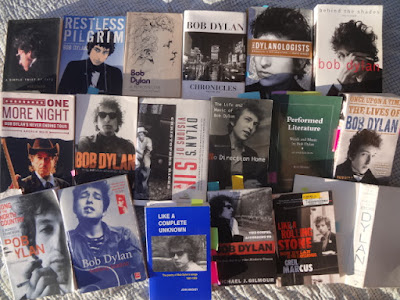
A portion of my collection of Dylan books. Photo 2018
Books. Over the years I've shared many a quote about books. With the exception of Poilu, all the books below were completed in 2021. I'm only halfway through Poilu and A World Undone, which I got for Christmas.

The first half of this list has links to the reviews I wrote about each. The latter half of the list are books that I checked out from the library, many of which were audio books I listened to while commuting to town or running errands.

The saying "too many books, too little time" is absolutely true. There's little in this world more rewarding than a good book. Equally rewarding is having friends to share your treasures with. That's part of my motivation for writing about the books I've been reading. 

What was your favorite book you read in 2021? 

Poilu, A Grisly WW1 Memoir from the Trenches, by Corporal Louis Barthas

Where Are You Tonight? by Jochen Markhorst

Bob Dylan: On A Couch & Fifty Cents a Day, by Peter McKenzie

H.R. McMaster's Dereliction of Duty

Homage to Catalonia, by George Orwell

The Great Divorce, by C.S. Lewis

Klara and the Sun
, by Kazuo Ishiguro


Jack London: A Life, by Earle Labor

Kingsblood Royal, by Sinclair Lewis


Coach: Lessons on the Game of Life,
by Michael Lewis

C.S. Lewis, A Life: Eccentric Genius, Reluctant Prophet, by Alister McGrath
Churchill and Orwell: The Fight for Freedom, by Thomas E. Ricks
Bob Dylan's Malibu, Martin Newman
Facing Unpleasant Facts, Orwell Essays
Ocean Prey, John Sandford
Brave New World, Aldous Huxley
Ethan Frome, Edith Wharton
The Trial of the Chicago 7: The Screenplay, Aaron Sorkin
Jurassic Park, by Michael Crichton (quite different from the film)
Experiencing the Trinity, by Darrell W. Johnson
Several Jack Reacher novels by Lee Child. (Interestingly, John Sanford has one of his characters reading a Lee Child novel in Ocean Prey.) 

The list above doesn't include the numerous books I started or read partially in order to get a taste for flavor. As already noted... there are too many books and such a shortage of time. Alas... it's time to turn the page.

Today is the last day of 2021. Here's a toast to 2022. 
May it reward you in ways you never expected.
HAPPY NEW YEAR

Thursday, October 14, 2021

Interview with David Asch Offers Insights On A.I.

In September my review of Kazuo Ishiguro's Klara and the Sun was published by the Medium publication Age of Awareness. What I especially like about the Medium community is the readiness to comment on stories, often adding new insights to something we initiated.

Though I only received one comment on my review I found it exceptionally insightful. Klara and the Sun is about A.I. and David Asch's review demonstrated his deeper understanding of the current status of Artificial Intelligence and where it is headed. I asked permission to pick his brain on this topic and he graciously accepted.

EN: What is your background and how did you come to take an interest in AI?

David Asch: I've had a long career as a software developer and as a leader of technology companies. In the late '80's, I worked for a government contractor alongside a team of Natural Language Processing (NLP) linguists and computer scientists. They worked on a DoD project trying to identify the few messages of concern from a plethora of communications they monitored. The NLP team was as arrogant as they were unsuccessful. It wasn't until the last ten years or so that Machine Learning using neural networks has enabled language processing and image processing to start living up to its vaunted potential. 

EN:  We’ve grown up in a world where “intelligent machines” keep getting smarter. Computers are everywhere. What is the difference between computers as we know them and AI?

DA: Artificial General Intelligence (AGI), the ability for a machine to learn any task as well as a human, has been the stuff of science fiction for a long time. Ray Kurzweil coined the term "the Singularity" as the point at which artificial intelligence becomes smarter than humans.  We're nowhere close to that point yet. Much of the AI-inspired smartness we see in our devices today are based on pattern and image recognition - like facial identification in lieu of a password or the leaps we've seen in machine language translation and voice recognition. 

EN: You mention the concern that AI will replace jobs. How do you see this playing out?

David Asch

DA: If you visit a factory today you'll often see more robots than humans. These robots aren't particularly intelligent but are a harbinger of the future.  AI will replace jobs that don't require humanity - the ability to interact with other humans. We already see the likelihood of AI replacing taxi and bus drivers in our lifetimes and possibly replacing us as drivers. AI is already used to help doctors identify cancerous tissue because it's better at it than humans. The immediate future will result in some job loss and some job modification to take advantage of AI. For example, AI technology may be used to drive a truck cross country, but a human may be needed to drive the final mile and will definitely be needed to handle the transfer of goods and bills of lading where people need to interact. Cardiologists may not need to develop the same expertise in reading EKGs because they'll have an AI assist; this may free them to spend more time interacting with patients.

EN: The Terminator films are based upon a future when the machines turn on the humans. It seems like the Internet-of-Things and global interconnectivity could make a malevolent AI a challenging and very real threat. Is this too far out to really happen?

DA: Elon Musk has sounded this alarm about the danger of malevolent machines. I agree that it's a danger, but it's so far away we'd do better to worry about imminent dangers like climate change. Ultimately, the builders of new AI technologies will be forced to self-govern and control the technology, like the scientists who created RNA sequencing technology. Otherwise, the government will step in and force regulation. 

It does seem that foot soldiers may become one of the jobs AI bots replace. The calculus of war will change when troops aren't on the ground fighting. 

EN:  Or equally disconcerting, a foreign power that uses AI to dismantle our power grids, Wall Street, health care and government systems….

DA: Big time. We're already seeing the beginnings of this with ransomware attacks on utilities. Cybersecurity is becoming a big business because so many systems are vulnerable to attack. There's no question that AI-fueled attacks will become a threat vector in the future.

Although it's interesting to focus on the negative effects of new technologies, it's also important to realize that the responsible deployment of these technologies will almost certainly improve our safety and health. 

EN: Thank you, David.

You can follow David Asch on Medium HERE: https://dasch804.medium.com/

* * * 

Related Links

The Importance of Klara and the Sun For Data Science Workers

Surviving AI by Calum Chace Is a Must Read for Those Who Plan to Be Here in the Future

A Visit with Futurist Calum Chace on his new book The Economic Singularity

Saturday, August 15, 2020

In Awe of Ishiguro's The Buried Giant

This week I completed Kazuo Ishiguro's The Buried Giant, yet another remarkable work by the worthy winner of the 2017 Nobel Prize for Literature. Once again I am wholly impressed by Ishiguro's skills in crafting original tales.

The novel takes place in England in that period after the passing of King Arthur. The central characters start to finish are an elderly married couple, Axl and Beatrice. For some reason they cannot remember their past, or rather, the memories they've lost touch with are hazy and dark.

The story begins with their seeming to recall that they once had a son, and they decide to leave their village to seek him. In a sense it is a classic road tale, a quest, in which they meet numerous unusual people and have remarkable adventures, see strange things and overcome all manner of obstacles including strange monsters, ogres and dragons. As the story moves along we unearth a multitude mysteries and over time the story of their past keeps unfolding.

Woven into the story we find history, mythology and poignancy. One reviewer called it "a beautiful, heartbreaking book about the duty to remember and the urge to forget."

Though the story stands alone in its originality, it bears resemblance to other original stories such as Lilith by George MacDonald, Beowulf, and even Pilgrim's Progress.

The story is truly remarkable in the manner in which it is told. One one level it is the story of Axl and Beatrice, a story that unfolds slowly but with greater clarity as it goes along. Even at the very end as they talk with the Boatman there are further revelations.

Drawing from when I was in high school.
But just as in every life, the lives of Axl and Beatrice have a historical context, and through their own quest to find their son the reader learns of the conflicts that took place between the Saxons and Britons in the years after the death of Arthur. So it is that Ishiguro is telling two stories, the painful personal one and the complex larger one whose characters include the Arthurian knight Sir Gawain and an old Saxon named Wistan.

A central theme in the story has to do with the forgetting what has taken place. The whole land is under this spell of not knowing or remembering its past. How this came to pass is slowly revealed. At one point someone asks, "Has God forgotten us?" It's a thought provoking story with many takeaways.

Here are a couple reviews from Amazon that also give the flavor of this tale.

alan216
I have never read anything quite like this ever before..The Buried Giant is part fable, part road-story, part exploration of character: when the point of the journey and the backstory becomes clear, it was as if a light came on. I can think of some people who'd find this writing infuriating: the whole way in which it's handled makes it hard to work out whether what's being described is the world as it is or the world as it's being seen by the characters. Once I'd decided simply to allow the author's approach to work itself out, I loved it: but, as I say, it's a really strange book, a really strange way of writing. Once I'd finished it, I thought it brilliant!

Leitir
There is an allegorical depth to this tale that will take some time for me to more fully understand and appreciate it. It is a tale that touches on what it means to love--in spite of hurt and pain. Of how people try and deal with grief both personal and tribal. It has clear echoes of resonance with what is happening today. How do we choose to remember and celebrate? What do we choose to remember and celebrate? And why? And when all is said and done and commemorated, what do we do then? Where do we go? This novel gives much for the soul and heart to ponder. Thank you.

For myself, the story served once again remind to me that there is power in stories, that Ishiguro is an exceptional writer who continues to amaze.

Related Links
A 3-Day Ride with Ryder: Ishiguro’s The Unconsoled Is an Achievement of the First Order
Kazuo Ishiguro’s ‘The Buried Giant’ (New York Times review)

Tuesday, April 16, 2019

A 3-Day Ride with Ryder: Ishiguro’s The Unconsoled Is an Achievement of the First Order

“What a long, strange trip it’s been.”

What happens when a world-famous pianist who comes to town to perform an important concert is forced to come to terms with who he really is? Ishiguro’s The Unconsoled has the feel of a cross between Lewis Carroll's Alice in Wonderland and the magical realism of Jorge Luis Borges. Like each of these authors, he has created a work that defies categorization.

The Unconsoled is the story of Ryder, a man who has achieved international fame. It opens with the pianist checking into a hotel whereupon he encounters character after character in scene after stretched-out scene in a manner not unlike Alice’s encounters after dropping through the rabbit hole. By means of their behavior toward him, and his internal attitude and responses, we get to know Ryder’s character in ways that at times become both hilarious and excruciating.

As I noted in my recent blog post The Identity Question, about how our identity is not fixed but varies based on context, we get to know Ryder—among other things--as deferential, modest, self-centered, selfless, anxious, overbearing, over-confident, and sensitive.

As we walk with him through this three-day ordeal, the events serve to reveal his entire life, especially his strained relationships with parents, family and fame itself.

The manner in which the story is told is surreal. The critics panned it when it came out, but near 25 years later it is hailed as one of the great novels of the last part of the century.

Readers will be cognizant that the storyline is becoming increasingly muddled, time stretched, situations absurd. But is that not what life can be like for one who is on the road, traveling, mushing through time from scene to scene to scene through setting after setting? I can't help but think here of the author himself perhaps, or of the Grateful Dead's traveling road show that inspired Bob Dylan's Never Ending Tour. What is this kind of life really like?

* * * *
My guess is that if the critics didn't like the book it's because they may have tried to read just enough to pin it down, much like pinning a butterfly into a display case and labeling it. The book defies such easy categorization. If you strap yourself in and go along for the ride, you'll experience all the drama of a roller coaster, emotional highs and lows, along with the tension of an overwound watchspring about to explode, a rope about to snap, or overstretched rubber bands. The tension mounts, is released a bit and mounts again.

What's exhilarating is how deftly the author paints all these characters and the scenes within this bizarre adventure.

In the story you will meet, in this order initially, Ryder, the hotel manager Hoffman, the bellhop Gustav, Gustav's daughter Sophie and her son Boris, a washed up conductor named Brodsky, the hotel manager's son Stephan, and an assortment of incidental characters who serve as foils in various ways.

One of the striking features of the story, for me at least, had to do with the porters. The manner in which servants and porters appear so prominently in both this and his heartbreaking Remains of the Day is quite interesting. The contrast between classes in both these books--which brings to mind another powerful story, Vatel--makes me curious if this theme is a recurring one in other Ishiguro novels.

The deference of Gustav to the powerful or more important people he serves, is all the more so because it is a very different culture from what many of us were used to growing up. If you grew up black in the Jim Crow south, however, this deference to whites was an unwritten and harshly enforced code. To a greater or lesser degree this same deference is ingrained and expected of busboys and bellhops in premier hotels, restaurants and country clubs to this day. I believe middle class Americans are surprised the elite still require this kind of stroking.

The story elements which cause much of the tension for readers are Ryder's constantly striving to remember where he is supposed to be and missing appointments because he is continuously allowing himself to get "off task." That is, when he is supposed to be here, he is asked to go take care of this other matter there, which leads to yet another diversion and another. Why does he not assert himself? It becomes an unbelievably frustrating experience for both the reader and himself and he repeatedly gives in to the expectations of others. Is his self-importance and the significance of this concert real or imagined?

The hotel manager's son Stephen is a developed character who resembles a young version of Ryder, exceptionally talented but unable to please his parents, somehow stifled by the context of his life. Ryder recognizes Stephen's frustration and through the lens of experience strives to help him. This theme strikes me as an echo of a Borges story in which Borges sits on a park bench and discovers, through a warp in time, that he himself as a young man is seated at the other end of the bench. He avoids making eye contact but strives to help this younger Borges.

For the reader who accepts the absurd features of Ishiguro's story, there will be many rewards. I saw myself in both of these characters, Ryder and Stephen. Perhaps you will find a little of yourself, too, in your own way.

* * * *


Related Links
Ishiguro on how he wrote Remains of the Day
Ishiguro on Dylan
Remains of the Day, A Review
The Identity Question: Who Am I?

Thursday, March 23, 2017

Throwback Thursday: Ishiguro On Dylan

Like most avid readers I read when I can, and never as much as I'd like. A lot of my reading occurs in snippets during my lunch hours. This week I carried around with me a borrowed Spring 2008 edition of The Paris Review, chiefly with the purpose of reading a fascinating interview with Kazuo Ishiguro, author of Remains of the Day which I recently wrote about here.

In this excerpt Ishiguro speaks of his early influences.

INTERVIEWER
What was your next obsession, after detective stories?

ISHIGURO
Rock music. After Sherlock Holmes, I stopped reading until my early twenties. But I’d played the piano since I was five. I started playing the guitar when I was fifteen, and I started listening to pop records—pretty awful pop records—when I was about eleven. I thought they were wonderful. The first record that I really liked was Tom Jones singing “The Green, Green Grass of Home.” Tom Jones is a Welshman, but “The Green, Green Grass of Home” is a cowboy song. He was singing songs about the cowboy world I knew from TV.
I had a miniature Sony reel-to-reel that my father brought me from Japan, and I would tape directly from the speaker of the radio, an early form of downloading music. I would try to work out the words from this very bad recording with buzzes. Then when I was thirteen, I bought John Wesley Harding, which was my first Dylan album, right when it came out.

INTERVIEWER
What did you like about it?

ISHIGURO
The words. Bob Dylan was a great lyricist, I knew that straightaway. Two things that I was always confident about, even in those days, were what was a good lyric and what was a good cowboy film. With Dylan, I suppose it was my first contact with stream-of-consciousness or surreal lyrics. And I discovered Leonard Cohen, who had a literary approach to lyrics. He had published two novels and a few volumes of poetry. For a Jewish guy, his imagery was very Catholic. Lot of saints and Madonnas. He was like a French chanteur. I liked the idea that a musician could be utterly self-sufficient. You write the songs yourself, sing them yourself, orchestrate them yourself. I found this appealing, and I began to write songs.

INTERVIEWER
What was your first song?

ISHIGURO
It was like a Leonard Cohen song. I think the opening line was, “Will your eyes never reopen, on the shore where we once lived and played.”

INTERVIEWER
Was it a love song?

ISHIGURO
Part of the appeal of Dylan and Cohen was that you didn’t know what the songs were about. You’re struggling to express yourself, but you’re always being confronted with things you don’t fully understand and you have to pretend to understand them. That’s what life is like a lot of the time when you’re young, and you’re ashamed to admit it. Somehow, their lyrics seem to embody this state.

The Paris Review
The Art of Fiction No. 196
Issue 184, Spring 2008

The rest of the interview is a good read, though I don't believe you can find it in its entirety online. Once your appetite has been whetted you'll have to make a purchase to get the rest.

In the meantime, if you were being interviewed today and were asked about your own early influences and interests, what would you say?

* * * *
The above story originally appeared on this blog in 2010.

Here's a quick reminder: DULUTH DYLAN FESTIVAL will kick off on May 20 with a concert featuring Robby Vee, son of the great Bobby Vee whom our local Nobel-prize winning Bobby Z (later Bob D) performed with once. 

Stay current with details on Duluth Dylan Fest. Follow us on Facebook.

Meantime, life goes on all around you. Get into it.

Popular Posts