Showing posts with label brushes. Show all posts

Thursday, July 10, 2014

Throwback Thursday: Five Years Ago Today

Gangnam Style at Chalk Fest 2013
What follows is a blog entry from July 10, 2009, Tools of the Trade. Other events on his day include Howard Hughes' record flight around the world in  91 hours (1938), and the opening day of what became known as the Scopes Monkey Trial in Dayton, TN. (1925) A Bible Belt town, there are still no liquor stores in Dayton. If you go out to eat you can only order beer and but you can bring your own wine if you know where to get it. (Hint: Pick up your wine at Wal-Mart.)

On this day in 1999 the U.S. Women's Soccer Team won the World Cup. his coming Sunday it will be Germany vs. Argentina for the Men's World Cup final.

Before diving into it, here's a quick recap of art-themed events happening this weekend. For full details see Monday's blog post.

Tonight
Sue Rauschenfels opening at Beaners.
The Chef is playing at Zinema in the Zeitgeist Building
Friday
Brent Kustermann @ Washington Gallery
TYPES @ The Prove
Swedish Immigration Opening Reception @ Nordic Center
Pineapple Arts 4th Year Celebration
Friday-Saturday
3rd Annual Chalk Fest in Two Harbors

Tools of the Trade
Every trade has its tools, and the visual arts is no exception. For drawing I have used a variety of pens, though for more than a decade I favored the Rapid-o-graph with its even lines and uninterrupted ink flow. If I had more time I would do more with pencils, but they are currently not my strongest suit. Instead, I favor brushes. I simply love the process of applying paint, ink or pigment by means of brushes.

Some of my brushes have been with me since my Ohio University days in the early 7o's. A few have been used so passionately for so long that they are practically nubs.

To the uninitiated a brush is a brush is a brush. But the reality is that brushes vary in type and style because they have different functions. Each applies color or pigment in a different manner, and the brush makes a difference in the outcome. Not only are the styles, sizes and shapes different, but the bristles themselves are made of different materials, from synthetic to camel's hair.

Many brushes are designed for special effects, such as the fan brush or the liner brush. Certain brushes are useful for scrubbing the paint into the canvas and some for laying it on thick, such as the mop brush. (I suppose if you had a really large canvas you might enjoy trying to use a mop itself.)

Some artists are adept at painting with a palette knife, which lays down paints in a thick coat or scrapes off areas for alternative effects.
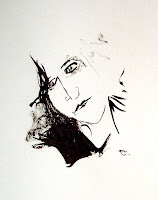
And occasionally, the fingertips make a good tool for applying color. I have used my fingertips in many paintings, sometimes to apply the pigment as a woman would apply mascara. And sometimes to spray the paint across the surface for special effects.

Speaking of spraying, I have even used a toothbrush for a few pieces. The stiff bristles make an excellent mechanism for spattering, and even for rubbing it in. I am referring to discarded toothbrushes, not the one I am about to brush my teeth with.

You probably didn't know, though you might have guessed, that the various parts of a brush each have names, from toe, bristles and belly to heel, ferrule (the metal part that holds everything together) and handle. The heel, the portion of the fibers underneath the ferrule) is not visible. Many of my brushes have had their toes worn off. And a couple have no belly left either. I still love what they can do.

For the record, I love my large paint brushes, too, from my days painting houses and apartments. Maybe some other time I can talk about those dear old friends as well. For the record there is one rule especially important whether working with art brushes or large paint brushes: clean them. You can't ignore this important need. Take the time it takes, don't shortcut this basic maintenance reality. It's like friendship. You just have to give it the time it needs or you will ruin a good thing. Then you'll have to start all over...

The two images here are ink on paper. I have fallen in love with the way ink works, whether for wet applications or dry brush techniques. And both of these are on the wall at my show this month at The Venue @ Mohaupt, at 2024 West Superior Street here in Duluth. Hope you can make it.

[EdNote: This Venue show, titled First Hand Experiences and which exhibited five years ago this month,  was my first in over thirty years, featured 130 piece.]

Friday, July 10, 2009

Tools of the Trade

Every trade has its tools, and visual arts is no exception. For drawing I have used a variety of pens, though for more than a decade I favored the Rapid-o-graph with its even lines and uninterrupted ink flow. If I had more time I would do more with pencils, but they are currently not my strongest suit. Instead, I favor brushes. I simply love the process of applying paint, ink or pigment by means of brushes.

Some of my brushes have been with me since my Ohio University days in the early 7o's. A few have been used so passionately for so long that they are practically nubs.

To the uninitiated a brush is a brush is a brush. But the reality is that brushes vary in type and style because they have different functions. Each applies color or pigment in a different manner, and the brush makes a difference in the outcome. Not only are the styles, sizes and shapes different, but the bristles themselves are made of different materials, from synthetic to camel's hair.

Many brushes are designed for special effects, such as the fan brush or the liner brush. Certain brushes are useful for scrubbing the paint into the canvas and some for laying it on thick, such as the mop brush. (I suppose if you had a really large canvas you might enjoy trying to use a mop itself.)

Some artists are adept at painting with a palette knife, which lays down paints in a thick coat or scrapes off areas for alternative effects.

And occasionally, the fingertips make a good tool for applying color. I have used my fingertips in many paintings, sometimes to apply the pigment as a woman would apply mascara. And sometimes to spray the paint across the surface for special effects.

Speaking of spraying, I have even used a toothbrush for a few pieces. The stiff bristles make an excellent mechanism for spattering, and even for rubbing it in. I am referring to discarded toothbrushes, not the one I am about to brush my teeth with.

You probably didn't know, though you might have guessed, that the various parts of a brush each have names, from toe, bristles and belly to heel, ferrule (the metal part that holds everything together) and handle. The heel, the portion of the fibers underneath the ferrule) is not visible. Many of my brushes have had their toes worn off. And a couple have no belly left either. I still love what they can do.

For the record, I love my large paint brushes, too, from my days painting houses and apartments. Maybe some other time I can talk about those dear old friends as well. For the record there is one rule especially important whether working with art brushes or large paint brushes: clean them. You can't ignore this important need. Take the time it takes, don't shortcut this basic maintenance reality. It's like friendship. You just have to give it the time it needs or you will ruin a good thing. Then you'll have to start all over...

The two images here are ink on paper. I have fallen in love with the way ink works, whether for wet applications or dry brush techniques. And both of these are on the wall at my show this month at The Venue @ Mohaupt, at 2024 West Superior Street here in Duluth. Hope you can make it.

Thursday, October 16, 2008

Brushes

There are many kinds of brushes in the world. Lint brushes, hair brushes, bottle brushes, wire brushes... Last week one of my paint brushes broke. In over four decades of painting, making art with paint brushes, I don't believe I've ever had a brush break like that.

It’s hard to believe that some of these brushes I have been using more than thirty-five years. Actually, a few are so worn down they are practically nubs, but I love my brushes.

In the early 80’s when I was a painting contractor (doing freelance writing at night) my paint brushes were like intimate friends. Even those brushes I loved, and my paint rollers, too.

When you care about something you take care of it. And paint brushes need special care or they will end up all gummed with dried paint, thereby becoming useless.

It’s interesting how the different brushes create different effects. With flats you can lay the paint down thick and get wavy effects. Oriental calligraphy is created with fine tipped brushes that almost have a teardrop shape. And of course the various brush styles all have names. Rounds, brights, fans, riggers, mops and the domed filbert.

My favorite brushes have been so used that many are quite a bit shorter now from when purchased long ago. As they scrub across various surfaces they become increasingly worn down. Some do little more than smear the paint on the surface like applying lipstick. Some simply stain it.

In point of fact, there are many ways to apply paint to surfaces including rags, fingertips, and pallet knives. The photo at the top of this entry, however, only shows a few of my brushes. Maybe I'll show you the rags, fingers and other tools another time.

Making art can be very gratifying as well as personally rewarding. As Thomas Merton noted, “Art enables us to find ourselves and lose ourselves at the same time.” Whether it is painting, making pottery, or creating a garden, as you lose yourself you often in turn enrich others. Hopefully some of my work here on this blogspot has done that for you.

Popular Posts