Showing posts with label faces. Show all posts

Saturday, October 4, 2025

Here's an Example of What Google's Gemini 2.5 AI Can Do

Over the past few years I have experimented a bt with various AI graphics programs and writing programs. I thought it my be fun to share some images showing what Google's Gemini AI can do (version 2.5 Flash)

Most of my pantings begin with a background. Backgrounds vary based on intentions. Some are very intentional while many are exploratory, in which I let the brushwork dictate the direction the painting goes. This is a medium sized canvas, 24"x 36". I began with these brushstrokes and colors, unsure where it would take me. A few years ago when I visited the studio of abstract painter Elizabeth Kuth, I saw how she would paint in layers, periodically rotating the canvas 180 degrees, bringing new elements into view, which she would highlight or bury beneath more visual elements. After a few rotations and layers I painted the following incomplete form of a man. Unsure of where to go with it, this has been siting on one of my easels since late last fall.


Last night I shared the above image with Gemini and 
asked that the AI to paint Vincent Van Gogh's face on my 
incomplete piece. Two minutes later I had the following,
which jumps fromthe canvas while retaining 
the original abstract aspects.
It's a collaboration.


This second sequence shows a common technique I had 
used for years. As anyone knows who knows me I am fascinated by faces and have been drawing them since  pre-school. 20 years ago or so, I began using Photoshop to break faces into contrasting patterms of light and dark.
I used to draw high contrast faces in high school. I loved the way the contrast would amplify the features while simultantously simplifying the elements. You can see how this works here on the cover of Meet the Beatles.

So I took my original painting and fed it to Gemini. [Gemini is a family of multimodal large language models (LLMs) developed by Google AI that can understand and operate across different types of information, including text, code, audio, image, and video.]  My prompt was: Paint this woman in the style of Rembrandt but in this color scheme. Have the face itself emulate that of Marlene Dietrich.

This was the result.

My next prompt was:
Change the background to a Dutch interior 
from the time period of Vermeer.


My final prompt was:

Change the background to be a starry night 

in the style of Van Gogh.


 Each image took less than two minutes to generate.

To try it yourself, go to https://gemini.google.com/
Press the little + symbol to upload an image and 
write an instruction prompt for Gemini to work on.

Wednesday, April 9, 2025

Just Doodlin'

As most people who know me know, I am a doodler. What is Doodling? Doodling is the act of drawing, sketching, or scribbling absentmindedly, often while engaged in another activity like listening, thinking, talking on the phone or daydreaming. These spontaneous creations can take many forms—simple shapes, patterns, abstract designs, or even small illustrations. They're typically done with pen or pencil on paper, though digital doodling has also become common. It is usually unplanned and lacks a specific artistic goal, distinguishing it from deliberate drawing or illustration. Here are some examples of my own doodles.


Why Do People Doodle?

People doodle for a variety of reasons, often without consciously intending to. I might be considered a compusively doodler by some, but years ago when I was asked about my doodling in a meeting, I'd just read some research stating that doodling can help maintain attention and improve concentration. I'm not sure if it was this one, but a 2009 study by psychologist Jackie Andrade found that doodlers recalled 29% more information than non-doodlers when listening to a monotonous recording. By engaging the brain’s default mode network lightly, doodling prevents daydreaming and keeps the mind anchored to the present task, such as during meetings or lectures.


For some folks, doodling serves as a calming mechanism, reducing stress and anxiety. The repetitive, rhythmic motions of drawing simple patterns can have a meditative effect, similar to mindfulness practices. Art therapy research suggests that doodling allows individuals to express emotions nonverbally, providing a safe outlet for feelings that might be hard to articulate. I also suspect that some people doodle because they are bored. For those I recommend taking up art. It can also be theraputic and even rewarding.


I just looked it up and learned that the word "doodle" dates back to the 17th century. It originally meant "foolish person." In the 20th century it referred to casual scribbling. In my journals from the past 45 years you'll find all kinds of doodles, patterns, marginalia and designs. If I were someone famous, I suppose there would be an effort made to analyze them and make pronouncements about what they mean. Since I'm not (famous) it means that most of these forty volumes of journal writing will likely become landfill or recycled paper. What do you think?

Friday, September 13, 2024

Why Do We See Faces In Abstract Designs?

From a very early age I've been fascinated by faces. When I look at clouds, or the swirls on a ceramic tile floor, it is not uncommon for faces to emerge. With the advent of the internet, and now AI, one can easily research this phenomenon that many of us have experience throughout our lives. Here's some of what I found.

Many people see faces in abstract images due to a psychological phenomenon known as pareidolia. This is the tendency of the human brain to perceive familiar patterns, especially faces, in random or ambiguous stimuli. Here’s some of why this happens:


Pattern Recognition

The human brain is a pattern-seeking organ, constantly trying to make sense of the world around us. When confronted with abstract shapes or random images, the brain automatically tries to organize the visual information into something recognizable. Faces are among the most familiar and easily recognized patterns, so we often "fill in the blanks" and perceive a face, even in the absence of one.


Facial Feature Sensitivity

Our brains are especially sensitive to certain key features that suggest a face, such as two eyes, a nose, and a mouth, positioned in a roughly triangular formation. Even if these features are represented vaguely or in abstract forms, the brain may interpret them as a face.

Emotional Connection to Faces

Faces also carry emotional significance, as they are tied to social interaction, communication, and empathy. Seeing a face in an abstract image can trigger an emotional response, which makes the image more engaging and meaningful. This emotional connection increases the likelihood that we’ll "see" faces even when none are intended.

Art and Imagination

In abstract art, there’s often no specific subject, leaving interpretation open to the viewer’s imagination. This freedom encourages the brain to impose familiar patterns, like faces, onto the image. Abstract art invites viewers to project their thoughts and perceptions onto the piece, and pareidolia is one way the brain makes sense of the ambiguity.


Not everyone enjoys abstract art, preferring clearly defined imagery that they understand. I myself enjoy the multitude of ways in which faces emerge when laying paint on a surface. It's often like being an audience to one's own performance in which you really don't know what will happen next. Sometimes it's trash and sometimes it's magic. And who doesn't enjoy watching a good magic show?

Wednesday, February 7, 2024

Almost Wordless Wednesday: More AI Art Shenanigans

And now for something completely different.

This is the original illustration, which 
I called, "The Scream."

Making selections using various prompts 
produces different effects. Notice the way
outcome models the visual information 
while creating completely different results.


Here are the same three images, expanded.


That's All, Folks!


Sunday, August 27, 2023

Five Pictures of a Teacher and Why Teachers Still Matter in the Age of AI

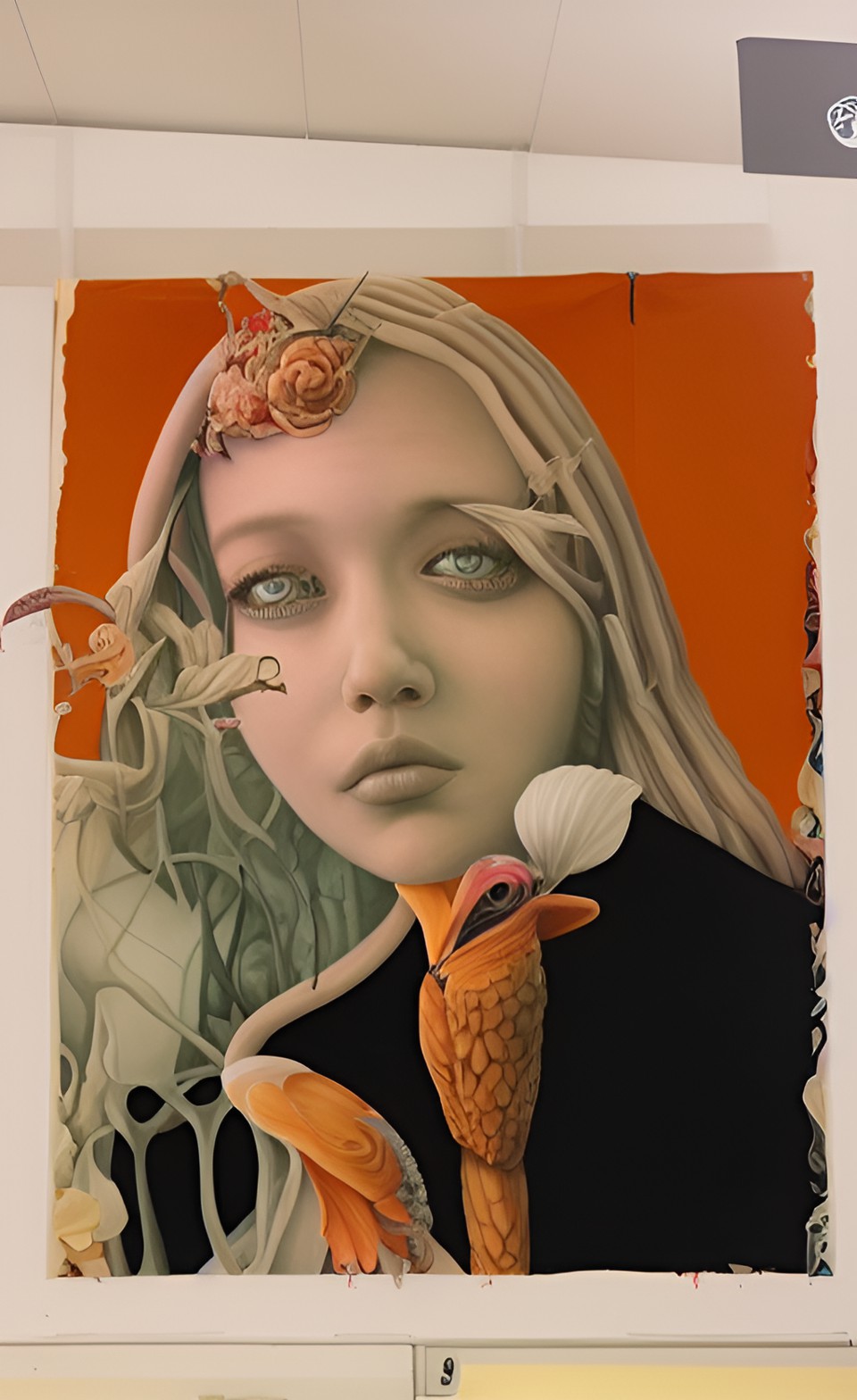
Last night while painting in my studio, I did a little touch up--made the orange more vibrant--on one of my pieces from ten years ago, acrylic on canvas paper. I called it The Teacher. 

I proceeded to photograph it, then fed it digitally into an AI art program. By varying the prompts, I ended up with some very different images. Here are the ones I didn't discard, plus a few quotes about teaching, to inspire those considering this profession.
 
Let's start with this quote by C.S. Lewis: "The task of the modern educator is not to cut down jungles, but to irrigate deserts."

"A teacher's job is to take a bunch of live wires
and see that they are well-grounded."
--D.D. Martin

"Students don't care how much you know
until they know how much you care."
--John C. Maxwell

"The best teachers are those who show you
where to look 
but don’t tell you what to see."
--Alexandra K. Trenfor

"Education is our passport to the future,
for tomorrow belongs to the people
who prepare for it today."
--Malcolm X

Here's the current status of the original:

Picture of the Day:
The Teacher

The AI compositions here are hybrids comprised of
my painting, a prompt and Dream by WOMBO

Wednesday, July 12, 2023

Almost Wordless Wednesday: Frankenstein's Monster Receives the AI Treatment

I came across one of my Frankenstein drawings and decided to play with it using an AI graphics app called Dream by Wombo. The first is my original. Those that follow are utilizing various prompts and features of the app. At the bottom is another of my Frankenstein monsters along with a link to a 2008 blog post titled Frankenstein: A Cultural History.

Frankenstein's Monster (Brush & Ink on newsprint)
Curious Monster
Comic Monster

Dangerous Monster
Steampunk Monster
Two-Faced Monster

Another ennyman original.

Related Link

Popular Posts