Showing posts with label teaching. Show all posts

Sunday, August 27, 2023

Five Pictures of a Teacher and Why Teachers Still Matter in the Age of AI

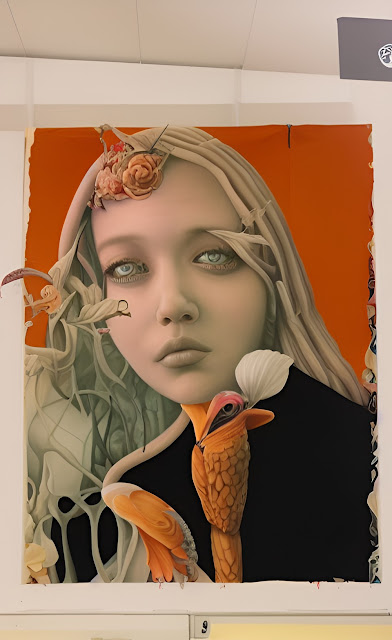
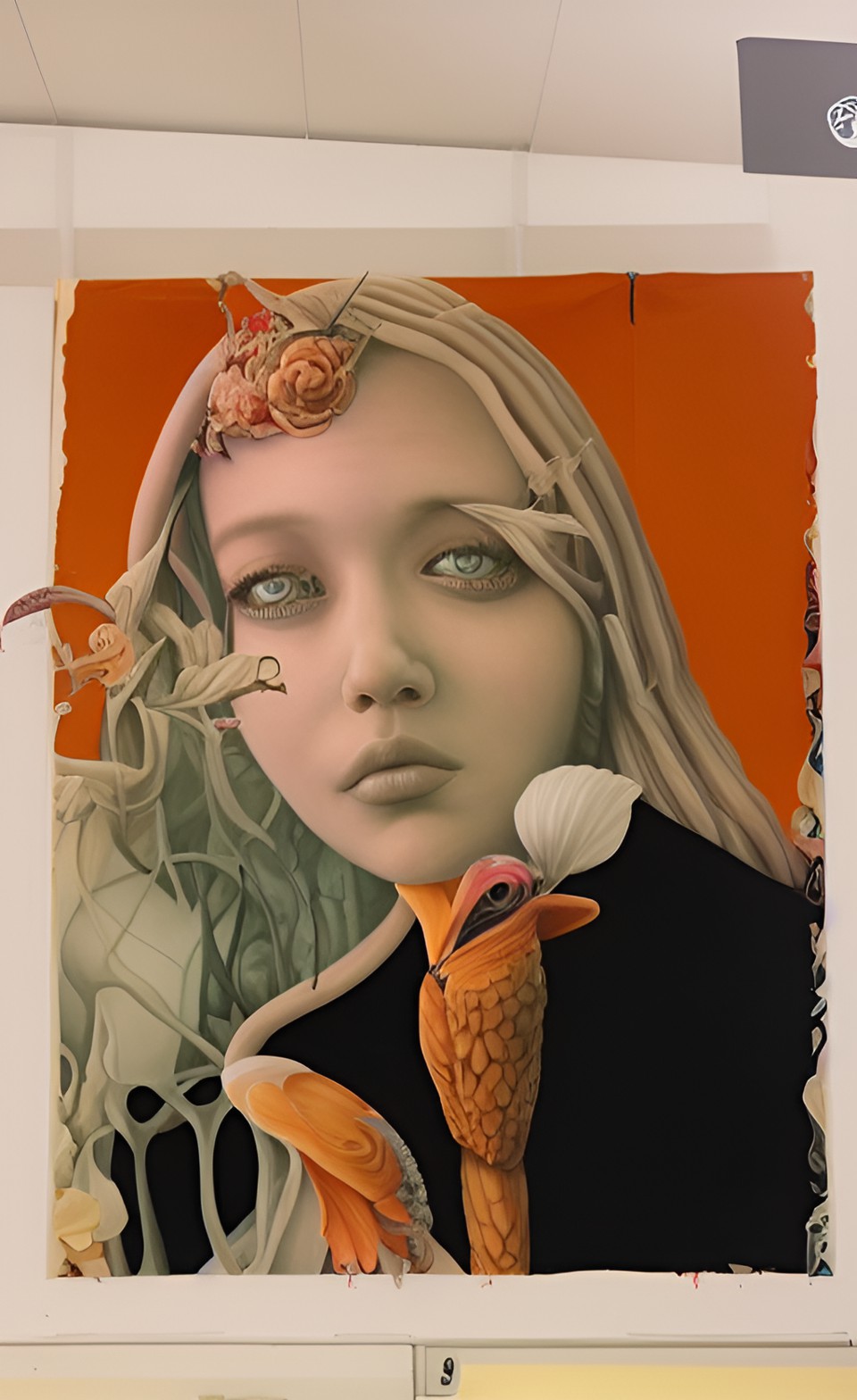
Last night while painting in my studio, I did a little touch up--made the orange more vibrant--on one of my pieces from ten years ago, acrylic on canvas paper. I called it The Teacher

I proceeded to photograph it, then fed it digitally into an AI art program. By varying the prompts, I ended up with some very different images. Here are the ones I didn't discard, plus a few quotes about teaching, to inspire those considering this profession.
 
Let's start with this quote by C.S. Lewis: "The task of the modern educator is not to cut down jungles, but to irrigate deserts."

"A teacher's job is to take a bunch of live wires
and see that they are well-grounded."
--D.D. Martin

"Students don't care how much you know
until they know how much you care."
--John C. Maxwell

"The best teachers are those who show you
where to look 
but don’t tell you what to see."
--Alexandra K. Trenfor

"Education is our passport to the future,
for tomorrow belongs to the people
who prepare for it today."
--Malcolm X

Here's the current status of the original:

Picture of the Day:
The Teacher

The AI compositions here are hybrids comprised of
my painting, a prompt and Dream by WOMBO

Monday, November 23, 2020

The Butler Who Folds His Hands Spills No Tea

In 2018 I published an article in which I shared 9 Maxims Which Carried Me Through a Career in Corporate America. While preparing a speech this week about leadership (which I delivered Thursday evening) for our Toastmasters group, I drew upon several of those life lessons. I had so many things I wanted to say that I deleted this from the speech lest it take too much of my allotted time. 

I'd first heard the expression in one of advertising guru David Ogilvy's books. If I remember correctly he was discussing the manner in which we manage creatives. Creating fresh ideas day in and day out is a challenge, and hitting it out of the park doesn't happen with every swing of the bat. (Unless you're Joe Hardy.(1) There are risks involved in aiming for the exceptional. Risk means there's a possibility of failure. The best way to kill a creative team is to never allow a whiff. 

There's always risk involved in any creative venture. Not every idea works. The best way to eliminate risk-taking is to do nothing. If you do nothing, you will never make a mistake. This is a business in which the competition for eyeballs is fierce. Creating something memorable and effective is no easy task. 

*

When we focus on punishing mistakes rather than rewarding initiative, we turn motivated students and workers into demotivated sheep. This is what prompted me to develop an alternative method of grading writing assignments when we were homeschooling our children. You can read my ideas on grading here.

*

Those ideas came from painful experiences I had in school (even though I tended to be an A student) and also from a workshop I attended for soccer coaches back in the 1990s. In the workshop Buzz Lagos, head coach of the Minnesota Thunder pro soccer team, taught of various games that our kids could play, by which they would develop as players. Ball control, passing and teamwork would develop as they played these various competitive skirmishes. 

During the Q&A afterwards, one of my fellow coaches asked an important question. "Sir, what skill level should my ten-year-olds be at?" That is, what are the benchmarks or milestones they should be at for the various stages at their age levels? How deft should their ball handling be? How strong and accurate their kicking?

Coach Lagos replied, "Don't even think about it. Only one thing is important, that they enjoy the game." 

When we are kids we do what we love and we get better at it. I'm not sure that parents, teachers and coaches can create these passions, but I am absolutely persuaded that we can quench them. 

The same can be true in the workplace. I believe most people want to do a good job, until years of mismanagement and abuse have corrupted this motivation. How we manage people can foster or frustrate their desire to excel. Once ruined, employees spend more time thinking about how to avoid punishment instead of focusing on the mission.

Do our employees know what the mission of the company is and how they fit into it? Are they--like players on a football team--playing in the right positions? Have they been properly trained? Is the value of their contribution recognized? Do you praise publicly and criticize privately? 

It's often easier to know the right things to do than to do them. Unless we try, however, we'll end up being the same old rat stuck in the same old maze. If you're a teacher or leader, and you're not seeing a spark in your students' or employees' eyes, it may be time to re-assess, and learn some new tricks.

*

Related Links
How to Teach Writing: A Soccer Coach Handed Me the Key
9 Maxims That Carried Me Through Three Decades in Corporate America

Photo by Alev Takil on Unsplash 

(1) Joe Hardy was hero for Washington in the musical Damn Yankees.

Wednesday, October 3, 2018

Spotlight on Artist Designer Victoria Lehman

During this past Friday's Downtown Arts Walk here in Duluth I stopped in at Joellyn Rock's Rockinghorse Studio where a half dozen or more paintings by Victoria Lehman were being displayed. An assistant professor, Ms. Lehman has been teaching art and design at the U of MN-Duluth for 20 years or so. As it turns out, two of the most talented designers I have ever worked with were once students of hers.

The visit wasn't long enough, but a good introduction and the interview that follows will take you further.

EN: When did you first take an interest in art? Were there any catalyst events the propelled you to a teaching career in the arts?

Victoria Lehman: My early influences were the artists in my family and I jumped in early into creating art using many different medias. There were also teachers in my family and their appreciation for art and teaching also headed me toward an art teaching career.

EN: What has been your career path since growing up in Luck?

VL: My undergraduate degree was in studio art and art education. I taught K-6 elementary art in our local school for eight years before teaching at Brown Institute and The College of St. Catherine. I liked graphics and bought a small graphic design business for two years before coming to UMD and returning to teaching design. Along the way I've painted for many galleries such as the Long Beach Arts, CA and joined collections.

EN: Are there any influential designers that have especially influenced you? You’ve taught some very talented designers. Why is design important and what are some of the applications of design?

VL: Switching from teaching studio to design mid-career wasn't very difficult. I've been influenced by the designers I've worked with in business or teaching, and when first designing, I liked the New York designers such as Paula Scher.

Design is one of those things we take for granted being surrounded by design messages every day. Designers want to interact with people by coaching them to look at this world differently or in a better light. Most of us only stop to look at design when it strikes a personal cord. That's a designers job to find that personal note in as many people as possible.

EN: You’re also a painter. What is it that you most enjoy about painting as a medium of expression?

VL: What I most enjoy about painting is the fact I can express abstraction in large format and it's on a wall giving it texture and structure that you can't get with digital work or almost any other format.

EN: Where can people see more of your work?

VL: www.victorialehman.com and Instagram.


Meantime, art goes on all around you. Get into it. 

Sunday, March 24, 2013

Handwriting Matters

This blog entry is a chapter from my upcoming book, tentatively titled, Writing Exercises: How to Teach Writing and Prepare Your Favorite Students for College, Life and Everything Else. Grace Moores, who is assisting me with the book, prepared the initial draft of this chapter


Handwriting Matters

Handwriting is a skill that is arguably in the process of being lost in our modern society. With the advent of online news forums and digital books, print and concrete handwriting skills are beginning to seem unnecessary. The computer is taking the place of the pen.

Developing good handwriting, however, is still important for a variety of reasons. Good handwriting is courteous for the person reading what you’re writing. It’s also something of a necessity when filling out a job application. And if the teacher can’t read the pupil’s work then there's going to be a problem when going over it together.

Without even harping on it, as you work with the student to improve her story telling abilities, the handwriting will improve on its own, for two reasons. First, handwriting is a motor skill that improves with use. Second, by being interested in helping her communicate more effectively, the student will take greater care to write more clearly. After all, she may be quite proud of the stories or ideas she is attempting to share and won’t intentionally aim to have the handwriting be an impediment.

Since the beginning of literacy, the skill of handwriting has developed and changed with along with changes in society and technology. Some forms of handwriting are artistic, for example calligraphy or graffiti. Others are more utilitarian such as the near-illegible scrawl used in a doctor’s office. All handwriting, being the medium in which a message is conveyed, is affected by both the writer and the reader. For example, a dinner invitation written in pristine calligraphy will be received differently than one written in a sloppy scrawl. Each note will elicit a different response. While one note may imply a formal dinner with suit and tie, the latter indicates that jeans and a t-shirt will be adequate. In this way, it is important to be aware of handwriting and the affect that it has on others.

Furthermore, it is courteous for handwritten messages to be easily legible to the recipient. Your student will likely one day secure a job in which written notes may be a necessity Handwritten notes are still an important form of communication in most employment settings. One such example is found in the experience of a clothing store employee. Every week, he orders more supply based on notes left by the other employees. All goes well until he processes the list left by one employee in particular. In order to ensure the accuracy of the order, he usually has to call the employee to confirm the list. This is a waste of everyone’s time and may result in costly errors when legible handwriting would have fixed the problem. Developing good handwriting throughout an academic career could be very important in future careers.

Developing good handwriting is also useful in developing linear thinking. When using a computer, it is easy to edit the format of sentences and whole paragraphs with a series of clicks. Word order is entirely flexible. Conversely, handwriting with pen and paper requires the mind to sequentially order the thoughts and plan further ahead when writing, sharpening positive thinking skills. This type of brain development is not present when solely typing on a computer.

At the same time, maintaining good handwriting forces students to be disciplined in writing out their ideas. While computers maintain pristine uniformity with absolutely no effort on the part of the writer, precision in handwriting requires both attention and discipline. (This is not to imply that good writing using a computer is effortless. It only resolves the legibility issue.)

In these ways, it is easy to see that handwriting is an important skill to develop in the student. Some tips to improving handwriting are as follows:
1. Practice. Print out a bunch of handwriting practice sheets. The most important thing about the paper is that it has wide lines. It is easy to see lack of uniformity and other inconsistencies when the letters are really big.
2. Develop good handwriting muscles. The muscles that should primarily be used in handwriting are muscles in the forearm and back. Too much finger muscle use in handwriting will develop really small, cramped handwriting as the writer painstakingly draws each letter individually.
3. Strive for uniformity. The key to good handwriting is consistency. Practice each letter until you can easily maintain a uniform shape for each.

In short… if you want to improve, write on.

Friday, May 13, 2011

A Visit with Painter/Teacher Lee Englund

My high school art class in New Jersey played an influential role in my life. Mr. Sebes created an environment that was somewhat of a refuge during that challenging time for me as my best friend had been taken in a car/bike accident the first day of my junior year. Advanced trigonometry and differential equations were too abstract for the internal things going on in my life at that time. Art proved to be a healing diversion for me.

This past month at the Clyde-O-Thon event here in Duluth, I was introduced to Lee Englund, an art instructor who is doing some wonderful oil painting. His teaching career began in 1984 in the Duluth Elementary schools, and was followed by two decades at Denfeld High School beginning in 1988. Englund then went back to grad school to get his masters in fine art whereupon he was hired by Lake Superior College and now teaches 2 painting classes.

I was enjoyed watching him paint at the Clyde, and was also interested in getting him to share some of what he's learned from teaching art over the years.

EN: What do you consider your most significant achievements?
LE: Getting in to National competitions and winning several awards has been rewarding..but I think seeing my work and my passion for it grow over the years is the biggest reward. I feel lucky to have the passion that I have.

EN: Who have been your favorite artists over the course of your career?
LE: My influences are many... and they have changed over the years. Those who have stayed with me: Caravaggio, Monet , Zorn, Mary Cassatte , Whistler. Artists living and working today who influence me are. Clyde Aspevig for plein-air landscape Richard Schmid for his brush strokes, David Leffel(who I took a workshop with) and Danial Green for portrait.

EN: Who most influence you when you were young?
LE: I always was interested in art, but my junior high school art teacher Ron Kokal influenced me to become an art teacher.

EN: What are you currently working on?
LE: I am currently working on a series of figures and nudes... This summer I will be painting plein-air landscapes out west and southwest. I have more experience to draw on, and a larger view of art history. I have also learned much through teaching.

EN: In what ways has art changed since you started painting and teaching?
LE: There have been many changes since I started this life long endeavor. Mostly I see too much technology being used. Images being traced or tweaked on computers I feel that art should come from the heart… paint what you see... not what the camera sees.

EN: Any suggestions for emerging artists?
LE: My advice to emerging artists would be to paint from life... it is the way to learn to see, which is what painting really is... Paint often... it almost takes being compulsive to get good at painting representationally, and paint with passion.

EN: If you had it all to do over what would you do differently?
LE: If I had it all to do over again, I probably wouldn't change much except I would like to take back the time that I wasted… Life is short.

To see more work by Lee Robert Englund, be sure to visit, http://www.leeenglund.com

Saturday, November 27, 2010

Why Children Need to Learn How to Write

It is the written word that has changed the world. Revolutions go hand-in-hand with words, dreams frozen in print, melted again by passion, bursting to life in inflamed hearts.

In my opinion the ability to write is one of the most important skills that any young person can develop. I suppose I’m biased, since I am a writer and make my living through putting words on paper.

It’s hard to believe that a hundred twenty years ago nearly ninety percent of our population made its living off the land. For the most part we were a rural economy. But the industrial revolution was in full swing, and in the early part of this century an entire generation was lured away from the land to the meat packing plants, steel mills, and manufacturing facilities that sprang up in big cities everywhere.

My great grandfather scratched out his living on a mountainside in east central Kentucky. He could neither read nor write. In fact, few of my Kentucky kin from the nineteenth century could put pen to paper other than to make an ‘x’, which someone else would note was "his mark."

When my grandfather eloped with grandma in 1923, it wasn't until after they were wed that she learned he was illiterate. Her first task was to teach him enough reading and writing so as to be able to fill out a job application. She had been a school teacher and knew all too well that reading and writing were basic skills essential to advancement in our changing world.

What was true then is even more true today. The ability, or lack of ability, to communicate in words will either open or shut doors of opportunity. We live in the Information Age.

When you think about it, the written word is everywhere. There are a lot of people today directly making a living putting words on paper. Journalists, screen writers, broadcast writers, advertising copy writers, technical writers, lawyers, legislators and magazine editors just to name a few. But there are countless more careers which require written communication skills.

There is nothing significant built without a written plan today. Patents for ideas require legal documents. The abstract for your house is a fascinating written record of the history of your property. Marketing plans, business plans, documents for making loans or borrowing money, instructions for software programs or bicycle assembly -- all require the written word.

The written word is an indispensable part of our lives, even in our diversions. We read novels, stories, comics, jokes, cereal boxes, newspapers, email, all kinds of newsletters and even an occasional blog entry.

Apart from the career opportunities it provides, writing can also be a valuable tool for personal growth and self understanding. I often find myself quoting Martin Luther's advice* to his barber: "The weakest ink is stronger than the strongest memory." If you have had an experience that made a profound impact on your life, write it down. A new insight? Write it down. My brother once shared with me a profound revelation which he had gained while in a therapy group. Several years later I shared with him how that insight continued to move me, because I had recorded it and from time to time re-read it. Funny thing is that he had forgotten it completely!

Teaching our children to write may well be the most important skill we can give them as we prepare them for life. Maybe one of our own children will write the next Declaration of Independence, Gettysburg Address, or a Nobel prize winning novel. Or maybe not. I can say with confidence that the better their writing skills, the more prepared they will be for whatever paths they explore in life.


*I have since read alternate attributions for this quote.

Friday, August 13, 2010

How To Teach Writing To Young People

A few years ago I had the privilege of participating in a workshop for coaches of youth soccer led by Buzz Lagos, head coach of the Minnesota Thunder, a professional soccer team. Coach Lagos showed us all kinds of neat games that would engage our kids while helping them learn basic skills. It was a fun experience and I learned a lot.

At the end of the evening he conducted a highly informative question and answer period, fielding questions with the same skills he showed us when demonstrating ball control. One attendee asked a key question that has across the board applications for all teachers or instructors. He asked “What skill level should we be expecting eight and ten year old soccer players to be at?” The answer surprised me, but then made perfect sense. Coach Lagos replied, “You should not even be thinking about skill levels at that age. What you want is for every child to learn the rules and enjoy the game.”

The coach’s reply demonstrated his love for the game. Buzz Lagos also showed a deep understanding that if the children do not enjoy playing, they will not apply themselves to mastering its fundamental skills. Instead of laying heavy expectations on eight and ten year old kids, let them simply have fun. Sure enough, this was how I developed my skills in baseball as a boy, and later as a young artist.

I also believe this is exactly what our children need when it comes to learning basic skills like reading and writing. If we can somehow foster a love of reading, and an enjoyment creative self-expression with words, we have done a remarkable thing. To give our children a love of learning, a love of reading, and the pleasure of self-expression through writing and art... what a wonderful gift!

I may be wrong, but I have always believed that children are filled with an innate desire to learn, to create, to explore, and to express themselves. In other words, as they begin life these are natural, innate motivations. Our role, then, is not to attempt to motivate, but rather to avoid quenching this natural desire. Here’s an example of how to kill the love of reading. Recently, my wife was at someone’s home when an argument erupted between the two children regarding what to watch on television. The father, infuriated, resolved the matter by punishing the one in the following manner: “Go upstairs and read a book.” Yikes! Reading as punishment is hardly the way to foster a love of reading!

Perhaps one day I will finish my book of exercises for training young people to become better and more interesting writers. In the meantime, take these words to heart. If your children have a passion for self-expression, whether through art, music or the written word, rejoice. Encourage. And worry about technique later. You never know where it will lead.

Thursday, December 4, 2008

Basic Article Structure

The following is an article I wrote for a homeschooling publication, but which has application to anyone interested in teaching writing or in becoming a better writer themselves.

HOW TO WRITE THE "BASIC" ARTICLE

I take issue with those who say a picture is worth a thousand words. It is simply not always the case. Without a caption, a picture can often leave viewers scratching their heads saying, “Huh?”

David Ogilvy, founder of the Ogilvy and Mather ad agency and guru of modern advertising, notes that photo captions are usually the first thing a person will read on the page. So if you're ever in advertising, be sure your photos don't stand alone. Add some sales copy beneath that picture, to clarify or reinforce the message you’re trying to communicate.

Granted, properly chosen photos and illustrations almost always enhance an article, story or poem. But they are not necessary to communication. Some of my favorite portions of magazines are those non-illustrated sections like editorials, columns, and letters to the editor. The key is good ideas, well-presented.
Essentially, what I wanted to present here is an overview of your basic article structure.There are many kinds of articles. If you read at all you'll soon recognize their distinguishing characteristics. Here, off the top of my head, are just a few of your most common article types: list articles, how-to articles, features, question and answer articles, and (today’s subject) your basic article.

Having a pattern or structure helps both the reader and the writer. Instead of a hodgepodge of miscellaneous notions, the reader is guided along and does not have to work at understanding what is being said. Perhaps you've had the experience of reading something and not “getting it” and thinking it was you. Frequently it is not you at all, but the writer who is at fault. The writer has not done his or her job, which is to communicate clearly.

It’s similar to bad handwriting. Yes, one can eventually decipher it, but it would be more courteous if the letter were written legibly.

Having a structure also helps the writer. It provides a form for organizing one’s ideas. I like think of it like pouring a concrete patio. First you build the forms using a network of boards; then you pour in the concrete. Once you have your structure, pouring out your ideas can be relatively easy.

The “basic” article consists, basically, of the intro (or hook), the billboard, the body and the ending, which is usually a summary or conclusion. When teaching writing, always challenge your children or students to think in terms of readers. This is especially important with writing introductions. In a world filled with television, video games and a thousand other distractions, one must learn to grab the reader quickly. Whether it's a story, an essay, a letter to the editor or a business proposal, a good opening whets the appetite, creates anticipation and gets the reader engaged. No matter what their writing assignment, be sure to remind your kids to make the beginning zing. They'll probably surprise you! I know my kids always did.

The next section of your basic article is the billboard. The billboard is a brief paragraph, usually no more than a few sentences, that tells the reader where your article is headed. In this particular article it is paragraph four. The meat of your article, that is, the main part of what you are writing, is called the body. Of course you can call it anything you want. Sometimes it is a little plump and should be trimmed a bit, but you don’t want to be all skin and bones. In the body of your basic article you generally make three main points to support your premise, or to flesh out your topic. Whether it is five hundred words or five thousand, it is easier if you break your main article into sections. When writing longer articles I almost always add subheads to help the reader identify the main sections.

The summary, or conclusion, is usually best if brief. You know how tiresome long goodbyes can be. Long endings can be the same. Once you've made your point, take a bow. Tie up the loose ends and do the sayonara.

In short, your basic article has four parts. An intro that hooks the reader, a billboard that announces where you're going, the body which amplifies what you are trying to say, and your conclusion.

I know you can do it. And so can your kids.

TIP: If you do not already have a copy of the compact and profoundly simple Elements of Style, by Strunk and White, then be sure to buy one. It will help every aspiring writer and writing teacher, and help improve the quality of communication in the age to come.

Monday, January 14, 2008

Physics: It's Not Always Rocket Science

Physics
1. The science of matter and energy and of interactions between the two, grouped in traditional fields such as acoustics, optics, mechanics, thermodynamics, and electromagnetism, as well as in modern extensions including nuclear physics, cryogenics, solid-state physics, particle physics and plasma physics.

~~~ ~~~ ~~~ ~~~

In high school one of my favorite teachers was my physics teacher Mr. Dennison. I don't recall all that much from the class other than a few films in time-lapse photography of a bullet piercing an apple, and clouds across the autumn skies. Something about velocity and gravity. Nothing about rocket science.

The reasons we like teachers vary, but in this case it may have been the special interest he showed to me. And it may have been that he was a baseball coach and I'd spent years dreaming that one day I would grow up to play baseball. Mr Dennison, my junior varsity coach in baseball at B.R.H.S.-West in New Jersey, had been a minor league pitcher for seven years. At the end of that seventh year he was brought up to the major leagues for a week, joining Boston's Red Sox bullpen the last week of a non-significant season and getting a chance to pitch part of an inning.

Evidently his dream had to be abandoned, because after this brief brush with the majors he let it go. Looking back on my own life I see any number of dreams embraced and abandoned, and understand now what I did not understand then. Perhaps this experience of pain made him a better coach and better teacher. He was certainly both, and an influence on my life.

It seemed as if he'd taken an interest in me. As a student, one tends to feel oneself to be a lost particle, insignificant as dust. To be singled out is a big thing. Especially by your J.V. coach.

My last period class was study hall and Mr. Dennison would take Joe Sweeney and I out of class to give us batting practice. Mr. D threw more junk at us than a carnival barker. His curves were impressive and the knuckle ball was a phenomenon. Both sophomore and junior years I had the second best batting average on the team and lowest strikeout percentage. Joe Sweeney had the best batting average, a healthy .500 or better junior year, and Skip Hoy similar our sophomore year.

But it was apparent we weren't going to be superstars. Late in the season I was brought up to varsity, played respectably at shortstop and earned a letter. The following year, however, the head coach was going to be re-building and it didn't take rocket science to see my future was not going to be in baseball.

I learned some valuable lessons from Mr. Dennison, a few in the classroom and some important ones out on the baseball diamond. His investment of time made an impact, and imparted some positive energy into my soul, an interaction that helped contribute to my own efforts years later as a coach, teacher and role model. Thank you, Mr. Dennison.

Friday, October 5, 2007

How to Teach Writing to Young People

A few years ago I had the privilege of participating in a workshop for coaches of youth soccer led by Buzz Lagos, head coach of the Minnesota Thunder, a professional soccer team. Coach Lagos showed us all kinds of neat games that we could have our kids play to help them learn basic skills. It was a fun experience and one in which I learned a lot.
At the end of the evening he conducted a highly informative question and answer period. One attendee asked a key question that has across the board applications for all teachers or instructors. He asked “What skill level should we be expecting eight and ten year old soccer players to be at?” The answer surprised me, but then made perfect sense. Coach Lagos replied, “You should not even be thinking about skill levels at that age. What you want is for every child to learn the rules and enjoy the game.”

The coach’s reply demonstrated his love for the game. Buzz Lagos also showed a deep understanding that if the children do not enjoy playing, they will not apply themselves to mastering its fundamental skills. Instead of laying heavy expectations on eight and ten year old kids, let them simply have fun. (This was how I developed my skills in baseball as a boy, and later as a young artist.)

I believe this is exactly what our children need when it comes to learning basic skills like reading and writing. If we can somehow foster a love of reading, and an enjoyment creative self-expression with words, we have done a remarkable thing. To give our children a love of learning, a love of reading, and the enjoyment of self-expression through writing and art... what a wonderful gift!

I may be wrong, but I have always believed that children are filled with an innate desire to learn, to create, to explore, and to express themselves. In other words, they begin life with natural motivation. Our role, then, is not to attempt to motivate, but rather to avoid quenching this natural motivation. Here’s an example of how to kill the love of reading. Recently, my wife was at someone’s home when an argument erupted between the two children regarding what to watch on television. The father, infuriated, resolved the matter by punishing the one in the following manner: “Go upstairs and read a book.” Yikes! Reading as punishment is hardly the way to foster a love of reading!
Perhaps one day I will finish my book of exercises for training young people to become better and more interesting writers. In the meantime, take these words to heart. If your children have a passion for self-expression, whether through art, music or the written word, rejoice. Encourage. And worry about technique later. You never know where it will lead.

Popular Posts