Showing posts with label totalitarianism. Show all posts

Monday, September 23, 2024

Censorship as First Step to Totalitarianism

Last night I finished reading Thomas Mann's Diaries for the second time. The Nobel Prize winner was considered one of the giants of the first half of the 20th century. This volume covers the years 1918-1921 and 1933-1939. The former is post-WWI and the latter highlights the rise of Hitler and the years leading up to WWII.

There are a number of recurring themes that make an appearance in his diaries. I was surprised at how often he took a med to sleep, and how often he mentions being uneasy and anxious. He continually mentions what he's reading (Tolstoy, Cervantes, Proust, etc.) and many of the names of people he is corresponding with.

His concerns regarding the restrictions on speech and free thought get increasingly highlighted in the late 30s. What's discouraging is seeing many of his observations playing out yet again in our own time. Here is the opening to one of Michael Shellenberger's emails from thesubstack Public News:

A little over a year ago, I participated in a public event in London with Russell Brand and Matt Taibbi. While there, I expressed my bewilderment at the censorship we had uncovered. It wasn’t the first time. When Matt and I testified before Congress in February, I also described being disoriented. After all, growing up progressive in the 1980s and 1990s, free speech was a foundational value, both for radical Leftists like myself at the time and for more moderate liberals. To watch liberal and Leftist Democrats demand censorship right in front of me was jarring, to say the least. I wondered aloud, “What is going on?” And I kept wondering until I found some answers.

I believe that my colleagues and I are now much closer to having a unified field theory of contemporary totalitarianism. We have published hundreds of articles so far on the censorship and other totalitarian tactics, including the weaponization of the FBI and CIA and the lawfare aimed at incarcerating Donald Trump, that we’ve been documenting. If I had to sum it up, I would say that there are at least four core drivers, all of which I described in a conversation I had yesterday with Russell...

--Michael Shellenberger


Are Shellenberger and friends being alarmist? How ironic that Gallup polls show that left-leaning Democrats are the ones most in favor of censoring free speech, while simultaneously declaring that Republicans are the ones determined to destroy democracy. Are the former leaders of the Sixties "Free Speech Movement" now its adversaries?


"Say it ain't so, Joe."


Wednesday, May 8, 2024

B&N Observations and a few notes about Hannah Arendt's The Origins of Totalitarianism

There was a time when visits to Barned & Noble were regular features of my monthly, and sometimes weekly, routine. Now, it seems, it has been a while since I spent an hour in a bookstore. 

Yesterday I did jst that, getting a feel forthe ambiance generated by shelves of books.

The big surprise was how large the religion section was. That's because a large percetage of Christians purchased their books through Christian bookstore 30 years ago. 

According to data from the Christian Booksellers Association, there were 75% fewer Christian bookstores in 2020 than there were in the 90s. The demand for Christian literature and study guides didn't disappear, and stores like B&N expanded their shelves to accommodate.


Here are a few other books that caught my eye yesterday.


And this one.


I believe I first became aware of Hannah Arendt (1906-1975) through a Sociology of Mass Movements class that I took in college. The idea of the class was more interesting than the class itself which was taught by a TA from India who read the lessons in a flat, non-engaged manner. 


Nevertheless, we were introduced to a variety of authors and ideas that we could explore on our own, and the topic has remained of interest even if the instructor was forgettable. (The textbook, however, was equality as boring as the instructor.)

Hannah Arendt's "The Origins of Totalitarianism" was considered a seminal work that analyzed the rise and nature of totalitarianism in the 20th century. Originally published in 1951, the book remains relevant, offering insights into the origins, characteristics, and consequences of totalitarian regimes.


Arendt begins by tracing the historical roots of totalitarianism, arguing that it emerged as a response to the breakdown of traditional forms of authority and social order in the modern world. She identifies imperialism, racism, and the decline of the nation-state as key factors that paved the way for the rise of totalitarian movements in Europe. The book then delves into the anatomy of totalitarianism, examining the ideologies and structures that underpin such regimes. 


Arendt distinguishes between two forms of totalitarianism: Nazism in Germany and Stalinism in the Soviet Union. Despite their differences in ideology, both regimes shared common features, including the use of propaganda, the cult of personality, and the suppression of dissent to consolidate power and control over society. (Sounds a lot like the direction we in America are headed today, does't it?)


Central to Arendt's analysis is the concept of "the masses" and their role in enabling totalitarian rule. Her ideas here dovetail with Eric Hoffer's observations as detailed in The True Believer: Thoughts on the Nature of Mass Movements. Arendt argues that totalitarian leaders exploit the atomization and alienation of individuals in mass society, manipulating their fears and desires to create a sense of collective identity and belonging. Through the use of propaganda and terror, totalitarian regimes seek to eradicate individuality and autonomy, turning citizens into mere instruments of the state. (Sheeple.)


Arendt also emphasizes the weaponization of hatred and the scapegoating of marginalized groups as tools for consolidating power and fostering social cohesion within totalitarian societies. (I'd be curious as to how Arendt, Orwell, Hoffer and their contemporaries would view the extreme polarization that has occurred here over the past 20 years.)


In the final section of the book, Arendt reflects on the enduring legacy of totalitarianism and its implications for contemporary politics. She warns against the dangers of authoritarianism and the erosion of democratic norms, urging vigilance and resistance against the forces that threaten to undermine freedom and human dignity.


Closing thought: What are the dynamics of oppression that we see at work today. Is your view of the future Utopian, Protopian or Dystopian, and why?

Saturday, May 6, 2023

Liberation Day: Italy Celebrates Victory Over Fascism, With Expressions of Gratitude to the U.S.

Mayor Nardella (right) prepares to lay wreath to honor
Americans who helped liberate Italy from fascism.
On April 25 I had considered making a day trip to Pisa. But then I learned that it was Liberation Day and that there were special events taking place that day in Florence. In Italy, this is a major holiday as the celebrate their nation's liberation from fascism and America's role in this momentous event.

Mussolini came to power in 1922 and remained dictator till deposed in 1943 during the Allied invasion in World War II. In 1945, when he was executed and hung upside down in Milan, my father-in-law was a soldier stationed less than a mile away. He could have gone to see it, but said he had seen more than enough death and violence during the war.

Here's an overview of what I saw, heard and thought on this most interesting day in Florence.


If you knew where to look you could find a schedule of events online. The first event was about to take place less than three blocks from my AirBnB at a monument by the train station. When I arrived there was a marching band playing John Philip Sousa music. There were also members of what looked like the Florence Royal Guard. Numerous dignitaries were present to watch the Mayor Dario Nardella of Florence lay a wreath at the foot of this monument honoring the Americans who gave their all to liberate Italy.

(L to R) Rodolfo, Jacob, Marco and Albert. 
There were a number of men dressed in the outfits of the Italy's Mountain Troopers, an underground resistance army that fought in the mountains of Northern Italy.

The men here were too young to have fought in the war but clearly had a kinship with those who so served, wearing the hats of the mountain troopers. They recommended that I see the film Bella Ciao.

At the end of the ceremony the band played taps, with an "amen" at the end.

* * * 

Here are photos from the first ceremony near the train station:


* * * 

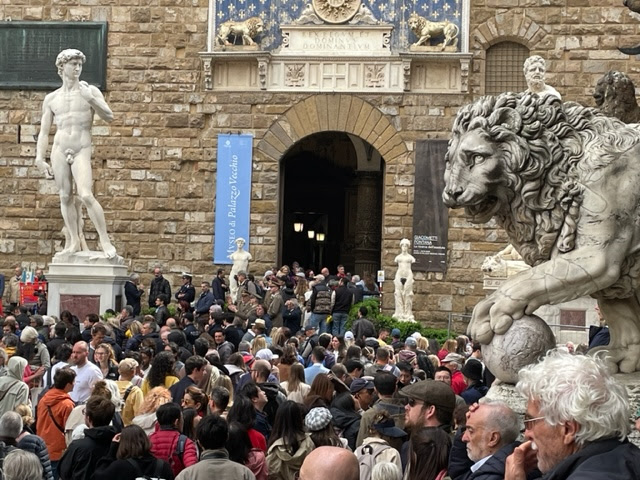
The statue of David is not Michelangelo's but a replica.
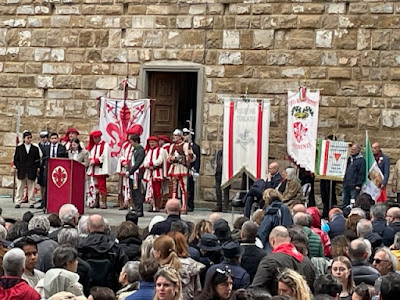
THE NEXT EVENT took place from eleven till noon in the square near the Uffizi. When I arrived there were as many as a thousand people assembled. Again Mayor Nardella gave a long enthusiastic speech to this larger crowd. He ended by saying, "Through this fight for freedom, with help from the United States, totalitarianism was pushed out of Italy.... today we have freedom and life."  (Huge huge applause.)

Next, a woman was introduced who began by saying "I love you" and then telling the "fundamental story" of liberation.

The third and fourth speakers gave short talks, then historian Aldo Cazzullo was introduced. 

"We're part of a tradition that includes Michelangelo, Dante..."  He mentioned Nietzsche coming here from Germany and other people and events of special significance to Italy. At the end of his talk there was another big applause.

A woman was then introduced who is a "scriba"... who shared a poem. This was followed by another woman who spoke of the fight against Mussolini and fascism. "We must confront it with confidence." 

At noon all the church bells rang.

* * * 

An Italian woman who spoke English told me, "I brought my son here so he is aware. We speak about fascism and the new government and what's changing and the dangers. Change comes slowly.

"My father lived here. We live in Milan. I'm here with my son to see grandparents. This (day in history) is a very important memory. Memory is very important so that we do not live it again. War is terrible."

One of the current issues in the news in Italy is a revelation that the current Prime Minister Giorgia Meloni has a fascist-leaning past. "We are all worried about it," the young woman said. "Italians were the first to experience directly the consequences of fascism."

* * *  


Learn more about the war in Italy from the point of view 
of a soldier who was there. Visit And There Shall Be Wars


Popular Posts