Showing posts with label United States. Show all posts

Saturday, May 6, 2023

Liberation Day: Italy Celebrates Victory Over Fascism, With Expressions of Gratitude to the U.S.

Mayor Nardella (right) prepares to lay wreath to honor
Americans who helped liberate Italy from fascism.
On April 25 I had considered making a day trip to Pisa. But then I learned that it was Liberation Day and that there were special events taking place that day in Florence. In Italy, this is a major holiday as the celebrate their nation's liberation from fascism and America's role in this momentous event.

Mussolini came to power in 1922 and remained dictator till deposed in 1943 during the Allied invasion in World War II. In 1945, when he was executed and hung upside down in Milan, my father-in-law was a soldier stationed less than a mile away. He could have gone to see it, but said he had seen more than enough death and violence during the war.

Here's an overview of what I saw, heard and thought on this most interesting day in Florence.


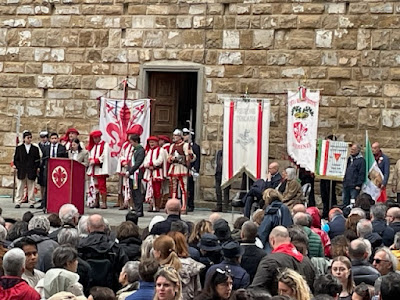
If you knew where to look you could find a schedule of events online. The first event was about to take place less than three blocks from my AirBnB at a monument by the train station. When I arrived there was a marching band playing John Philip Sousa music. There were also members of what looked like the Florence Royal Guard. Numerous dignitaries were present to watch the Mayor Dario Nardella of Florence lay a wreath at the foot of this monument honoring the Americans who gave their all to liberate Italy.

(L to R) Rodolfo, Jacob, Marco and Albert. 
There were a number of men dressed in the outfits of the Italy's Mountain Troopers, an underground resistance army that fought in the mountains of Northern Italy.

The men here were too young to have fought in the war but clearly had a kinship with those who so served, wearing the hats of the mountain troopers. They recommended that I see the film Bella Ciao.

At the end of the ceremony the band played taps, with an "amen" at the end.

* * * 

Here are photos from the first ceremony near the train station:


* * * 

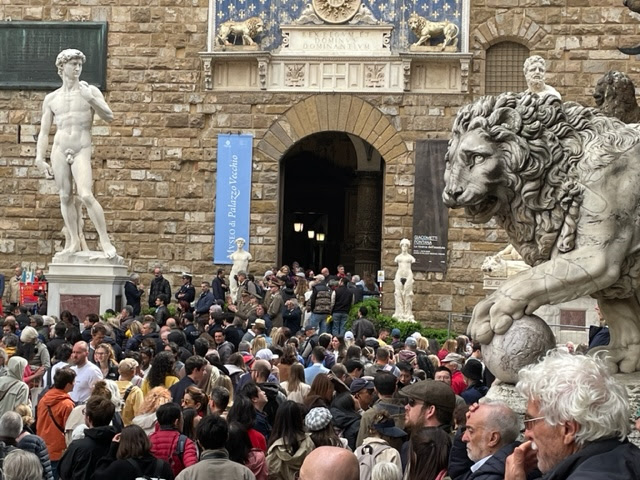
The statue of David is not Michelangelo's but a replica.
THE NEXT EVENT took place from eleven till noon in the square near the Uffizi. When I arrived there were as many as a thousand people assembled. Again Mayor Nardella gave a long enthusiastic speech to this larger crowd. He ended by saying, "Through this fight for freedom, with help from the United States, totalitarianism was pushed out of Italy.... today we have freedom and life."  (Huge huge applause.)

Next, a woman was introduced who began by saying "I love you" and then telling the "fundamental story" of liberation.

The third and fourth speakers gave short talks, then historian Aldo Cazzullo was introduced. 

"We're part of a tradition that includes Michelangelo, Dante..."  He mentioned Nietzsche coming here from Germany and other people and events of special significance to Italy. At the end of his talk there was another big applause.

A woman was then introduced who is a "scriba"... who shared a poem. This was followed by another woman who spoke of the fight against Mussolini and fascism. "We must confront it with confidence." 

At noon all the church bells rang.

* * * 

An Italian woman who spoke English told me, "I brought my son here so he is aware. We speak about fascism and the new government and what's changing and the dangers. Change comes slowly.

"My father lived here. We live in Milan. I'm here with my son to see grandparents. This (day in history) is a very important memory. Memory is very important so that we do not live it again. War is terrible."

One of the current issues in the news in Italy is a revelation that the current Prime Minister Giorgia Meloni has a fascist-leaning past. "We are all worried about it," the young woman said. "Italians were the first to experience directly the consequences of fascism."

* * *  

Learn more about the war in Italy from the point of view 
of a soldier who was there. Visit And There Shall Be Wars


Sunday, March 7, 2021

Another Explanation as to Why the Founding Fathers Didn't Deal with the Slavery Issue

Many of us, if not most, have spent a lifetime cobbling together personal views on various issues from personal to global. Personal examples include: what do I want to do with my life? How do I want to spend my time this coming weekend? How am I going to come up with money to fix the car or get a new one? 

Then there are the wider issues. What should we be doing about illegal immigration? How much money should our government spend on space exploration? 

On most issues, most of us probably have an answer in our heads that satisfies us for the moment, or at least until the notion is seriously challenged, because most matters have pro and con arguments to support or oppose them. Is Democracy the best kind of government? Until a few summers ago this was a settled question for me. I am less sure than I used to be.

Was Abraham Lincoln our greatest president? Has the American Experiment run its course? Does the Bible teach that people should submit to the governing authorities or is the State the enemy?

I share the above by way of introduction to a new thought. Why didn't the Founding Fathers do a better job of dealing with the problem of slavery?

How would you answer that? Do you have some kind of pat answer that you've accepted as the reason slavery was permitted to continue alongside the pronouncement in the Declaration of Independence that "all men are created equal"?

Somehow, the answer that I'd accepted some time back was that the most important issue in breaking free from England was to have a unified opposition amongst the Colonies. That is, I believed the Northern colonial territories were willing to put off the slavery question till a later date in order to address the pressing issue of the moment: Breaking from from England.

A NEW EXPLANATION

Ben Franklin
I'm currently reading a book called American Creation: Triumphs and Tragedies in the Founding of the Republic, by Joseph J. Ellis. The subtitle pretty much spells out the author's intent here. Our history has been remarkable as regards its growth from backwoods colonialists to world power by just over 150 years, and dominant power by 200.

On the other hand, our track record with regard to this continent's native peoples, and with regard to the slavery issue, has been shamefully dreadful. (I think here, for example, of the black servicemen who defended our country in World War II, putting their lives on the line for freedom only to return to a Jim Crow South where they couldn't drink from "white" water fountains and had to sit in the back of the bus.)

How was England able to eliminate, without a Civil War, the institution of slavery in 1807? This seems remarkable to me. What took us so long?

Here's what Ellis explained. Keep in mind that a primary motivation for the Founding Fathers to break off from England was the odious experience of Centralized Power. As a result, when they wrote the Constitution, a primary aim was to restrict the powers of the Executive branch of government. 

Having thus set up a system where states had power to self-govern to the largest extent possible, it became increasingly problematic for the the Federal legislators and presidents to change the rules by which they governed. 

Abraham Lincoln's Emancipation Proclamation was noble, but did not have any teeth. If anything the Civil War's major achievement, apart from ending slavery, was to strengthen Federal power and transform the country into a single nation as opposed to being a collection of independent states.

Even so, the foundation of state independence still remains, as we've notably seen in the past year as governors respond in a variety of ways to the disruption of Covid-19.

Our past 100 years has seen a level of Federal consolidation unlike anything anticipated by the Founders. I'd be curious how they would have felt about the increasing quantity of legislation set in motion by Executive Orders in the last 20 years. 

All that aside, I look forward to reading Joseph Ellis' interpretation of this significant saga, the founding of our Republic.

* * * 

Sunday, October 7, 2018

Killing Fields: New Book Proposes that the Cold War Wasn't Really Cold, It Was Just Different

This past ten days I've been reading Paul Thomas Chamberlin's The Cold War's Killing Fields: Rethinking the Long Peace. Chamberlin attempts to connect the dots regarding what was happening in the world during the cold war for the purpose of seeing it as it actually was rather than as mediated to us through the media. The book has been meticulously researched and for myself has been exceedingly compelling.

One reason Chamberlin wrote the book is because most of us have received our history by means of mediators who put a spin on events that, in our case, favors an American perspective. For example, when the My Lai massacre came to light it was treated as a shocking anomaly in the Cold War. What Chamberlin points out is that from the end of World War Two till the end of the Cold War, the casualties to civilians who were not involved militarily would have been equivalent to a My Lai EVERY DAY from 1945 thru 1990, many of these directly by American aggression or American armaments.* In other words, though there was no official world war, it was never a time of peace.

The audiobook I've been listening to is read aloud by Grover Gardner. It's always a pleasure to begin an audiobook where I discover that Gardner is the reader. In this case, there was no mention on the cover, though I eventually learned that his name appears on each disc of this Harper Collins Audio.

The book itself is filled with so many fresh insights about this period of history that I've now ordered a copy in print so I can review sections of the narrative. Everything is documented, sadly.

KIRKUS REVIEW summarizes the book in this manner: The traditional historical narrative of the Cold War is that it was a bipolar conflict between the United States and the Soviet Union during which proxy conflicts occasionally flared, and in which tensions were at times almost unimaginably fraught, but where the two antagonists avoided a hot war. However, as Chamberlin (History/Columbia Univ.; The Global Offensive: The United States, the Palestine Liberation Organization, and the Making of the Post–Cold War Order, 2012) shows in this ambitious, important book, while the two nuclear powers never engaged in a shooting war, the era from 1945 to 1990 was hardly the “Long Peace” of legend. The author explores a vast swath of geographical territory and shows how, at the time, these “bloodlands” were engulfed in myriad devastating conflicts, sometimes as Cold War proxies but often as combatants in internecine struggles tied into Cold War politics but not always bound to the major powers. The result was some 14 million deaths, the majority of which were civilians; for them, the war was anything but cold.

* * * *
An Amazon.com read wrote this review:
The conventional wisdom has always held that the Cold War was an era of uneasy peace because the United States and Soviet Union had their nuclear weapons pointed at each other and the threat of mutually assured destruction largely prevented the two countries from engaging in combat.

Paul Thomas Chamberlin in The Cold War's Killing Fields: Rethinking the Long Peace throws the conventional wisdom on its head. The Cold War was actually a bloodbath, but only for peoples throughout the developing world who were involved in wars seeking independence and freedom from colonial control. And sadly for most people in the US and Soviet Union these conflicts had an out-of-sight out-of-mind feeling, with notable exceptions.

Chamberlin’s work takes the listener from Korea, Vietnam, Indonesia, Afghanistan, Iraq, and Iran among others to illustrate that the proxy warfare brought on by Cold War strategic calculations actually led to hundreds of thousands of deaths among native populations and gave rise to a new breed of Islamic conflict that the world is still fighting today. 

* * * *
I began writing this blog post after having read the first years after WW2 up through the Korean War. It's scary to think that even with such a marginal conflict there were discussions in Washington regarding the use of an atomic bomb. Instead of seeing conflicts within countries as internal struggles for power after the eviction of Colonialists, the American interpretation always escalated matters into a global good guys and bad guys struggle between us and them (meaning the Communists.)

When the American forces landed in Korea, they brought an American arrogance that led them to believe this was going to be a quick operation like mopping up a kitchen floor. When we pushed them back to the 38th Parallel, Chamberlin shows how this arrogance had a near devastating outcome. Chamberlin states that the North Koreans retreated purposely, making the American army believe North Korean forces were weak, thereby stirring up American arrogance another notch, which was already excessive, and turning our soldiers into sitting ducks spread out and far from where they were supposed to be.

* * * *
TODA\Y I'm two-thirds through the audiobook and awaiting my own print copy so I can cite some of the shocking statistics from this under-reported recent history. At this point Nixon and Kissinger are debating how to withdraw from Vietnam. Both know we lost, but Nixon wants to leave South Vietnam in a manner that looks like we have handed power over to the South Vietnamese so when Hanoi overruns the South, America didn't lose, but rather the South Vietnamese, whom we armed and trained, were the ones who blew it. Such stupidity and posturing is the whole game in Washington, and so transparent. And clueless leaders wonder why the general public has lost respect.

It's unbelievable how much suffering has been caused, in every corner of the world, by the weapons American arms-makers have produced. The massive quantities of bombs we've dropped (or that our "friends" have dropped) makes Guernica look like a raindrop. American bombs have produced more devastation in more places than most of us were really aware of. When we think of the wars we've been in, we only think about American casualties. Yes, we're losing fewer troops these days, but we're still blowing up multitudes of innocents.

I'm not suggesting that we are the only bad guys. Mao's "Great Leap Forward" was a costly tragedy. And the Pol Pot's Cambodian experiment, a greater stupidity still.

If you're my age consider this: These things have happened in our lifetimes. Why didn't we weep? Partly because we were left in the dark.

The book is important because, as the saying goes, if we don't know our history we're bound to repeat it. Paul Chamberlin's book makes an important contribution to our understanding.

* * * *

* Our Republic of Korea (South Korea) allies slaughtered innumerable quantities of peoples with "Communist" sentiments. After shooting hundreds of villagers on one occasion, the South Korean army said, "O.K. if you are not dead you can stand up and go home." Then they shot all these as well. The author cites another example of U.S. soldiers rounding up unarmed villagers and gathering them into a mass of 400 or so beneath a bridge, then taking turns firing machine guns into the crowd until there were none left alive. In all, Chamberlin states that there were more than 1200 instances of mass killings of civilians by U.S. and South Korea troops in the Korean War.

** NSC 68. United States Objectives and Programs for National Security, better known as NSC 68, was a 66-page top secret National Security Council (NSC) policy paper drafted by the Department of State and Department of Defense and presented to President Harry S. Truman on 7 April 1950. It was one of the most important American policy statements of the Cold War. In the words of scholar Ernest R. May, NSC 68 "provided the blueprint for the militarization of the Cold War from 1950 to the collapse of the Soviet Union at the beginning of the 1990s." NSC 68 and its subsequent amplifications advocated a large expansion in the military budget of the United States, the development of a hydrogen bomb, and increased military aid to allies of the United States. It made the rollback of global Communist expansion a high priority. NSC 68 rejected the alternative policies of friendly détente and containment of the Soviet Union.

While NSC 68 did not make any specific recommendations regarding the proposed increase in defense expenditures, the Truman Administration almost tripled defense spending as a percentage of the gross domestic product between 1950 and 1953 (from 5 to 14.2 percent).
source: https://en.wikipedia.org/wiki/NSC_68

Wednesday, December 31, 2008

How Will It End?

The Truman Show, starring Jim Carrey as Truman, is a wonderfully original film about a man whose whole life, unbeknownst to him, has been lived in front of TV cameras. His life is a TV show. The story becomes a vehicle for many insights and questions about our own lives, the roles we play, our level of awareness as regards what is really going on outside our own little world.

One of the themes in the film is a pin Truman is wearing. "When Will It End?"

Despite the comic story line, amplified by Carrey's naturally inventive style, the film is serious in tone. And this question is not simply for Truman's audience, but for each of us as well.

We're all familiar with sayings like "it came to pass," with which we comfort ourselves during hard times or a cold spell. Nothing lasts forever, we say. Yet when we say this, we seldom apply this across the board. We generally live as if we ourselves are not going anywhere any time soon. And by extension, few of us can imagine a future in which the United States is no longer the United States.

So when we read books and articles about the fall of the Roman Empire, designed to teach us lessons about how nations and empires fall, how is it that we do not, almost cannot, relate it to our own nation, which is currently the world's strongest superpower?

Last Saturday I wrote about bread and circuses. Someone responded Monday by sharing an article with me from the Wall Street Journal that day regarding a prediction that the U.S. will be history by 2010. According to Andrew Osborn, a certain Igor Panarin has predicted for more than a decade that the U.S. will break up in a civil war due to economic and moral collapse.

This is no lightweight academic. Panarin is a former KGB analyst who is head of the Russian Foreign Ministry's academy for future diplomats. The factors that will bring us down include "mass immigration, economic decline, and moral degradation"... along with collapse of the dollar. His new portrait of our United States will be a breakup into six pieces, Alaska ultimately returning to Russian control.

The story sounds far fetched, but stranger things have happened. No one expected the USSR to unravel as quickly as it did when the Soviet empire began to implode. Would the Wall Street Journal print something like this if it were the rantings of a lunatic? The friend who forwarded this to me found it on The Drudge Report.

There was a time when Britain basked in the glow of knowing that the sun never set on the British Empire. How long can the United States be so blissfully oblivious to the reality that all things must pass?

Which leads directly to my question. How will it end? Nothing lasts forever. We know that. So, what next? The evidence that America is in decline is all around. Predictions of decline have been heralded for some time. How serious is our sickness? Will the patient recover?

Is this all too far out? You tell me... because an inquiring mind wants to know.

Saturday, August 2, 2008

Report from Germany

We hear all the time how good life is in this country, but many Americans have nothing to benchmark it against. It is usually our only experience.

Frequently, we hear about the low cost of health care in Sweden of France and the damage being done to our uninsured and underinsured here. Some people get incensed as if it's un-American to say some things might be better elsewhere. Naturally, we don't always know whose reports are reliable or what things are being reported with an agenda.

For this reason I thought my friend's observations below were insightful and worth sharing. He had lived in Germany for a number of years. Came to the States in 2007 and was surprised how bad our roads were as well as our houses. I asked him in an email to elaborate on some of the differences between life in these United States and life in Germany. I share this exchange below.

Dear S.
Thanks again for visiting Friday eve. I found your comments on the inferior quality of American roads and run-down-ness here to be interesting. I was wondering if you could go into more detail on that sometime. What was it like in Germany? Susie asked me a few questions that I failed to ask and didn't know re: the politics, the education system etc.
The very best to you and yours,
ed


Hi Ed and Susie,
This is a long-delayed response to your email, and I’ll try to answer some of the questions.

I think Germany has three things going for it. First, it is basically a homogenous culture, where most of the people think and act pretty much the same. So they can pass laws that actually represent the will of the people, and they are all willing to obey them. Second, they are Germans, and that means that their culture values things like quality, longevity, and promptness. So things tend to get done right the first time, and they are not afraid to pay a bit extra to get the best. Third, they are letting the U.S. spend its resources to be the leader of the developed world. They give a token amount to various good causes, but mostly they use their economic growth to benefit themselves. We spend an inordinate amount outside of our own country, particularly at this time.

If we had these three things going for us, we would be the leader of the world in deed, not just in word. However, our culture is hardly homogenous, and therefore we can hardly pass any laws that the majority of the people respect. We value what is inexpensive and transitory, and most everything around us shows it – houses, cars, clothing, body fitness, entertainment. And of course, we are spending billions in foreign countries that other countries are not.

The German school system separates children into two tracks at about 4th grade – one track into the trades and one track into the professions. I am not sure I like that, but one benefit of it is that the universities are not cluttered with people who have no business being there. And the blue collar workers are paid enough and given enough respect that they are happy with their lot and not always jealous of the "rich."

The politics of Germany is basically all the planks of the Democratic party platform taken for granted. There are no arguments about things like abortion, the environment, gay rights, etc. The society accepts all these "hot button" issues as already settled and not worth discussing. Our culture is still wrestling with these ethical issues, and there are many more Bible-believing people here than there.

Even the Bible-believing Christians in Germany are more liberal socially than we are here though. I might see that as a sign of maturity that comes from having a culture with ancient roots, or it might be a sign of a post-Christian society that is only going downhill morally. Both might be right.

Take care and God bless you and yours.
S.

P.S. I looked at your blog and it is very interesting. I added it to my "favorites" list and will explore it further!

Popular Posts