Showing posts with label Uffizi. Show all posts

Tuesday, June 13, 2023

Unveiling the Goddess: Exploring Warhol's Fascination with Botticelli's Birth of Venus

Botticelli's The Birth of Venus, approx. 68" x 109"
It was while visiting Pittsburg's Warhol Museum in April 2019 that I became aware of Andy Warhol's fascination with Sandro Botticelli's, The Birth of Venus. In the 1980s Warhol created a series of silkscreens based on the painting, many of which were featured in a room on one of the museum's upper floors. Warhol was no doubt drawn to the painting's beauty and its iconic status. He also saw it as a metaphor for the rise of celebrity culture.

Having now stood before this painting at the Uffizi in Florence this spring, I suspect that there were several reasons The Birth of Venus appealed to Warhol. First might be Botticelli's use of color. Where many, if not most, of the Renaissance paintings were saturated with color, The Birth of Venus struck me as surprisingly muted, more pastel, while simultaneously vibrant. As it turns out, whereas much of the art of that period was painted with oils, this painting was painted with tempera paints. (Tempera, also known as egg tempera, is a permanent, fast-drying painting medium consisting of colored pigments mixed with a water-soluble binder medium.)


The Birth of Venus (detail)

The scale of the painting is impressive, no doubt contributing to its iconic status. Warhol may have been fascinated by its fame, which has transcended time, and its ability to capture the imagination of people around the world.


Did Andy Warhol see The Birth of Venus as a metaphor for the birth of celebrity culture? It's well-known that Warhol saw celebrities as the modern day equivalent of gods and goddesses. 


Warhol's silkscreens of The Birth of Venus are among
his most famous works.

Warhol's silkscreens of The Birth of Venus are some of his most famous works. 

Warhol may have also been drawn to The Birth of Venus because of its connection to the past. Botticelli was a master of the Early Renaissance, and his work was inspired by classical antiquity. Warhol was fascinated by the past, and he often used historical imagery in his work. The Birth of Venus may have also appealed to Warhol because it was a reminder of a time when art was more focused on beauty and less focused on commerce.


For those unfamiliar, Venus, the Roman equivalent of the Greek goddess Aphrodite, played a role--according to Virgil's The Aeneid--in the founding of Rome in Italy. 


Botticelli's The Birth of Venus depicts the mythological goddess Venus emerging from the sea, born of the foam created by the severed genitals of Uranus, the sky god. This myth is a powerful image of the power of love and beauty, and it has been interpreted in many different ways over the centuries. It was commissioned by Lorenzo de' Medici, the ruler of Florence during the Renaissance. It embodies the Medici family's interest in classical antiquity and their patronage of the arts. The painting also reflects the Renaissance's interest in beauty and its celebration of the human body.

When I look at the eyes of Warhol's Venus, her left eye seems to be looking back at the viewer. When I look at the eyes of Botticelli's Venus, her expression appears more forlorn. Part of the fame of this Venus is her modesty. You can see it in her posture, covering her private parts with her hands, and you see it in her face. Perhaps it is this attitude of innocence that contributes to her power.

Related Links

Backstory on Aphrodite and the Trojan War
The Andy Warhol Museum: Reflections of the American Soul

Saturday, May 6, 2023

Liberation Day: Italy Celebrates Victory Over Fascism, With Expressions of Gratitude to the U.S.

Mayor Nardella (right) prepares to lay wreath to honor
Americans who helped liberate Italy from fascism.
On April 25 I had considered making a day trip to Pisa. But then I learned that it was Liberation Day and that there were special events taking place that day in Florence. In Italy, this is a major holiday as the celebrate their nation's liberation from fascism and America's role in this momentous event.

Mussolini came to power in 1922 and remained dictator till deposed in 1943 during the Allied invasion in World War II. In 1945, when he was executed and hung upside down in Milan, my father-in-law was a soldier stationed less than a mile away. He could have gone to see it, but said he had seen more than enough death and violence during the war.

Here's an overview of what I saw, heard and thought on this most interesting day in Florence.


If you knew where to look you could find a schedule of events online. The first event was about to take place less than three blocks from my AirBnB at a monument by the train station. When I arrived there was a marching band playing John Philip Sousa music. There were also members of what looked like the Florence Royal Guard. Numerous dignitaries were present to watch the Mayor Dario Nardella of Florence lay a wreath at the foot of this monument honoring the Americans who gave their all to liberate Italy.

(L to R) Rodolfo, Jacob, Marco and Albert. 
There were a number of men dressed in the outfits of the Italy's Mountain Troopers, an underground resistance army that fought in the mountains of Northern Italy.

The men here were too young to have fought in the war but clearly had a kinship with those who so served, wearing the hats of the mountain troopers. They recommended that I see the film Bella Ciao.

At the end of the ceremony the band played taps, with an "amen" at the end.

* * * 

Here are photos from the first ceremony near the train station:


* * * 

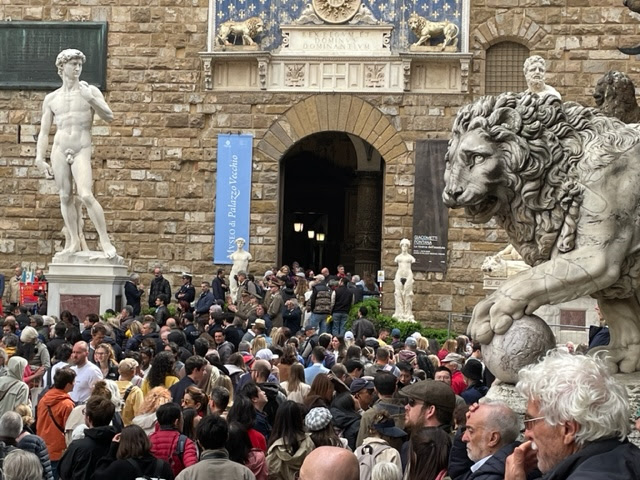
The statue of David is not Michelangelo's but a replica.
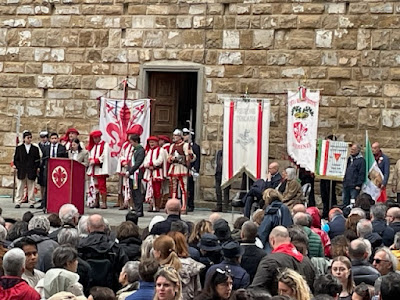
THE NEXT EVENT took place from eleven till noon in the square near the Uffizi. When I arrived there were as many as a thousand people assembled. Again Mayor Nardella gave a long enthusiastic speech to this larger crowd. He ended by saying, "Through this fight for freedom, with help from the United States, totalitarianism was pushed out of Italy.... today we have freedom and life."  (Huge huge applause.)

Next, a woman was introduced who began by saying "I love you" and then telling the "fundamental story" of liberation.

The third and fourth speakers gave short talks, then historian Aldo Cazzullo was introduced. 

"We're part of a tradition that includes Michelangelo, Dante..."  He mentioned Nietzsche coming here from Germany and other people and events of special significance to Italy. At the end of his talk there was another big applause.

A woman was then introduced who is a "scriba"... who shared a poem. This was followed by another woman who spoke of the fight against Mussolini and fascism. "We must confront it with confidence." 

At noon all the church bells rang.

* * * 

An Italian woman who spoke English told me, "I brought my son here so he is aware. We speak about fascism and the new government and what's changing and the dangers. Change comes slowly.

"My father lived here. We live in Milan. I'm here with my son to see grandparents. This (day in history) is a very important memory. Memory is very important so that we do not live it again. War is terrible."

One of the current issues in the news in Italy is a revelation that the current Prime Minister Giorgia Meloni has a fascist-leaning past. "We are all worried about it," the young woman said. "Italians were the first to experience directly the consequences of fascism."

* * *  


Learn more about the war in Italy from the point of view 
of a soldier who was there. Visit And There Shall Be Wars


Popular Posts