Showing posts with label Doom. Show all posts

Tuesday, May 27, 2025

The Four Grand Transitions That Created the World We Live In Today

I've always admired people who have the ability to take complex issues and make them simple to understand. This is doubly enjoyable/useful when people with a comprehensive grasp of history do the hard work of identifying events or trends and assembling them in a manner that creates new insights that any average Joe or Josephine can grasp. 

One such thinker who specializes in this sort of thing is Vaclav Smil, a Czech-Canadian scientist, policy analyst and Distinguished Professor Emeritus in the Faculty of Environment at the University of Manitoba in Winnipeg, Canada. I myself became aware of him because of his reputation as one of the world's leading experts on the history of energy.


In 2021 Smil wrote a book titled Grand Transitions: How the Modern World Was Made. In it, he examines the transitions that structure our modern word. What made the modern world work? For Smil, it all boils down to four "grand transitions" of civilizations: (1) population, (2) agriculture, (3) energy and (4) economics. The cumulative effect of these transitions has transformed the way we live. 


When a society goes through all four of the major changes—like improvements in health, farming, energy, and the economy—it ends up in a very different place: people live longer, there's plenty of food (and a lot gets wasted), energy use goes way up, and there are more job and business opportunities. But not everyone in the world has caught up—hundreds of millions of people still live without many of these advances. 


Vaclav Smil looks at how all these big changes connect. He says it's more important than ever to share the good stuff of modern life, especially with the growing gap between rich and poor. But doing that while also trying to protect the planet is a tough balancing act. The next big challenge—what he calls the fifth transition—is dealing with climate change, shrinking resources, and disappearing wildlife. Whether we succeed at this will decide if all the progress we've made actually lasts.


* * * 

When I read the Four Transitions cited by Smil, it brought to mind Niall Ferguson's fire alarm Why Civilizations Fail. Ferguson in his book cites four things that together produced the rise of Western Civilization. They were:
1. Democracy -- the consent of the governed.
2. Capitalism -- and the vibrant society healthy markets produce.
3. Rule of law -- secure property rights, fairness and (in theory) equality.
4. Civil society -- how we treat one another.


The lists differ, but both author express a serious concern about the cracks in our foundations today, and more importantly, the ever widening gap between haves and have nots. 


There are plenty of reasons to be concerned about the direction things are going.  What do you think?


Related Links

Why Civilizations Fail: Niall Ferguson Sounds A Wake-Up Call
Grand Transitions: How the modern world was made

Niall Ferguson on the Breakdown of the Rule of Law


Tuesday, May 21, 2024

Apocalyptic Themes in the Music of Bob Dylan: Can This Really Be the End?

It's been frequently noted how the arc of Mark Twain's life coincided with the appearance and re-appearance of Haley's comet. One might similarly argue that the arc of Bob Dylan's career has coincided with periods of cultural upheaval that gave birth to apocalyptic fears and doomsaying. Both the tempestuous Sixties and our current cultural  unheavals have generated books, articles and (now) podcasts forecasting the end of the world. (Examples include Hal Lindsay's The Late Great Planet Earth, Billy Graham's Four Horsemen of the Apocalypse, Kurt Vonnegut's Cat's Cradle and Nevil Shute's On the Beach.) As we look around today the theme of doom has had a major resurgence, for better or worse. 

It's well known that from the beginning of his career Bob Dylan's music has often touched on apocalyptic themes. The Cold War weighed heavily on our hearts and in our thoughts. I remember practicing air raid drills in school and many Americans (including relatives of mine in Cleveland) stockpiled food and water in fallout shelters. 


Original lyrics to "Go Away Bomb." Bill Pagel Archives.
So it's no surprise that young Bob Dylan produce songs dealing with societal upheavals and the search for meaning in turbulent times. One such song, which he penned shortly after his arrival in New York, was "Go Away Bomb," which he wrote for Izzy Young of the Folklore Center.

Here are some other noteworthy examples:


"A Hard Rain's A-Gonna Fall": Released in 1963, this song is filled with vivid imagery of impending catastrophe. Purportedly written during the Cuban missile crisis, the song reflects more than just the anxiety of the Cold War era, it also paints a bleak picture of a world on the brink of destruction, with references to natural disasters, political turmoil, and moral decay.


"All Along the Watchtower": This song, which first appeared on John Wesley Harding, features apocalyptic imagery inspired by the Book of Isaiah. Dylan's lyrics evoke a sense of foreboding and uncertainty, with references to "two riders approaching" and "the wind began to howl," symbolizing an impending reckoning. The opening line sets the tone though.  "There must be some way out of here," said the joker to the thief. 


"The Times They Are A-Changin'": Released in 1964, this iconic anthem captures the spirit of social upheaval and transformation. While not explicitly apocalyptic, the song reflects a sense of impending change and the need to adapt to shifting realities. Dylan's lyrics convey a message of hope and resilience in the face of uncertainty.

[This hasn't been the only song in which Dylan shakes the tree and contemplates coming changes. See Dylan and Fifty Years of Change: Six Songs About Transitions.]


"Ain't Talkin'": From his 2006 album Modern Times, this song features apocalyptic imagery reminiscent of biblical prophecy. Dylan's lyrics paint a haunting portrait of a world in decline, "walking through the cities of the plague" and just walkin' "in the last outpost, at the world's end." Dylan's ominous tone reflects a sense of impending doom and existential dread. Then again, there are a lot of songs in which he opts for that ominous tone, (e.g. "Not Dark Yet")


Today, we seem to be confronting more threats than a Hydra, a mythological swamp serpent creature that would grow two new heads for each one that was severed. Wars, bombs, plagues, corrupt leaders, injustice, climate change, the tenuous energy grid... and a host of other threats seem to hover over us. 


In 1776 Thomas Paine wrote, "These are the times that try men's souls." There is a sense of peril in those words. The Great Depression produced a similarly ominous national mood, as did the Cold War--which in the Sixties was exacerbated by assassinations, riots in the streets, burning cities and and unnecessary war. 


In light of all this history, "Can this really be the end?"


* * *

Related Link: Are You Protopian, Utopian or Dystopian?


Tonight is the kickoff for Duluth Dylan Fest. If you're in the 'hood and want to be part of some of the events, visit https://duluthdylanfest.com/duluth-dylan-fest-2024/

Thursday, April 11, 2024

Economic Climate Change: There's a Train Wreck A-Comin'

Economics historian Niall Ferguson, while talking about his book Doom a few years ago, noted that the U.S. was in serious trouble because its politicians perpetually avoid doing anything that was unpopular. To be specific, he was referring to raising taxes. Our national debt can not keep increasing like it has. And yet nowhere do I see protests about this fiscal irresponsibility.

This notion came mind during this year's State of the Union address in which the president vowed that he would not raise taxes on anyone making less than $400,000 a year.

President Biden's declaration, when juxtaposed against the facts, shows how out of touch Americans are with regard to our nation's financial situation. The reality is that taxes will have to be raised for all of us because the government refuses to cap spending. Year after year our legislators raise the debt ceiling, sometimes even more than once a year. The government perpetually spends more than taxpayers are paying. 

Every time the government needs more money, they squawk about the need to raise the debt ceiling. And voila! The debt ceiling is raised so we can keep the government running and maintain the illusion that all is well. As of February 2024, the U.S. national debt was $34.37 trillion.

You would think that with the national debt being so massive our government leaders would be discussing a responsible plan for reducing this economic noose, but no. The forecast going forward is continuous bloat. Or rather, an ever deeper hole. In ten years the federal debt is projected to be a mind-boggling $54 trillion.

Individuals who get in a bind because they've maxed out their credit cards can end up in the untenable situation where all the money they make is used to pay off the interest on their debt, while never having hope of getting free. 

Eventually our nation will be in that same scenario. At some point in time the entire U.S. economy will be devoted to making interest payments on the debt, a debt which will never decrease. There will be no money left to fix failing infrastructure and at some point no money left to keep the lights on.  

This is not to suggest that Republicans will do what's necessary if they regain the reins of power. Neither party seems to have the stomach for doing what is needful. This is the Achilles heel of democracy. Politicians pander to please an uninformed public. As a result, everyone has their hand out for their share of government largesse. And neither party has the courage to be forthright or honest about the consequences.

*

To reiterate, President Biden affirmed his commitment to not raise taxes for families making less than $400 thousand. What strikes me about the $400,000 number is that the president acts as if people making less than that amount are living in poverty. Some day, when electric grid goes down and our economy collapses, we'll find out first hand what poverty really feels like.

* * * 

Originally published on the Op-Ed page of the Duluth News Tribune, March 2024.

Tuesday, October 3, 2023

Scrooge's Question for Our Times: Hope or Doom?

For my family it has been a Christmas eve tradition to watch the George C. Scott version of Charles Dickens’ timeless “A Christmas Carol” each year. Over the course of three decades we’ve probably memorized all the scenes and half the lines, yet we still enjoy it as both entertainment and soul food.

It’s a strange story about an old miserly man, Ebeneezer Scrooge, who is visited by three ghosts. The first ghost shows him key moments from his past. The second, the Ghost of Christmas Present, gives him a tour of events taking place at this very moment in time.

Then, near the climax of the film, Scrooge is led to a snow-covered grave slab by the Ghost of Christmas Yet to Come whereupon he cries out, “Spirit, are these the shadows of the things that Will be, or are they shadows of the things that May be, only?” 

At its core, this statement addresses the distinction between fate and free will. Scrooge is inquiring whether the scenes he is witnessing, depicting a bleak and desolate future, are preordained and immutable or if they represent possibilities that can be altered through choices and actions. This inquiry has profound personal and societal implications.

On a personal level, Scrooge’s question prompts us to reflect on the choices we make and the potential for change in our own lives. It reminds us that our destinies are not set in stone but are shaped by our decisions and choices. Just as Scrooge had the agency to transform from a miserly, cold-hearted figure to a generous, compassionate one, so do we ourselves possess the power to redirect our own futures through acts of kindness, empathy, and selflessness.

I thought of these things today, in part, because of my concern about the future for our country. I see the disruption, the brokenness, the polarization, the lawlessness, the cruelty, the failures of our institutions and fear that I am watching a slow motion train wreck. Are we standing on the precipice of a national collapse?

I ask myself, “Are these current events the shadows of things that Will be, or are they only shadows of the things that May be?” 

It’s a call for reflection as the answer to this question will be determined by our collective choices. Let’s not be swept away by hysteria and hate. Mercy, humility and wisdom are the values we need to embrace. 

Are we witnessing a national train wreck? The future is in our hands.

Sunday, August 20, 2023

Two Things I've Heard All My Life That Don't Make Sense

Even though we're closer to Armageddon than we were 50 years ago, somehow it seemed like the real "Armageddon Fever" took place a half century ago. Maybe it was Hal Lindsey's 1970 bestseller The Late Great Planet Earth that stimulated the subsequent firestorm of pop-Apocalyptic lit. Or maybe it was simply the turbulence of the times--assassinations, Viet Nam, cities burning--that spawned the belief that humanity was doomed.

While Christians were reading about the end of the world and looking for their Lord's return, secular readers were engaged with books like Paul Ehrlich's The Population Bomb and doomsaying by groups like the Club of Rome. And let's not forget the angst generated by the somewhat intangible, though ever present, threat of nuclear holocaust as presented in books like On the Beach and Pat Frank's Alas, Babylon.

From those times to the present I've observed a few statements by pundits that never seem to go away. They may lay dormant for a season or two, but pretty soon they are being recycled again.

The first: In 10 years we will be out of oil.
This declaration was always accompanied by hand wringing about oil running out and the need to cut our dependence on oil. The latter is noble, though when I was young the statement emphasized cutting our dependence on foreign oil. There is so much oil under U.S. soil that you can't even imagine it. For some reason this off limits and that is off limit and those folks should be permitted to use their oil rigs and that pipeline has to be shut.... Bottom Line: It's empty rhetoric.

The real moral of this story is: Repeating silly pronouncements with specific dates or numbers will diminish your credibility

The second: There are too many people to feed. The world can't sustain any more.
In 1960, the population of the world was 3 billion. By 1974 it had grown to 4 billion. As of this moment, August 2023, there are 8 billion people populating our planet. 

Paul Ehrlich's book predicted mass starvation of the global population by the end of the 70s. 

What I remember most is that despite the troubling rise in population, technology was also advancing to make production of food more efficient and human life sustainable.

Now here's what I don't understand. After decades of handwringing about not being able to feed the world population as it grows, these very same people are diverting food crops for ethanol. And they are eliminating cattle in the Netherlands because of flatulence. (Ireland and Canada are pushing 30% cuts as well.) And I just heard that even more cropland is being eliminated for solar panel farms.

What happened to the concern about hunger?

Photo by Jesse Gardner on Unsplash
Sometime around 20 to 25 years ago Popular Science magazine had a detailed breakdown of the costs and benefits of turning corn into ethanol for car fuel. By the time you grow the corn, harvest it, transport it, convert it, distribute it.... There has been absolutely no gain. It uses up as much energy to create ethanol as the net gain from using it. In short, it is a waste.

Here's something else they don't tell you. E-10 gasoline (E-10 means 10% ethanol) can cause damage to small engines if not handled properly. It's too technical for this blog post, but you can look into it. The problem is called "phase separation." 

So what does our Minnesota leadership do? They are now pushing the use of E-15 instead of E-10. Moving forward with ethanol is ridiculous. Lawmakers close their ears to the experts who point out the silliness here. First, ethanol can damage older engines because it is a solvent which can dissolve some of the plastics, metals and rubber components used in older engines. Second, it has a lower energy content than gasoline. The result is lower fuel economy, the exact opposite of the increasingly stringent fuel economy objectives pressed by the EPA through CAFE regs. Third, because ethanol evaporates more easily than gasoline, it can contribute to smog formation. So why is Governor Walz celebrating the increased use of E15?

Why are we decreasing food production to increase production of a form of fuel that is less efficient and creates more smog? Whatever happened to all that concern about not being able to feed the masses?

*

A couple stats about corn in Minnesota. According to the USDA, Minnesota farmers planted 8.5 million acres of corn in 2021. 31% of this corn crop was used for ethanol. That's slightly more than all the acres used for cities, towns and roads in Minnesota. 

*

It's time to take a walk.

Tuesday, September 6, 2022

Is the Old World Order on the Verge of Collapse?

How precarious is our future? Is the world really on the verge of economic collapse? What would a global economic collapse look like?

Here's a podcast that makes a case for the Doom scenario. At this moment in time most of us are living on faith, faith that the power grid will sustain us, that the banking systems will remain operational, that goods and services will continue as they have in the past. 

Peter Zeihan is a geopolitical analyst who spells out why the next 50 years will look very different than the last fifty years. 

Here's what makes the economy work: a mix or consumers, investors and workers. Because of the demographics shift taking place, all three are on the decline.  

This video is an hour long. If you listen to the first ten minutes you'll get some striking insights from a perspective you probably haven't thought that much about. 

The Old World Order Is About To Collapse - Peter Zeihan

Modern Wisdom Podcast 514

https://www.youtube.com/watch?v=wRT7P-VKM0k


* * * 

This is just a discussion starter.

Whatcha think?

Wednesday, July 27, 2022

The Death of Common Sense: How Law Is Suffocating America

Photo by The Good Funeral Guide on Unsplash
“We need a new idea of how to govern. The current system is broken. Law is supposed to be a framework for humans to make choices, not the replacement for free choice.”
--Philip K. Howard, The Death of Common Sense

Niall Ferguson, in his book The Great Degeneration, identifies the four pillars that lifted Western Civilization, which Ferguson calls The Four Black Boxes. They are:

1. Democracy -- the consent of the governed.

2. Capitalism -- and the vibrant society healthy markets produce.

3. Rule of law -- secure property rights, fairness and (in theory) equality.

4. Civil society -- how we treat one another.

Ferguson's book is a warning though. The 2010 volume is subtitled How Institutions Decay and Economies Die. In the book he shows how all of these platforms have become corrupted and are in the process of decay. It's not a pretty picture. 

I mention Ferguson's book in order to reference point 3, the importance of the rule of law. When I read Philip Howard's The Death of Common Sense: How Law Is Suffocating America in the 1990s, I immediately placed it on my Top Ten Recommended Readings list. It's apparent that regulations and red tape are both strangling our economy and stealing our joy. 

Here's a quick overview of the book.

The bloated bureaucracy; the rules; the laws; the regulations; are so integral to our lives that we no longer would recognize a life without these burdensome evils. We continue blindly with no discretion, a growing behemoth, with no end in sight; this was never meant to be. With the thousands upon thousands of pages of rules and regulations we believe we can remove all conceivable risks, contemplate every eventuality, plan for everything; all in the name of "rights", and fairness. What is meant for good, and to bring about harmony, only results in stagnation, closed businesses, higher prices, less choice, rise of litigation, etc. We all pay a price. Ingenuity pays a price. Ironically, "[t]he more precise we try to make law, the more loopholes are created." Mandated perfection only ends in the opposite, along with an incredible waste of money and manpower, not to mention it treats individuals as criminals. This expansion of law into agencies and programs was never meant to be. Three big culprits (though there are many) are OSHA, EPA, and the USDA.

For example, right now the U.S. is experiencing a housing crisis. Even though most community leaders are aware of it and are making pronouncements about fixing it, very few seem to recognize how deeply entrenched government regulation is contributing to the problem, almost always in the name of virtuous aims such as safety and fairness. Examples abound.

Here's another example. We complain about the high price of meds while failing to see the mind-boggling amount of paperwork required by the FDA to get a drug approved. I once read that the paperwork alone would fill a semi trailer. There has to be some kind of incentive for doing 10 years of research to get a product approved. (This is not a defense for the excesses of Big Pharma, but important for the sake of perspective.)

Ferguson, in his book, tells a story about how it took a little girl months to get a permit to set up a lemonade stand in New York City.

Here's more about Howard's book:

"The Death of Common Sense" consists of four long chapters, presented without an introduction or conclusion. They deal with (1) the impossibility of devising laws and regulations that will sensibly address every variation and permutation of a given problem without the need for human judgment; (2) the pitfalls of elevating legal process over objectives; (3) the destructive consequences of creating "rights" for more and more disadvantaged groups without much heed to the burdens imposed on the rest of the population; and (4) the author's proposed solution to the problems discussed, which is for all concerned to stop looking to the law as a source for "final answers."

Reviews from Amazon:

Totally Amazing and Scary!
The message is quite clear: our legal system is very sick, if not broken. The result is that no one wants to take responsibility for fear of being sued or inconvenienced. Plus, the definition of "rights" has been so badly distorted by legislation and court system that the social and actual costs to Americans is becoming intolerable. The direction we are all heading is only making the conditions worse. Something has to change, but how long are we willing to wait?

Frustrating In Its Accuracy
This book came highly recommended by an attorney friend. I have not finished reading yet because it is so frustrating in its accurate portrayal of government and its often illogical way of operating. Having worked in government, I do understand the need for rules and consistency, however the examples portrayed in this book so clearly display how so many rules exist for the sake of the rules themselves. The intent behind the rules are lost and the results often are more harmful than good. If only our government officials could take off their blinders and take to heart the messages from this book. This country would be in a far better place.

* * * * 

Something to think about.

If interested, you can find a copy of this book here on Amazon.

* * * *  

Monday, January 3, 2022

Niall Ferguson On Disasters and What We Can Learn from History

This past year I discovered the writings of Niall Ferguson, a Scottish historian and author of numerous insightful books about the growth and decay of civilizations and the challenges we have lived through and will face again tomorrow. Here are some notes from a YouTube video I listened to titled "Humanity must learn from its mistakes."

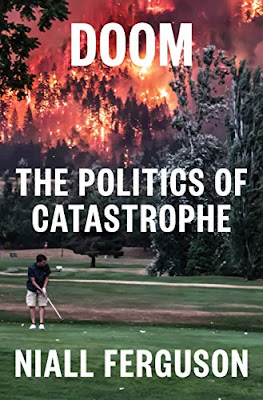
He had been invited to Budapest to discuss his most recent book, Doom: The Politics of CatastropheThe discussion took place in September 2021, which helps give context to the introductory portion about Covid-19. I will leave a link at the end of this page in the hopes that you will watch it in its entirety. 

* * *
Ferguson began by reminding us that from the start of this pandemic we have seen two narratives in operation. On the one hand there were those who said it was not a big deal, or maybe even a hoax. On the other hand we had those saying that the pandemic is as bad as the Spanish Flu and we must lock people in their homes or millions and millions will die. Some experts estimated that it would kill 2.2 million people in the U.S. alone.

By September last fall it was apparent that the Covid-19 impact lies somewhere between the extremes. How bad has it been? 

Clearly is has been as bad as the H2N2 SARS outbreak of 1957-58. But it has not been nearly as deadly at the Spanish Flu. According to Ferguson, the Spanish Flu of 1918-19 killed two percent of the population of the whole world. By way of contrast, the death toll for Covid-19 has been only 0.06 percent, less than one-tenth that of the Flu of a century ago.

* * * 
Ferguson states that even if we don't accept the lab leak theory for Covid-19, China is culpable because of its attempt to cover-up the disaster in its early stages.  The cover-up helped enable the spread.

The point he drives home, however, is that there will always be disasters and we can't predict when they will happen. We don't know when the next war or major earthquake will occur, but we do know they will come. It then becomes our responsibility to improve the ways we cope. 

The U.S. Health Department had a 36-page preparedness plan on hand in the event of a pandemic like this. It became useless in real life. Things don't unfold as anticipated. It only provided officials with a false sense of security. Why do these big government agencies fail?

The host of the program asked Niall Ferguson why he didn't wait till the pandemic was past before publishing this book. Then he could have had more information about how it was resolved.

Ferguson replied that he is 57 years old and Covid will be here for another century. There is plenty to be learned from the past with regards to disasters, and to be gleaned from the past 18 months that can be applied here and now. "Applied history really matters," he said. "We must learn from these disasters."

Niall Ferguson is a Senior Fellow at Stanford and Harvard. The 48 minute talk has many insights that are worth pondering.

* * * 
Related Links

Popular Posts