Showing posts with label Kindle. Show all posts

Monday, March 29, 2021

How Effective Is A Personal Website for Short Stories?

What follows is my answer to a question I was asked on Quora, the international crowdsourcing Q&A website. In 2018 I got the nod as a top writer on Quora, a website I enjoyed because I could help people by answering their questions, from silly to curious, earnest and serious, and everything in between. In 2019 I dropped off from being so active on Quora because I'd amped my participation on Medium, a platform that pays its writers whose work is being read and appreciated.

Q: How effective is a personal website for short stories?

Effective in what way?

When the internet was first emerging I created a website and shared poetry, art, journalism and short stories…. among other things. There were not a lot of websites in 1995–96 and I even got a badge from the St Paul Pioneer Press as a Top 5 Minnesota Websites of the Week.

One day I got contacted by a poetry website in Croatia. They asked permission to translate my story Duel of the Poets into Croatian as a centerpiece. (The story now appears in my book Unremembered Histories.)  A few months later a Russian website contacted me to translate another one of my stories into Russian.

Later, a French grad student was given the assignment to translate a story by an American writer into French and he selected my story Terrorists Preying. This was especially interesting because the word Preying is a Homonym for Praying and he had trouble trying to convey that in his translation.

Still later, I was contacted by a pair of young filmmakers for permission to make my story Episode on South Street into a short movie. I said I was honored and within the year it was on Vimeo.

I never made a penny, but felt honored and gratified that my work was appealing to readers. So I go back to the question “How effective in what way?” Keep in mind that the whole world is uploading content at dizzying speeds and your little batch of stories may never be seen at all if you don’t also find ways to let people know they are there. According to this website “There are 2.5 quintillion bytes of data created each day at our current pace, but that pace is only accelerating.”

In early 2011 I received some encouragement from someone I respected that my stories were worth sharing more widely and by the end of the year I published Unremembered Histories and two volumes for Kindle which, if I could do over again I would have done differently.

I think a website is useful for having all your work in one place. The downside is that most publications consider your work “published” if you do this, and you will have trouble selling it later.

I did it in order to share my work with readers. I disliked the whole game of sending things to publishers and waiting for rejection slips. But if you do decide to put your stories online, you can also repurpose them and share them on. Medium, which is a community fo writers.

As a  final aside I'll mention here that also used the website to share a few stories my children wrote. We were homeschooling for a while and in 2000 or 2001 I shared a long cowboy story my son had written and two of my daughter's stories. As it turns out, one of my daughter's stories was published in a California periodical and another in a New Zealand publication. No money in either, but it did make me a proud papa.

I hope this has been helpful.

Friday, November 15, 2019

Flashback Friday: Did you Know George Orwell Took a Stand Against Paperbacks?

Illustration by Tara Stone
Not sure if you have been following the conflict between Hachette and Amazon regarding publishing and especially eBook pricing. As an eBook author using the Kindle Direct Publishing system, I was on the receiving end of an interesting email this morning. I found it interesting to learn that book publishers were seriously frustrated when the paperback book industry emerged with low cost alternatives to expensive hardcover books that the majors stocked shelves with. Especially surprising was George Orwell's response to this upstart industry.

Here's the first portion of the letter I received. I've included a link at the end so you read the whole of it, including the call to action. 


Dear KDP Author,
Just ahead of World War II, there was a radical invention that shook the foundations of book publishing. It was the paperback book. This was a time when movie tickets cost 10 or 20 cents, and books cost $2.50. The new paperback cost 25 cents – it was ten times cheaper. Readers loved the paperback and millions of copies were sold in just the first year. With it being so inexpensive and with so many more people able to afford to buy and read books, you would think the literary establishment of the day would have celebrated the invention of the paperback, yes? Nope. Instead, they dug in and circled the wagons. They believed low cost paperbacks would destroy literary culture and harm the industry (not to mention their own bank accounts). Many bookstores refused to stock them, and the early paperback publishers had to use unconventional methods of distribution – places like newsstands and drugstores. The famous author George Orwell came out publicly and said about the new paperback format, if “publishers had any sense, they would combine against them and suppress them.” Yes, George Orwell was suggesting collusion. Well… history doesn’t repeat itself, but it does rhyme.

Fast forward to today, and it’s the e-book’s turn to be opposed by the literary establishment. Amazon and Hachette – a big US publisher and part of a $10 billion media conglomerate – are in the middle of a business dispute about e-books. We want lower e-book prices. Hachette does not. Many e-books are being released at $14.99 and even $19.99. That is unjustifiably high for an e-book. With an e-book, there’s no printing, no over-printing, no need to forecast, no returns, no lost sales due to out of stock, no warehousing costs, no transportation costs, and there is no secondary market – e-books cannot be resold as used books. E-books can and should be less expensive.

Perhaps channeling Orwell’s decades old suggestion, Hachette has already been caught illegally colluding with its competitors to raise e-book prices. So far those parties have paid $166 million in penalties and restitution. Colluding with its competitors to raise prices wasn’t only illegal, it was also highly disrespectful to Hachette’s readers.

The fact is many established incumbents in the industry have taken the position that lower e-book prices will “devalue books” and hurt “Arts and Letters.” They’re wrong. Just as paperbacks did not destroy book culture despite being ten times cheaper, neither will e-books. On the contrary, paperbacks ended up rejuvenating the book industry and making it stronger. The same will happen with e-books.

Many inside the echo-chamber of the industry often draw the box too small. They think books only compete against books. But in reality, books compete against mobile games, television, movies, Facebook, blogs, free news sites and more. If we want a healthy reading culture, we have to work hard to be sure books actually are competitive against these other media types, and a big part of that is working hard to make books less expensive.

Illustration by the author.
Moreover, e-books are highly price elastic. This means that when the price goes down, customers buy much more. We've quantified the price elasticity of e-books from repeated measurements across many titles. For every copy an e-book would sell at $14.99, it would sell 1.74 copies if priced at $9.99. So, for example, if customers would buy 100,000 copies of a particular e-book at $14.99, then customers would buy 174,000 copies of that same e-book at $9.99. Total revenue at $14.99 would be $1,499,000. Total revenue at $9.99 is $1,738,000. The important thing to note here is that the lower price is good for all parties involved: the customer is paying 33% less and the author is getting a royalty check 16% larger and being read by an audience that’s 74% larger. The pie is simply bigger.

But when a thing has been done a certain way for a long time, resisting change can be a reflexive instinct, and the powerful interests of the status quo are hard to move. It was never in George Orwell’s interest to suppress paperback books – he was wrong about that.

You can read the rest of this letter at www.readersunited.com I'd be interested in hearing what you think.

Do you read eBooks? Do you have a Kindle or eReading device? Do you read books on your iPhone? Leave a comment. Inquiring minds want to know.

# # # #

Featured eBook of the Day: The Red Scorpion
To purchase any of my other books, click on the covers at the right... No shipping. You may purchase and download these stories from nearly anywhere in the world. 

Thursday, June 18, 2015

Throwback Thursday: Cuernavaca

The post here was written on this date in 2008. At that time I didn't know that I would be publishing my young adult novel on Kindle three years later. What I do know, and knew then, is that I had many rewarding memories of my year south of the border and one of my favorite places there was the city of Cuernavaca on the southern slope of the high altitude mountain that supports Mexico City.  (Cuernavaca itself is nearly a mile above sea level, hence its comfortable spring-like temperatures year-round, despite its proximity to the equator.) 

Among other things in life, I have taken a stab at writing a novel. The setting for part of the story was Mexico, having lived there a year and having become enthralled by its magic. The Red Scorpion is its working title.*

Last night I came across a disk with some of the slides I took in Mexico that year. Over the next few days I'll try to share some of the images here. The people and places of Mexico, and the accompanying memories, will always have a special place in my heart.

What follows is the beginning of my story.

Chapter 1
He woke abruptly, jostled to alertness by the screech of brakes and final recoil as the bus jerked to a stop. He was surprised to find that he had managed to fall asleep at all. The crowded bus included peasants with chickens, crying babies and a crush of people from all stations in life.

Dr. Comstock, glancing out the window, was dismayed to find the bus had not yet reached its destination. It was picking up more passengers, even though the aisle was now full. Several villagers squeezed up onto the steps, some hung out through the doors which had been left open. The bus lurched forward, gears grinding.

A small boy eating a mango placed a sticky hand on the rail in front of Comstock’s knee. Comstock smiled at the boy, but the boy turned his face away. Comstock was a stranger and a foreigner. The boy had been trained not to trust him.

Once more the bus screeched to a stop. This time he could see they had arrived. It was the last leg of his journey, descending to Cuernavaca from the high altitudes of Mexico City. He was eager to begin his work.

Dr. Comstock, a professor of anthropology at the University of Minnesota, had come to Mexico to locate the final resting place of Quetzlcoatl, the plumed serpent of Aztec legend. This was Comstock's second research expedition in Mexico. He intended to develop contacts that would enable him to obtain funding for a longer trip the following year. It was Christmas break back home at the University. He could think of nothing better than being in Cuernavaca. While arctic winds chilled the Minnesota countryside, flowers remained perpetually in bloom here in the land of Eternal Spring. Red and coral bougainvillea, lavender jacaranda, flaming poinciana, and golden geraniums splashed the air with color and fragrance. The floral tapestry delighted his eyes in every direction that he looked.

His wife Adele had wanted to join him, but he balked at the idea. Her presence would interfere with his work, he said. He promised she would accompany him on next year’s trip if they could find caretakers to run the Eagle’s Nest, the bed and breakfast they owned and operated.

Comstock had an angular face with deep set eyes and thick, dark eyebrows. He wore his hair cropped short. He felt he looked too British to pass for Mexican, though occasionally it worked out that way because he tanned easily and well.

Exhausted from the journey and relieved to have arrived at all, he carried his baggage the two blocks from the bus station to the hotel.
click on photos to enlarge

*The hotlink for the book was obviously not in the original post, since the book did not yet exist at that time.

Friday, September 26, 2014

Nine Books By Ed Newman

Bob Dylan in Minnesota
Although this is not a book I wrote entirely myself, I did contribute seven chapters. Most Dylan fans  know that 
Bob Dylan was born here in Duluth, grew up in Hibbing and cut his musical teeth in the folk scene of Dinkytown in the Twin Cities's Midway.

This travel guide brings together stories from these key locations as well as the roots and early life of Bob Dylan. You will also introduce you to four Minnesota contributors who live in Dylan’s homeland and play an active part in promoting everything Dylan.

Thus far the book has received a number of positive reviews. It is available locally at Zenith Books in West Duluth. Otherwise you can find it here online.

 *
The Red Scorpion
--- My haunted house story with a supernatural twist. Lord of the Flies meets Stephen King. One Amazon reviewer called it "a good mystery/suspense/science fiction thriller... carefully crafted and realistically portrayed." A Nook reader wrote, "This book kept me reading straight through till the end. It kept me guessing and wondering what would happen next."

BEST VALUE: $2.99 here on Kindle. 


* * * *
CHILDREN'S PICTURE BOOK, AGES 6-9
A Remarkable Tale from the Land of Podd
The good people of Podd are a strange lot. Everyone in the kingdom thinks himself or herself to be somehow odd or weird—and considers everyone else to be perfectly normal. Some worry they have funny hair; others don’t like the shape of their noses; and still more think their eyes look strange.

When an enemy threatens to march his army into Podd, the king (who thinks he has very odd-looking feet) looks for a hero to defend the country. But everyone he asks refuses to lead Podd’s army, arguing their problems make them too weird to save the kingdom. Will the citizens of Podd learn to accept themselves for who they are and find the courage to defend the realm, or are the land of Podd and its people doomed?

Written by Ed Newman and illustrated by Ian Welshons, A Remarkable Tale from the Land of Podd uses wry Seussian humor, rhyme, and captivating illustrations to teach an important lesson about self-awareness and self-worth. No matter how we perceive ourselves, we can make the most of what we’ve got—and others probably won’t even notice what we don’t like about ourselves anyway.

Ideal for children in 1st through 4th grade, though engaging for all ages. Do you have nieces, nephews, grandchildren or children of your own? Makes a great gift. Is available signed and at a discount if you know me personally. 

Available at Amazon.


SHORT STORY COLLECTIONS
Unremembered Histories
This book contains some of my favorite short stories. 
The paranormal becomes the common denominator in these six original tales. An Amazon.com reviewer wrote, "If you value the short-story form, written in a way that entertains, informs, and prompts you to think, then there's a lot to appreciate in this little gem."

In the 1990's one of my favorite stories, Duel of the Poets, was translated into Croatian to be a cornerstone for a poetry site there.

NOW AVAILABLE IN PRINT and as an eBook at Amazon.com

Newmanesque
Newmanesque is my second collection of original short fiction. This set of stories includes The M Zone, A Poem About Truth, The Unfinished Stories of Richard Allen Garston, The Nose, and Terrorists Preying, which has been translated into French by Aude Fondard. One reader of these stories wrote, “My very first impression is that there's a certain style in some ways similar to Franz Kafka which is good and intense… very mysterious for one doesn't know where the whole thing is going to go, but it's sure that there's a message to be captured from the many moments stated in the short sentences that are all poignant to the story."

Purchase a Kindle version of the book here.
ONLY $.99 but worth every penny.

The Breaking Point and Other Stories
This, my third collection of short stories, features my winning 1991 Arrowhead Regional Fiction Competition story "The Breaking Point" plus four other stories. The stories here are more conventional, with the usual twists. One reader wrote that the stories "contain insight into relationships" with "subject matter regarding love relationship's emotions, expectations, illusions, and delusions in the most mundane characters." In the midst of their ordinary lives there is a decisive extraordinary event.

Available as an eBook on Amazon.com here.


Especially For Homeschoolers 
Writing Exercises
How to Teach Writing and Prepare Your Favorite Students for College, Life and Everything Else.
Good writing skills are essential to success. This book outlines my philosophy for teaching writing which I nearly guarantee will make a difference in your child’s life. This is a book originally written to help home school teachers but is actually for anyone interested in helping kids improve their writing skills. Essentially the book offers an original teaching approach that helps unstop critical barriers that inhibit young students. The exercises are designed to teach critical skills and tactics, and to make writing fun.

AVAILABLE HERE ON AMAZON

Free STEAMPUNK/SCI FI eBook Intergalactica
In the spring of 2012 I was involved in an exhilarating collaborative art project called Artist Kamikaze IV. This was my second year and I was initially paired with clothing artist Patricia Mahnke. The project we undertook was ambitious so we didn't waste any time meeting to outline a plan. What we decided was to create a character and costume, whom I would then paint. Eventually this evolved into two characters and costumes.

As the project evolved we had the good fortune of being able to obtain a third partner, Kate Dupre, who brought photography and Photoshop skills to the project. I found the completed project so cool that I felt it shouldn't be such a temporary piece. With assistance I had the story and images re-assembled into an eBook which is available Free on iTunes.

You can read the beginning of the story here without downloading.

* * * *

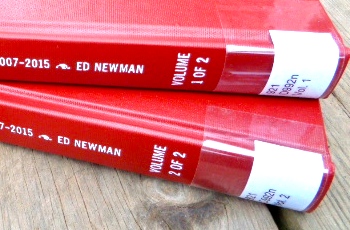
Reflections from the North Country, 2007 – 2015
Notes, observations and impressions about the music, art and life of the Northland’s Bob Dylan

Reflections is a compilation of all my Dylan-themed blog posts from 2007 to December 2015. A reference librarian from the Duluth Public Library asked if I might like to have my blog posts about Bob Dylan bound and placed in the permanent archives. The library routinely collects and preserves books by local authors for posterity, but in this case not only would it be a collection of blog posts by a local author, the subject matter was Dylan and Dylan is, naturally, a Duluth Native Son.

Although this 2-volume set is not for sale, it can be found in the biography section of the Duluth Public Library along with numerous other books on Bob. As time permits, look for volume three sometime within the next year.

* * * *

Meantime, keep reading. Books are  a gateway to life.

Sunday, January 22, 2012

Sunday Catch All

Ever notice how hard and crusty bread gets when it's all dried out? Hard to chew. It can even cut your gums. It's still nourishment but not a delightful way to get it. Do you think the same thing applies to dry text books in school? They contain information nourishing to the mind, but it's presented so dried out you can hardly chew it.

***

Last summer when I made up my mind to publish my novel and several volumes of short stories as eBooks, it seemed that I'd better go ahead and get an eBook reader. When my Kindle arrived we became fast friends, and I even wrote about it in a few blog entries including this one with the non-ambiguous title Love My Kindle.

Well, this week I discovered at least one drawback to eBooks and the devices that you read them with. Despite the ten day battery life, they still need to be re-charged. And if you live in Minnesota, but leave your recharger cord in Florida where you spent part of your vacation, you will not be happy when your Kindle runs out of juice. I have yet to have this kind of problem with a paperback novel or magazine.

Fortunately, even though our local Target store had the re-charging cords on backorder, our local Radio Shack came through for me and -- voila! I can read again!

***

Along the same lines, what are we going to do when the world as we know it comes to an end and there is no more electricity? I better hold onto my Reader's Digest Complete Do It Yourself Manual so I know how to fix things around here. The last time I replaced my toilet by watching three videos on YouTube.

***
Speaking of eBooks, someone said they wanted to read some of the stories in my Unremembered Histories, but they didn't own a Kindle, Nook, iPad or Kindle Fire. I asked if she had a Chrome browser, and she said yes. Voila! She can read my books!

In fact, you can read eBooks on smart phones, too. Follow this link to a page where you can download Free Kindle Reading Apps for all your favorite devices. (O.K., not all, but a surprising number of them nevertheless.)

***

The trigger for all this rambling was an item I saw at Business Insider that indicated surprise that people were using their Kindle Fire tablets more for reading books than for surfing the web. Maybe the Kindle brand is so strongly associated with books that it becomes natural to groove with it in that manner. What could be more important than reading books?

Here's a little something to serve as a closing thought on all these matters, a poem by Beverly McLoughland called Surprise.

Surprise

The biggest
Surprise
On the library shelf
is when you suddenly
Find yourself
Inside a book-
(the HIDDEN you)
You wonder how
The author knew.

Have a wonderful day in your neighborhood. Thanks for stopping by.

Friday, December 23, 2011

eReader Wars

Woke this morning dreaming about digital eReaders. In my dream a company called Digital Mayflower had been the pioneer in eReaders, which is funny because when I woke and looked it up online, there really is a company called Digital Mayflower, though in a different technology category. The trigger for this dream was an Editor’s Pick article that I read yesterday in Wired magazine about eReaders.

About Wired Magazine
In 1994 I took a one day class about the Internet at U of M, Duluth in part because I wanted to be ready for the coming technology revolution. There were many highlights that day, chief of which was searching through libraries in Berlin and Pisa via Archie, doing Veronica searches. When I got home, abstracts for several articles were magically downloaded onto my 20 meg Mac… Right then I knew something powerful was happening.

The second highlight was less profound, but quite practical. The instructor said there’s a new magazine all of us should be reading, and he showed us his copy of Wired. I went out and bought a copy and have been reading it ever since.

Back to the Story
So yesterday I was paging through the January issue which I came in the mail earlier this past week. In the midst of a hundred other topics was this Editor's Pick article by Tim Carmody. In Carmody's estimation, the surprise winner is... the Kobo Touch.

Huh? Never even heard of it. But I'm sure they will make hay with the endorsement, because Wired magazine is no longer a fledgling start-up. It is a million reader powerhouse whose recommendations and endorsements have real clout.

For the record, you really don't need an eReader to read eBooks. Browsers like Chrome can download books from the Amazon.com store or the Barnes and Noble eUniverse. But as Carmody points out, "When it comes to book-length reading, no glowing LCD tablet screen can hold a backlight to the eye-saving e-ink of these readers."

Other eReaders compared and featured included the Nook Simple Touch, the Sony Reader PRS-T1 and the Kindle from Amazon. And why it matters which eReader you choose? Well, the Kindle and Nook each have special relationships with the "mother ship" and the more Kindles there are, the more Amazon sales will soar. Ditto for B&N for buyers of Nooks.

Despite Wired's influence, Kindles have been selling at the brisk rate of a million per day as we head into Christmas, undoubtedly due to the low price point of less than a hundred dollars per unit. Nook countered by lowering the price on its own eReader.

To best understand the eReader wars, picture the theater industry. Hollywood made the movies, but there was a time when no one could view them without the theaters. The distribution network gave the film industry its power. Likewise modern ePublishing. B&N and Amazon maintain the inventories, but the distribution systems determine which resource people will use to buy their eBooks from.

For this reason questions were raised in various blogs regarding the article's selection of the Kobo. Why? Because something is at stake. And here's the first article I found in response: Paul Biba's short and too the point Wired’s Tim Carmody stacking the deck against Amazon ereaders? Slanted review warning! It's a really concise criticism that you'll really want to read if you're still undecided between a Nook, Kindle, Sony and now Kobo.

The heart of Biba's beef is summed up in a paragraph that appears after listing the four eReaders reviewed by Carmody.

What’s going on here? Carmody is taking a completely different category non-touch Kindle and comparing it to three higher-end touch ereaders. In addition, one of the “Cons” he lists of the low end Kindle is that it has ads. This same version of the Kindle is available without ads, but he chose not to mention this and then decides to use the ad version and list it as a con.

Biba's barb ends, "Shame on you, Wired."

On the very same day Carmody posted a few comments of his own at another site.

The January issue of Wired has my first article/review in the print magazine, a roundup of new e-readers. We didn't get to include the new Kindle Touch or the Kindle Fire, because they weren't released until a month ago (magazines take a long time to make!). But I was still surprised at how much I liked the Kobo Touch and how disappointed I was with the $79 entry-level E Ink Kindle.

Kobo put up scans of two pages of the review. (I don't even have my print copy yet! The world is crazy.) Still, very happy to be in my first issue of the magazine — and I'm already writing something for my next issue now.

Personally, I don't care one way or the other what eReader you choose. I already have my Kindle and love its ease of use. What matters more to me is that people continue to enjoy reading. The high volume of eBooks being sold seems to indicate that there are still a lot of folks with this passion.

Books are a labor of love for those who write them, and authors find no small measure of satisfaction in connecting with readers who appreciate their work, in whatever form it is encountered. As an author myself, I am not very particular whether you buy my novel The Red Scorpion at Amazon.com or B&N. What matters to me is that you enjoy the ride.

Here's the page to visit for a brief introduction to my four current books. And if you get an eReader for Christmas, start anywhere.

Friday, November 11, 2011

Book Beat: Tablets and eReaders See Increased Market Share

This month's Internet Retailer arrived yesterday and it seems impossible to not mention a few stats that the editors had assembled at the back of the mag. I like graphs and stats because they can compress a whole lot of data into a tight, easy to grasp image. A good graph really is worth a thousand words.

The title of the page reads, "E-readers outpace tablets in sales to consumers." The first chart shows how rapidly the e-reader and Tablet devices have been funneling into the market. In 2009 only 2% of the population owned an E-reader like the Kindle. And this is hard to believe but Tablets like the iPad did not even exist yet.

Think about it. Doesn't it seem like iPads have been here forever?

A year later 3% of all Americans, according to Pew Research, owned a tablet. Just a few months later it was 4% and 5% owned a Kindle. By May of this year, this number had grown to 12% owning e-readers and 8% having tablets.

Why is this? First, no doubt it's due in part to price. The iPad has been a $500 item during this span and Kindles around one-third of that. But the versatility of the iPad is worth that extra chunk of change, since Kindles are essentially only good for reading books (Like!) and browsing the Amazon.com online book store. (OK, yes, there are some free games, too.)

A second chart on the page shows the E-reader and tablet market share. Then the third chart shows how cell phones still rule, with 83% of U.S. adults owning one. 57% own a desktop computer, and 56% own a laptop.

But its the growth of the e-readers that is interesting to me. The number of adults who have e-readers (Kindles, Nooks, etc.) actually doubled from November 2010 to May 2011. And with the Kindle dropping to below $100 it shouldn't be long before we see this market penetration double yet again.

What's on your Santa wish list? My guess is that there will be a lot of Kindles under Christmas trees this year.

One of the more interesting stats on the page is the market penetration by race of these two electronic devices. 11% of whites own e-readers and 7% own tablets. African Americans are a smaller percentage, but in the Hispanic community e-readers are owned by 15% of all adults, and so are tablets.

Naturally I have a vested interest in following some of these stats. In September I began publishing my own eBooks through N&L Publishing. This weekend my associate TJ Lind will upload The Breaking Point and Other Stories, my third collection of short fiction, all priced at $1.99 apiece, joining my debut novel The Red Scorpion. All of our books are available on Kindle, Nook and soon the Apple iStore.

An article in Tuesday's edition of PC World outlines some of the reasons why e-readers have become big winners in the tablet wars.

As e-reader prices plummeted, features improved. Released two years after its predecessor, the Kindle 2 was 50 percent thinner, improved battery life by 85 percent, ballooned storage to 2GB from 256MB, and showed 165 shades of gray versus only four shades in the original. Another two years went by and the third-generation Kindle improved on that -- two ounces lighter, 50 percent clearer contrast -- until today, when the Kindle Touch barely resembles the original in looks, feel, or function. Similarly, when the Nook Simple Touch debuted, it blew the original Nook out of the water at more than 4.5 ounces lighter, 25 percent faster, and a huge, two month battery life. Sony, which also just joined the tablet wars, updated its Reader to version PRS-T1, which retails for $149 and is the lightest of the bunch at 5.9 ounces.

Near the end of the article there's a humorous picture of a box of cereal with a big starburst proclaiming "FREE NOOK INSIDE!" That's certainly the direction pricing has been going. Ultimately B&N and Amazon.com are in the book business, and as movie theaters were to Hollywood film producers, so these distribution channels need to be out in the streets in order for their digital wares to find distribution.


VETERANS DAY SPECIAL

There are still some who do not own a Kindle or Nook and prefer reading the old fashioned way. I won't hold it against you. Your kids make poke fun some at you some day, but I won't.

Today is Veteran's Day and I can't let it pass without mentioning my father-in-law's book,

AND THERE SHALL BE WARS
World War II Diaries and Memoirs
536 pages. Illustrated with 178 original photos and documents.

Available at Savage Press:

And There Shall Be Wars.

Read On!

Monday, September 12, 2011

How to read Kindle books on various devices.

We're live. The Red Scorpion is now available on Amazon.com. Here's the page where you can find it.

It's currently only an eBook, which many people believe means it can only be read on a Kindle or Nook. But the truth is, eBooks can be enjoyed on a wide range of platforms and devices these days, many of which are now being used by tens of millions of people daily. Here are some instructions for people interested in reading eBooks on their iPads, Androids

iOS (iPod Touch, iPhone, iPad)
To download the Kindle application on iOS, simply navigate to the app store and search for “Kindle.” The first result will be “Kindle” by “AMZN Mobile LLC.” Follow the on-screen instructions to download the app and off you go! When you run the app for the first time it will prompt you to enter your Amazon account information. If you haven’t yet set up an account, it can be easily created on Amazon.com. From the home page on any web-browser click sign in, then “create account.”

Tada! You are set to start reading ebooks on your iOS device! Due to Apple regulations, you cannot buy eBooks from within the Kindle app. You need to go to www.amazon.com/kindle to purchase books.

Android OS
The process of downloading the Kindle application on Android mobile phones and tablets is virtually the same as for iOS. Open the Android Market and search for Kindle by “AMZN Mobile LLC” and follow the instructions to download the application. When you open the app the same will happen as with the iOS version.

Mac or PC
Open your web browser and navigate to www.kindle.com. Scroll down a bit until the heading “Buy once read everywhere.” From here click on either Mac or PC to get to the download page. Follow the onscreen instructions and you are ready to go.

Amazon also offers a cloud reader where you can read books within your web browser. When at The Red Scorpion page, or any Kindle page, look for the small text Cloud Reader in the white Kindle Store menu bar at the top of the page. It's right next to Buy A Kindle. Currently, the app is designed for the Chrome and Safari browsers.

Currently the book is listed at #18,374 among Amazon Kindle bestsellers, so we have a little climbing to do to reach the top of the charts.

In the meantime, have a great week, starting today. And if you're in the neighborhood stop in at our launch party, 7:00-9:00 p.m. Thursday September 15 at Goin' Postal in Superior.

Monday, August 22, 2011

Unremembered Histories

In 1991 my short story "The Breaking Point" won the Arrowhead Regional Fiction Competition. The unexpected rose had a thorn in it. This was the first year that the winning story was not published.

It's strange how those things go. After this, repeated submissions to literary magazines and other publications were perpetually returned. I started to conclude that publication of an unknown writer's fiction seemed to be a futile pursuit. I did not have the postage or the motivation to continue that route and instead chose to share my stories on a website that I created in for that purpose, among others. Three of my stories were eventually translated into Croatian, Russian and French.

For the most part the stories remained dormant as my energies had been directed into other pursuits... until this past winter. An email from Portuguese artist Margarida Sardinha reminded me that I had poured a lot into my fiction, had been serious about it and took great pains to craft stories worthy of any collection. The stories were things of value and needed to be treated that way.

My very first impression is that there's a certain style in some ways similar to Franz Kafka which is good and intense - very mysterious for one doesn't know where the whole thing is going to go... but is sure that there's a message to be captured from the many moments stated in the short sentences that are all poignant to the story. Perhaps what I want to say is that I feel the work to be extremely existentialist in a serious way and not in an ironic one - best portrayed by Sartre.

Also, there's an enormous spiritual and ethical awareness in your writing which is not directly implied in Kafka's work but if one reads him under the light of the Jewish religious upbringing he had like Harold Bloom pointed out, one will find it there, something that is completely ruled out in Sartre's views. Yours, generally speaking and only from what I've read so far, is slightly more lyrical or poetic if you will, but carries that acute seriousness and extreme loss of hope and faith (common to Kafka) only you give it a try in explaining it, be it searching for religious/spiritual arguments or other author's references which I very much sympathize with because it becomes a "loss of hope when hope is not all lost"... And there you achieve something great for the stories are open cycles (not dead-ends like Kafka), they become allegories, which by definition are circles constantly closing and opening on themselves. You match Borges here beautifully. I also like very much how you build the stories to show the two sides of the same coin without being preachy or moralist, again this duality which has been around since the beginning of time, is explored in a very simple and engaging way enabling us to breathe and reflect when needed; for although the stories are of an existential character they are mostly of an extrovert attitude, in the sense that the reader understands what the character is feeling by what he says and not by some introvert description of how he feels which in my modest opinion is extremely liberating and contemporary - reminding me of Eco in some ways and of Plato's simple dialogues full of meaning and hidden messages.

Maybe this is a very simplistic way of putting it and I know you are influenced by many other writers and not necessarily by Kafka or the others I mention here, but still as I'm meant to humbly and with all respect say what I think in these comments I hope you take it as a personal view that is only "simply another view" and not set in stone in any way.

Ms. Sardinha's commentary set in motion a renewed desire to see the stories brought to a wider public. As the year progressed a pathway opened up and the launch of N&L Publishing has created the platform from which several books will be launched this fall. N&L Publishing is a collaboration with TJ Lind, a high school student with an iPad attached to his fingertips.

Currently we are in the final stages of preparing The Red Scorpion, my debut novel, for publication. It's starting to feel like we're close, aiming to launch in September. The three volumes of stories will roll out on the heels of that release.

Unrembered Histories is a compilation of six stories with a supernatural twist. The collection will feature:
Two Acts That Changed the World
The Empty Space
Duel of the Poets
Lu Lee
Unremembered History
The Nonsense Room

This volume will sell for $1.99 on Kindle and Nook. And I'm fairly confident that they will make you hungry for more.

Tuesday, August 9, 2011

More Lavish Praise For Kindle

I'm on Day 10 of my love affair with Kindle. There are just so many things you can do with this device. Clearly the Amazon.com folks spent a lot of time conceiving, testing, fine-tuning their eBook reader before pushing it into the marketplace.

As a marketing guy, the first thing I noticed was how effectively this device was for selling books. Now if you believe in books like Amazon.com does, then being an evangelist for reading is probably O.K. The Kindle does a fab job of ever pointing you to shop in the Kindle store. It does this non-intrusively though and you do not feel forced or fandangoed.

As a reader, I like the manner in which it leads you to the books that seem suited to your taste. Maybe I'm wrong but I get the feeling this thing has an intelligence, since it is always making me aware of books it believes would interest me. For example, when you go to the Kindle store, you can browse the books, mags, newspapers and more, just like sections of a normal book store. Then there are the featured items, and a short list of things to try. Across the bottom are recommendations specifically for you. One of the recommendations on my Kindle is the Harvard Classics best 200 works of fiction of all time. For only 99 cents. Yes, I can own a collection of the greatest literature of all time for under a buck, and still have room for fifty more such collections.

Now think of it... the 51 volume Collier edition of Harvard Classics which I received from my grandmother's collection takes up more than six feet of shelf space here in my home office. To own and carry around 200 volumes of the world's greatest lit in a device the size of a slim pocket paperback is somewhat mind-blowing.

I'm not the only one praising Kindles these days. Here's the opening of an article by a U.K. fellow named Ian Betteridge from his Technovia blog.

Getting the out-of-box experience right with consumer electronics is hard, which is why so many companies get it wrong. With the Kindle, Amazon has produced a customer experience that Apple would be proud of. In fact, it’s arguable that the integrated experience of Kindle is actually better than anything Apple has done.

Open the box, there’s the Kindle. On screen is a message, telling you how to plug it in to charge and how to turn it on. This message isn’t printed on a cheap sticker – it’s actually on the Kindle screen. One of the advantages of eInk is that you can put something on screen and it will stay there, without drawing power, until the screen is refreshed.


I think it was this more than anything that helped me appreciate what the Kindle designers had done. Like a first date, the experience was comfortable, natural. I hate to say it, but my iPad experience was not like that at all so that I (regrettably) gave my iPad to my son rather than get frustrated trying to figure it all out. I would have done well to have someone mentor me with it, and maybe I would be writing lavish praise for the iPad instead today. Alas...

But that isn't the only reason I fell in love with the Kindle. I love my Kindle because it is so exhilarating to be able to read so many interesting things. I enjoy reading and find myself reading more, catching a whiff of Innocents Abroad, then a bit of Portugal's Fernando Pessoa, then off to the incredibly compelling Open, by Andre Agassi. And even if I did not buy Agassi's book, by reading the sample chapters (free) I was hooked into it, and hope one day to find it audio so I can read the whole of it while commuting.

I have samples of a Mick Jagger Wiki Book and several books by on of India's leading literary figures, Munsi Prenchand. Tales of the Jazz Age by Fitzgerald, a commentary by Martin Luther, Dick Van Dyke's autobiography and Thoreau's Civil Disobedience are but a few of the eBooks I've been tasting these first ten days.

Well, I'd best start my day. You have a great one, too.

You can find the rest of Betteridge's column here: http://www.technovia.co.uk/2010/11/in-praise-of-kindle.html


Sunday, August 7, 2011

eBooks All Around!

Thursday, the Huffington Post published an article by Amy Edelman that called Indie eBooks the "Gateway Drug" to traditional publishing. Here's the opening, Edelman's article in blue, my comments in blood red:

Gone are the days when a writer had to spend hours hunched over a stack of query letters,

>>>Been there, done that<<<

...only to have their hopes dashed months later with the arrival of an unsigned form letter.

>>>I could wallpaper my office with this stuff<<<

Today, thanks entirely to the creation of the e-reader (yay Jeff Bezos!),

>>>Yay, Jeff Bezos<<<

there's no longer a need for authors to deal with middle men. For less than what it costs to buy a book, an author can jump directly to the end game: formatting their titles, uploading them to a sales site and finding actual readers.

>>>You still have to purchase an ISBN, but hey, thatz-ok.<<<

Edelman goes on to explain that for many writers the prize is still out there in the traditional publishing world, but for the time being getting readers satisfies an important need. Not only are eBook authors still looking for conventional publishers, the publishers themselves are combing the ranks of independent authors to find their next round of author heroes.

Edelman is founder of the website IndieReader.com which lists the top selling eBooks each week.

In other news: The Tulare County Library has gone digital and is doing away with late fees — on ebook downloads. If you have a Nook, more and more libraries are making these new digital works available just like regular books. The local libraries here will become accessible on Kindles by the end of the year.

I asked my publisher TJ Lind to write up some instructions on how to read eBooks via other platforms when you don't have the official Kindle or Nook reading devices. Here's a short piece he wrote up, aptly titled eBooks All Around.

eBooks All Around!
In a previous article, “eBook Supremacy,” I had mentioned that part of eBook success is due to the ability for customers to “buy once, read everywhere.” If one were to download a book on a Kindle or Nook they could read the first few chapters on their eReader before bed, then another few chapters on their phone during their commute, another few chapters on their iPad during lunch break, and read some more on their computer during down time at work! Moreover, some readers do not realize that they do not need to own a Kindle or Nook to read books from their respective stores. There is a Kindle app for every major platform; iOS, Android, Blackberry, Windows, and Mac. Chances are the device you are reading this article on is able to download.

The download process differs depending on which platform one is using. Users with Apple products need only to search for “Kindle” or “Nook” in the App store. Same goes for Android and Blackberry users. If one wants to download the Kindle or Nook apps on a computer, simply navigate to the Kindle Store on Amazon, and select “Kindle Reading Apps” in the left hand column.

Once the app is downloaded, it will present instructions to download eBooks
. Now your books will be synced between your devices!

Edelman ends her HuffPost piece with this challenge: So next week, after you've finished the Times crossword puzzle, why not try a new game? See if you can discover (and pass on!) the next great indie book...before a traditional publisher beats you to it!

>>>Hint: The Red Scorpion.<<<

Monday, August 1, 2011

Love My Kindle

This past spring when I saw a friend showing off his Kindle I inwardly cringed. "What's this world coming to?" I thought. But he was enthusiastic and I didn't end our friendship over it.

How quickly the tables turn. Now I not only have a Kindle (as of a few days ago) but I love my Kindle and think you might, too.

I had a host of reasons for being opposed to Kindle before.
1. I love books, their feel in my hands.
2. I didn’t want yet another device to carry around.
3. I didn’t want to get yet one more electronic device that caused me to spend yet more money for things I already have but in another format. I've been through albums to cassettes to CDs and likewise VHS movies to DVDs.

But I went ahead and purchased a Kindle after all. Why? Because, well... if I'm going to be publishing some of my books on Kindle this fall, I'd better see what Kindle eBook publishing looks like.

In church yesterday morning I was told by a fellow Kindle owner that the best part is all the classic literature available for free. Mark Twain and many others. All kinds of versions of the Bible, and so much more.

So, I came home from church on a mission. Figure out how to find and download free books. I started right in with three books by Twain. It entered my mind to find a certain Jack London story and sure enough I was already buying things. I couldn’t resist the price… 99 cents for the complete 43 volume set of Jack London’s works. No sooner had I completed the download when I was able to find in seconds the story I was seeking, Lost Face. And guess what? I couldn’t put it down.

Now here's a cool feature of the Kindle. You can set it in front of you and don't have to waste the use of your hands to hold the book open. It's open right there for you and turning the pages is even easier than a book. You just hit the button on the right side of the tablet.

While looking about for more freebies I stumbled on the Complete Works of Mark Twain, again for only 99 cents. I’m such a sucker that I went and bought this accumulation of works as well. And even now it is hard to keep writing this blog entry because I want to read Twain’s acidic commentary on James Fennimore Cooper.

So, what do I like about my new Kindle? Well, this blog post by Supermaw captures a lot of it.

Supermaw begins by stating that eReaders have progressed so that the reading experience is no longer uncomfortable to the eyes. In less than two weeks she'd read five books, then bought one for her husband who was "equally smitten." She declares now that eBooks are her preferred format for reading.

I don't know if I'll go that far yet. I ended the evening last night reading ten pages from a book about Dorothy Parker, a fat paperback I've been working my way through. Reading is often kind of a nightcap for my day and I've gotten used to having a fairly hefty stack of books by my easy chair. Will the Kindle be able to outdo that? What would a wall be without a bookshelf or a room without a wall of books?

Much more could be said and I still haven't entirely figured out all the functionality, but at first blush it appear that, yes, I am in love.

Popular Posts