Showing posts with label Tech Tuesday. Show all posts

Tuesday, December 28, 2021

Tech Tuesday: Interview with Innovator James Yu, Co-Founder of Sudowrite

Photo by Jackson So on Unsplash
In November I read about an AI program that helped writers create stories, write poetry and more called Sudowrite. During a three day trial period I became utterly enthused by the program and used it as much as I was able before the time limit expired. For some reason, I received a weeklong extension and did some additional "playing" with the program, exploring its possibilities and limitations.

When I began sharing come of the collaborative writing on this blog and Twitter James Yu, a co-author of the program, "liked" one of my tweets. After a brief exchange I reached out to see of he would be willing to share a little more about AI, Sudowrite and another shared interest, NFTs.

EN: Which came first, your interest in writing or your interest in technology?

James Yu:
I would say they were intertwined with gaps. I’d always had an interest in storytelling, and wrote lots of short stories as a pre-adolescent. At the same time, I was programming my own little games and experiments in BASIC. I have a faint memory of playing with a very simple markov model where I could input my emails and it would spit out other “probable” emails (this was back in the late 1990s) — that fascinated me, that a facsimile email could appear to be real.

Later I got addicted to creating tools for developers and creatives, and this continues with my work on Sudowrite.

EN: Sudowrite seems to take a different approach to AI-powered writing than the other tools. How many iterations of the program have you produced and where do you see it going

JY: Don’t really know how many “iterations” there have been, but it’s grown organically between me and my co-founder Amit Gupta. We were both part of the same writing circles (mostly consisting of other techies who got into writing fiction). We built it up from a toy, slowly letting word of mouth grow it over time, focusing primarily on creative and literary writers while most other AI writing programs were focused on business users.

EN: The Summer Olympics in China had an AI “newsroom” that generated articles about the various events, much like a journalist. I found the stories to lack feeling. They came across as boilerplate. Some of the poems I create in conjunction with Sudowrite seemed quite evocative. Can you explain what is going on here?

JY: I don’t know the details on how those newsroom AIs were built, but my guess is that they were trained on some sports article templates, and didn’t have much leeway to diverge from them that far. Sudowrite’s poem tool is built on GPT-3, with prompts that focus specifically on modern, evocative free verse poetry. Therefore, the output will also be more evocative.

EN: What is GPT-3? Is this the hardware or the ghost in the machine?

JY: I’m not a GPT-3 expert and the details on its architecture are pretty well known so I won’t go into that specifically. As for the ghost in the machine: we love to anthropomorphize AIs, especially large language models, since at times, they seem to evoke a strong sense of self. It’s no surprise that GPT-3’s reading comprehension has reached almost human level accuracy. Of course, this is all an illusion. It is statistics. A simulacrum. There is no consciousness within the silicon (yet).

EN: Are NFTs a fad like Tulip Bulbs or are they here to stay?

Painting by Jonathan Thunder
who has been a featured artist
in the NFT scene in 2021.
JY:
There’s definitely a lot of tulip bulbing out there right now. The signal to noise is exceedingly small, and even if you’re immersed in the NFT world 24/7, you can easily miss the next fad. The same sort of thing happened in Web 1.0 and Web 2.0 eras: so many companies and products that were ephemeral. But from those eras, certain key technological innovations did survive, so I’m bullish that this random walk down crypto art will also yield lasting value. In particular, the idea of digital ownership will be huge, especially as more of our life moves online.

EN: Looking back over the history of art—especially in the 20th century--I find it somewhat fascinating how creativity has continually found new ways of expression. Will there be galleries like the Louvre or Guggenheim that exist as repositories of AI-generated art?

JY: I believe so yes! The genre of algorithmic art has existed for a while and they’ve already made it into the traditional galleries way before NFTs. But it does feel that this type of art is “native” to the NFT world and it’s encouraged a lot of new artists to tinker with AI in art.

EN: Do you have some “heroes” or mentors in this genre?

JY: I really admire Mario Klingemann (https://quasimondo.com), who’s been doing AI art for a while now, and has also made a serious living from it. I also love how he shares his knowledge and encourages others who might be new to the field.

EN: Why do some creative people become entrepreneurs and others do not?

JY: Don’t know for sure! It probably has to do with a specific type of thinking that makes a good entrepreneur: you have to be obsessed with a particular problem and potential solutions to it, so much so that you would say, “Hey, I’ll quit my job and drop everything to work on this for years with a high risk of failure.” It’s kind of crazy. But if you have that itch, it never seems to go away until you try to see it through to completion. Not all creative people thrive with these kinds of problems.

EN: Who or what were your early influences in this direction?
 
JY: I credit Y Combinator. I was an early employee at one of their companies and saw the rise of the program circa 2006, and eventually started my own YC funded company. The energy at during that era was off the charts. Being surrounded by other people like me who were product obsessed propelled me.

And secondly I would say my IBM 286 computer I got in 1994 was the other cornerstone influence. My parents didn’t give me that much guidance: just let me hack and make interesting things on that machine. That, dovetailed with the rise of the internet, forms a lot of my worldview today.

EN: Thank you, James!

Related Links

Tuesday, October 26, 2021

Tech Tuesday: Thought Provoking Energy Stories

I have currently been reading Meredith Angwin's Shorting the Grid: The Hidden Fragility of Our Electric Grid. The book challenges us to think about matters we have probably given very little thought to. Specifically, how do our power systems work? Why do the lights go on when I flip a switch? What would our lives be like if we shut down all the power plants? That is, what would happen if the power went out forever?

Here are some article to chew on for today's energy lesson. (I'm not an expert. Just relaying ideas that strike me as significant from this week's readings.)

Our electricity demand is shifting into high gear. That's why we need diverse energy sources. | Opinion

The question isn't whether our country will need more power, but what energy mix is needed to meet our economic and environmental goals.

READ MORE

* * * 
In another article
I had a new insight about solar energy that I'd not considered. 
KEY NEW THOUGHT: The more Sun we get to produce energy, the higher the demand to run air conditioners and cooling systems. 

* * * 

Regarding the best way to achieve carbon neutrality by 2050 in Europe, it's apparent that the EU nations are hardly in unison. Here are two excerpts from a thought-provoking article at FairPlanet.com.

France, an ardent supporter of nuclear power, drew 70 percent of its energy from nuclear sources last year, while the Czech Republic relied on its six nuclear reactors for 37 percent of its energy. 

President Emmanuel Macron doubled down on France’s nuclear strategy, announcing a new €1 billion investment in new-generation nuclear reactors. On the other hand, 2022 will witness the shutdown of the last of Germany’s nuclear reactors, completing Chancellor Angela Merkel’s 2011 plan to phase out the country’s 17 nuclear power plants in the wake of the Fukushima disaster.

* * * 

THIS SKYNEWS STORY proposes that  Climate Change "could be solved overnight" with nuclear. It seems an ambitious claim. Tomorrow evening more details will be spelled out regarding the role nuclear will play in the global effort to achieve netzero carbon.

* * * 

In Europe Germany is on the way to phasing out nuclear completely. France leads the EU with 70% of it power generated by nuclear. Which country produces more carbon? Germany by more than 6-fold. Which country best exemplifies the future of energy reliability? France. 

Details HERE.  

* * * 

Who among you (older readers) ever imagined that people would one day be "mining" bitcoins using powerful computers? The concept is still elusive for many, if not most, laypeople. 

Well there have been remarkable new developments in the field of nuclear power. Are you familiar with Thorium? Read this introduction to Thorium from the World Nuclear Association. 

* * * 

For the record, small scale nuclear power has been around for decades. Nuclear-powered submarines are submarines powered by nuclear power. When Australia recently cut a deal to build a fleet of nuclear powered subs, it did not mean submarines loaded with nukes. 

According to this article in Business Insider, the advantage of nuclear-powered subs is that they can operate at sea for longer, spend more time submerged, and sail at higher speeds than conventionally powered subs.

* * * 

There are now Portable Nuclear Reactors That Can Power Over 1,000 Homes

* * * 

According to Meredith Angwin, author of Shorting the Grid, a world without coal, oil or nuclear power is wishful thinking. It's a notion suggested by people who do not understand how power generation works. 

To learn more, read my interview with Ms. Angwin. It is amazing what science is achieving in the realm of clean energy today. 

* * * 

May all your skies be blue. (Except when we need a little rain.)

Tuesday, March 9, 2021

Tech Tuesday: How Can a Tweet Be Worth More Than the Handwritten Lyrics to Bob Dylan's Like a Rolling Stone

In the summer of 2014 the handwritten lyrics to Bob Dylan's hit "Like a Rolling Stone" were sold for the staggering amount of $2.045 million dollars. That's a lotta cabbage, as they say. 

Naturally the event gave me an opportunity share my thoughts and observations as to why this song and its author were so significant. Some ask how the lyrics to a song could be so valuable. I dunno. I suppose it's all a matter of how you define value. Here's what I wrote at the time in defense of the value of this song and Dylan's prose.

Jack Dorsey's first Tweet
When I read the news today that a single Tweet fetched $2.5 million, the above story leapt to my mind. How could a Tweet be worth more than the lyrics of a Dylan song.

And yet, here it is. The times are a-changin'.  

Twitter CEO Jack Dorsey is selling his first ever tweet from 15 years ago this month, and there are buyers bidding it up. That's five words, currently worth $500,000 apiece. 

Compare that to four pages of Like a Rolling Stone, which amounts to a full page of words for a half million a piece. 

How does one "own" a piece of digital real estate? This is very strange to me. 

According to the article in my Stocktwits eNewsletter for March 9 (today) Mr. Dorsey will convert the winning auction proceeds to Bitcoin and then domat to his Give Directly Africa Response, an organization providing Covid relief to vulnerable families. (Big shout out to Dorsey.) 

The article includes a link to the auction in the event you wish to outbid the current high bidder. here’s the link

Here's the story at CNBC: Jack Dorsey’s first tweet is on track to sell for $2.5 million, and he says
the money will go to charity

* * *  

How high will the bidding go? Place your bets.

Tuesday, September 29, 2020

Tech Tuesday: The 5G Conspiracy

Back in the 90s, Minnesota Power was seeking to shore up its power resources by adding a backup connection to the grid that comes out of Chicago. What this meant was the addition of a corridor of high tension wires across Wisconsin.

As you might expect, there were plenty of people opposed to this. "Not in my back yard" applies to all kinds of matters, and having wires strung across the back 40 doesn't always have a lot of appeal for most people.

Well, one day a full page ad appeared in the newspaper paid for by these opponents. The ad included a quote from a friend of mine who was the PR spokesperson for the power company. The ad declared how evil he personally and the power company were for placing deadly power lines across the land. The ad informed readers that 60 children and infants had purportedly died from the low-frequency magnetic fields that were generated when strung across a reservation in Canada.

60 children died? This is quite an indictment. Was it true? Are power lines this unsafe? (The answer is no, though it will kill you if you illegally trespass, climb a tower and touch the wires.)

That story came to mind when I read Kaitlyn Tiffany's article in the May issue of The Atlantic, Something's in the Air. The article is about conspiracy theories related to technology in general, and with regards to 5G specifically. 

She opens with by noting that cancer caused by power lines was a major conviction of many people back in the 70s. Televisions and microwave ovens were believed to be human health risks. More recently, the notion of having cell phones next to our brains was leading to brain damage. (That is why I always put you on speaker phone. JK)

In short, Tiffany begins her article by citing the manner in which our paranoia can be fed when we do not understand technologies. 

I once wrote an article about how we are constantly bombarded with radio waves and sound waves and other kinds of wavs, that if we could see it all, we'd see that we are sitting in a solid mass of waves. What looks like empty space is not empty at all.

The article's intro is designed to remind us that in the light of history (and I am surprised the Luddites didn't get noted at this point) the current resistance to 5G shouldn't surprise us. What is surprising, however, is its vehemence. She writes:

A wildly disorienting pandemic coming at the same time as the global rollout of 5G—the newest technology standard for wireless networks—has only made matters worse. “5G launched in CHINA. Nov 1, 2019. People dropped dead,” the singer Keri Hilson wrote in a now-deleted tweet to her 4.2 million followers in March. As the coronavirus spread throughout Europe, fears about 5G appear to have animated a rash of vandalism and arson of mobile infrastructure, including more than 30 incidents in the U.K. in just the first 10 days of April. In the case of one arson attack in the Netherlands, the words “Fuck 5G” were reportedly found scrawled at the scene.

The article is well researched and quotes people from different points of view. David Savitz, an epidemiologist, notes how cell phones went from nowhere to everywhere in about a decade. Simultaneously, wifi and cell towers became ubiquitous.  "Now nearly every public urban place has Wi-Fi," he said, "and we will soon have small cell towers every few blocks. Whether or not you believe this will give you brain cancer, you didn’t have a chance to opt out."

Further on in the article Tiffany writes about businesses that have emerged to protect us from the adverse effects of all this technology, both products and services. Would you like your new home inspected to make sure it's not killing you? For $150 an hour, this can be done. If you know who to call. (A 21st century version of Ghostbusters, I suppose.)

Everything above is only scratching the surface as to why the 5G rollout has encountered resistance. There's that whole other aspect of a techno-culture with wraparound surveillance. They can be watching and listening to us everywhere we go. They track us by our cell phones. Why not all the other sensors in our Internet-of-Things world?

BOTTOM LINE: It's an informative deep dive into a complex issue. Wherever you stand on this issue, I believe Kaitlyn Tiffany brings a fair and thorough overview of what's happening in our age of disruptions.

Here's the link:
https://www.theatlantic.com/technology/archive/2020/05/great-5g-conspiracy/611317/

Tuesday, January 7, 2020

TechTuesday: Cars Go High-Tech at CES

I've been attending trade shows and conventions for more than three decades and the one constant in every industry has been change, much of it driven by technology. I attended my first trade shows while working for a manufacturer in the screen printing industry. The Screen Printing Association held an annual SPAI convention at various locations around the country from Houston to L.A. to Atlanta and elsewhere. As the digital world expanded, this association had to change as well and became the Screen Graphics Association with its annual convention called the SGAI.

While with AMSOIL I attended the Specialty Equipment Manufacturing Association (SEMA) show in Las Vegas each year from 1986 till my semi-retirement in 2017. SEMA is an association of companies in the automotive aftermarket. The first shows were held in the basement of the Los Angeles Dodger baseball stadium. Eventually they outgrew this space and moved to Las Vegas where it continued to flourish, becoming the third largest event in this city that never sleeps.

When SEMA is in full bloom every hotel is occupied as more than 160,000 people come into town. 3300 members of the media show up from countries all over the world to see what's new from the 2400 exhibiting companies showcasing their wares on 1.2 million square feet of exhibit space.

The big daddy of Las Vegas conventions, however, is CES, the Consumer Electronics Show. I remember once being on a bus in Vegas during SEMA and having someone ask me, "Is CES in town?" The man asked because the city was bursting with people and he knew CES was always a massive disruption. I replied that CES is at the beginning of January, that "this week is SEMA."

Mustang Mach E. I'm thinking of Corinthian towers when I look at this.
THE BIG EVOLUTION in the auto industry is how much technology is embedded in cars these days. As result, we have automakers attending the CES show in order to show off the inroads they've made incorporating consumer electronics into their new and future designs.

We've been hearing about the Internet of Things (IoT) for a while now. If you were at CES this week, you'd have a chance to see just how far this brave new world has come.

According to a story on Seeking Alpha, here are the four main themes related to auto-tech development:
Automated driving today and Autonomous mobility of the future
Data monetization and the transformation of the Connected Car
Evolution of in-vehicle user experience, from software to virtual assistants
Architecture transformation from ECUs to servers on wheels

These cars ain't what they used to be. They know what you want even before you know.

One paragraph in the story concerned me, though. Advertisers will be zeroing in on your car as another way to send you marketing messages. It's one thing to get ad-blocking for your TV and you iPhone. Do we now have to buy and download ad-blocking services on our cars now, too?

I'm curious about a few other issues, such as how often we'll be stuck somewhere because our car is updating its software or running checks on its operating system (OS).

At least 10 automakers are here in Vegas this week. Here are the first four listed in an Autonews story.

BMW will tease an interior concept for its i3 EV. The "BMW i3 Urban Suite," said to have the "relaxed feel of a boutique hotel," features a large seat with footrest, a screen that flips down from the headliner and a "personal Sound Zone."

Fisker will debut the Ocean all-electric crossover, powered by an 80-kWh lithium ion battery pack and with an expected range of up to 300 miles. Production should begin at the end of 2021.

Ford will show its 2021 Mustang Mach-E crossover. The highly anticipated mass-market EV, with a 300-mile range, is Ford's answer to Tesla, General Motors and others that beat it to the electric market with long-range EVs.

GM will demo integration of Amazon's Alexa Auto voice-controlled virtual assistant in a new Cadillac CT5. "Alexa. Find me the nearest public bathroom."

Other manufacturers with cool goodies at this show include Honda, Hyundai, Mercedes, Nissan, Renault and Toyota.

Read the rest of this story here.

"Alexa. Fetch my car and take me to the river." 

Tuesday, March 12, 2019

Tech Tuesday: What Rich Guys Think About In Their Spare Time

Photo by Justin Dickey on Unsplash
So Bill and Jeff are sitting around the fireplace at Bill's place one evening, sipping wine and chatting about this and that. Jeff is impressed that Bill has a 50-car garage, and a house full of windows. Bill is impressed by the valuation of Jeff's company stock.

The conversation bounces from theme to theme until finally Bill asks, "What are you doing to save the world?"

Jeff reflects on his childhood and recalls a game he used to play with a balloon in which he would keep tapping it upward toward the ceiling so as to keep it from touching the ground. If it hit the ground the world would blow up. In other words, it was a game with high stakes.

Of course high stakes is what made the game exhilarating.  Bill listens quietly as Jeff relates this childhood experience.

"Everything will end at one time or another," Bill says. "I just don't want to be there when it happens."

"Me neither," Jeff said. "That's why I called you tonight. I've had a really hot idea.. It's going to take some capital, but you know how it is. Nothing ventured, nothing gained."

Jeff shared his idea, and Bill liked it.

"Nuclear fusion," Bill said, pondering the sound of the words as he repeated the phrase. "I like it."

Will nuclear fusion be the energy of the future?

EdNote: Jeff Bezos and Bill Gates have thrown a few million tokens into the pot with a handful of others to invest in a startup called General Fusion. The goal is to provide energy for the one billion people in the world who do not yet have energy.

"Can you imagine? If we pull this off, your original dream for Microsoft can actually happen. Every home in the world will be able to have a personal computer."

"Yes," Bill added, "And Amazon will have one billion more potential customers."

"I'll drink to that," Jeff said, lifting his glass.

"Wait. I should fetch a bottle of Chateau Petrus 2015 red," Bill interrupted.

"Just a sec," Jeff said, setting his glass on an oak end table. "What about Heaven's Door? You wouldn't--"

"I do," said Bill. "Do you prefer the Tennessee Bourbon or the Double Barrel Whiskey?"

Jeff laughs. "I like the Straight Rye."

"Rye not," Bill says, chuckling at his wry humor.

There's no record of how the rest of the evening went.... for what it's worth, here's the rest of the story.

* * * *
Follow the link below to see what it's really all about.
Will Nuclear Fusion Be the Energy of the Future?
https://www.cnbc.com/2019/03/06/bezos-microsoft-bet-on-a-10-trillion-energy-fix-for-the-planet.html

EdNote: Other than the links, this blog post is a work of fiction. Any resemblance to what really happened is purely coincidence.
* * * *
Related Links
Bob Dylan's Foray into the Whiskey Business
Heaven's Door Whiskey

Tuesday, February 19, 2019

Tech Tuesday: Amazon Pulls Plug On New York. Spinners Go Into Overdrive.

Photo by Dorian Mongel on Unsplash
This past week Amazon pulled the plug on their planned creation of a second HQ in New York at Long Island City, Queens. Activists considered it a major achievement to have derailed the planned move, which would have generated 25,000 jobs with salaries on average of $150,000 per year.

Depending on what media outlet you choose, New Yorkers lost or won by kicking Amazon out. The anti-Amazon sentiment seemed misguided to me, though. Yes, they were going to get 3 billion dollars in incentives to build a headquarters there and not have to pay taxes. But if you have 25,000 jobs at $!50,000 a year average, this alone is nearly four billion dollars in taxable income, plus when these Amazon employees spend their money in New York stores and restaurants, all that money is taxed as well. It's not like the Big Apple is getting nothing.

The upshot is that Amazon will now invest their resources in the Crystal City section of Arlington, Virginia. (Or split their investments in two cities, with Nashville being another candidate.)

"If people even bother to compare the skylines, street life and family and neighborhood stability of Long Island City in Queens, NY, and the Crystal City section of Arlington, VA, in the year 2039, they will be appalled by the poverty of the former and the prosperity of the latter."--New York Shoots Itself In The (Amazon) Headquarters, Seeking Alpha

According to a Washington Post story, "Opponents, including freshman Rep. Alexandria Ocasio-Cortez (D-N.Y.), protested that the influx of Amazon employees, to be paid an average salary of at least $150,000 a year, would cause housing costs to skyrocket, drive out low-income residents and worsen congestion on the subway and streets."

OK, this housing cost issue may be real and is the heart of the anti-gentrification movement, but what I want to know is why a solution to this issue can't be found. Why is it an either/or issue? Why can't there be job creation AND low income housing?

"New York City mayor Bill de Blasio and Congresswoman Alexandria Ocasio-Cortez were among those who hounded Amazon out of a development where the average worker was to be receiving a salary of at least $150,000, according to the Washington Post."

Instead of this being a loss of 25,000 jobs for New York, Time Magazine is spinning it as a black eye for Amazon. "It is a clear loss for Amazon and a wake-up call for all tech companies."

What is the wake up call? That tech companies, if they want to grow, should export jobs to China and Japan? "We don't want jobs," hardly seems like a visionary approach to the future.

What's intriguing is how many big cities have forked over a billion dollars to build stadiums for the NFL franchises, none of which will generate even close to 25,000 jobs that average $150,000 a year.

When you read the articles that spin this as a victory for New York, you soon realize that the actual enemy is capitalism. Successful companies should be penalized is the ethos here. On the other hand, logic says that if you have more jobs, then wages will rise as companies compete for good employees, right? If you reduce the number of jobs, then unemployed people will be willing to work for less because a modest income is better than nothing, right?

The comical aspect of all this is that Time's story states that the people of New York do not want this, whereas the Washington Post article stated that 70% of New Yorkers did want this. Unfortunately, a militant vocal minority got in the way.

The deal was already signed in 2018, but before the ink was dry a surge of activist groups got riled and used their animosity to produce a change of heart in the world's largest retailer.  The Wall Street Journal explained it like this:

After getting mauled by a mob of unions and politicians, Amazon on Thursday cancelled plans to build a second headquarters in New York City. It’s a testament to New York’s toxic business environment that even $3 billion in subsidies wasn’t enough to keep the company in town.

According to a Bloomberg article, Governor Cuomo "predicted that Amazon would hire 40,000 workers within 25 years and that the city would reap as much as $27.5 billion in tax revenue—a great return on a $3 billion enticement. They had won the game, 'doing what mayors and governors have done for time immemorial, which is to get companies to locate in their region,' says Margaret O’Mara, a professor at the University of Washington who has studied the history of Silicon Valley and other technology hubs."--How Amazon Lost New York, Bloomberg

Stephanie Denning, writing for Forbes, reiterates these estimates, expressing it this way:
"From a purely economic point of view, Amazon was expected to generate $27.5 billion in tax revenue over a 25-year period, 9x the $3 billion government incentives offered. Anyone arguing that $3 billion was an overly excessive offer accidentally chased out $24.5 billion from the city. And that is just the first-order effect." --Why Amazon's Decision To Pull Out Of NYC Is A Loss

The Dems who pulled off the rout will now work overtime to spin it as a positive for New York. Their fans will swallow this line, but the truth will out. Fifteen years from now it will become apparent that Arlington was the beneficiary of New York's foolishness.

Oh the games people play.

Tuesday, February 12, 2019

Tech Tuesday: Dali Is Back!

If you watched the Super Bowl you most likely saw the unusual ad featuring Andy Warhol eating a Whopper. I was on the phone with my brother at the time and he said, "Is that Andy Warhol?"

I replied, "No, he's been dead nearly 30 years. It's just a look alike."

Silly me. It was indeed Andy Warhol. Like, wow.

This morning's The Drum (an eNewsletter devoted to marketing) has a related story about the re-appearance of of another internationally famous artist, Salvador Dali. Unlike the Warhol bit, the Dali Museum has worked with the ad agency Goodby Silverstein & Partners to create an AI deepfake Dali, a computer generated resurrection, drawn from analysis of footage and writings, for the purpose of showcasing The Dali Museum.

For nearly a dozen years I flew to Tampa to help drive my mom back North after doing her winter snowbird thing there. One several of those trips I took advantage of the opportunity to visit the Tampa Museum of Art, the St Petersburg Art District or the Dali Museum.


Dali, perhaps one of the three most well-known artists of the 20th Century, had been a strong source of inspiration for me when I was a young art student. I'd often intended to see the fabulous Dali collection when it was in Cleveland, and only later delighted to discover it was now housed here in Florida.

Like the art itself, the architectural design of the museum is a worthy complement to the life of Dali. If you've never been, you owe it to yourself to make time for this treasure if you're ever in the vicinity.

Now, not only does his work live on, but he himself will live on in his own inimitable way.

Read Anatomy of a deepfake: how Salvador Dalí was brought back to life

Related Links
Dali Steps Out
Dali Museum More Striking Than Ever
Warhol Revisited
Warhol and Lichtenstein

Photos created using a Salvador Dali die-cut card purchased at the Dali Museum. 

Tuesday, January 15, 2019

Tech Tuesday: A Device That Helps Casinos Defeat Cheaters


Young Terry Roses, the Magician.
Whether it’s dice, slots, roulette or poker, everyone is hoping they can find a way to put the odds in their favor in the gaming room. A simple Google search will bring you all kinds of advice from how to throw the dice in craps to how to distract a dealer at a blackjack table. Most of those tips being proffered are pretty harmless to the casinos, usually giving people a false hope that they’ve found an edge.

On the other hand, because of the stakes, there are many others who push boundaries and actively work up new ways to cheat and, if able to not get caught, to win. It is gamers of this latter type, the cheats, that surveillance teams are on the lookout for, because they can be a threat.

So begins an article recently published in Casino Life magazine titled Optical Warfare at the Gaming Table.

The article features insights from Terry Roses, a consultant in the gaming industry who trains surveillance professionals on how the cheaters cheat, and how they can protect the integrity of their gaming enterprises.

Years of research and extensive testing led Roses to develop his relatively low-cost Inspecta Card Scanner, which has been endorsed by leading game protection experts including Ted Whiting, VP of Corp Surveillance at MGM Resorts International.

At one time the K.C. Card Company of Chicago sold crooked dice and all kinds of crooked card decks that people could order by mail from the catalog known as The Blue Book. These shady characters were ultimately shut down, but marked cards and other methods for pilfering greenbacks from innocents' wallets continue to this day.

Inside the Roses laboratory.

I've been told that with all the high-tech laser inks and marked cards coming out of China, every casino or private game operator is in jeopardy. The new inks being used can't be discovered using ultra violet or a black light. It's anyone's guess where all this is leading. Having been inside Terry Roses secret lab, I've observed the lengths to which he has gone to develop tools to stay ahead of the game.

It's not hocus pocus. It's science. Terry Roses remains on the cutting edge.
The markings on this ace are invisible to the naked eye.

 There is a lot more going on than you will ever know.

Related Link
Optical Warfare at the Gaming Table
Terry Roses' Inspecta Card Scanner website
Introduction to Gaming Cheats from the Wild West to the 21st Century
Robert Asiel Shares Stories About the Old Days of Cheating Casinos

Disclaimer: This blog occasionally accepts forms of compensation for writing about certain topics. 
The Inspecta Card Scanner is one of these topics.

Tuesday, February 20, 2018

Tech Tuesday: Data-Driven Marketer Jon Thralow Talks About eCommerce, SEO and What's New @ Google

I've been reading Walter Isaacson's The Innovators: How a Group of Hackers, Geniuses and Geeks Created the Digital Revolution, a thoroughly researched history of the men and women whose ideas and energy created the Internet and all the other manifold technologies that have become so embedded in our lives, from video games to A.I. and self-driving cars. Imagine a world without Google, Apple, Microsoft and Facebook.

One of the beneficiaries of all this innovation has been Jon Thralow, a geek programmer who evolved into a data-driven marketer with his fingers on the pulse of emerging trends and the application of new technologies. When I interviewed him in 2009 I asked what were the two or three most important things internet entrepreneurs needed to know. He replied, "First, set up tracking mechanisms to measure every marketing penny that you spend. Second, find your niche and don't deviate; stay focused. Third, use the scientific method so that you can test for the outcome. This ensures that you do not make the same mistake twice."

His article at the end of this interview will show you how he's not deviated from this path and, in fact, has only become more sophisticated at it.

EN: You've been doing eCommerce now for almost two decades. What are some of areas that have been of special interest to you during this time?

Jon Thralow: My first love was programming viral SaaS software. It was fun to see a creative take on a life of its own and grow, but I did not have the time to develop the infrastructure on the program and, eventually, it grew to a point that was unsustainable. I then found SEO and hacking Google's algorithm became a passion of mine. I was getting anything to the top positions and it was easy. Then Google got a lot smarter and the workload to get a site listed on the first page became too time-consuming so I shifted to paid search. Paid search is about the only thing that I do today.

EN: Google has certainly emerged to be a very big gorilla in cyberspace. How did this happen from your point of view. They began simply as a fast, reliable search engine, right?

JT: There was a race to be the most accurate search engine. In 1998 I was trying to get our site listed on about 50 different search engines. All of them had a chance to be the most used after the shakeup, but in 2000 Google came along. It was a research project from Stanford so it did not have the money-hungry feel. It felt like a service and it gave great results. It quickly grew and took the number 1 spot where people found things on the internet.

EN: Online success is more than good Search Engine Optimization, but don't the rules for good SEO keep changing? How does a business stay current?

JT: Today it is more work than ever to be a top ranked site. Google has started ranking profitable sites below content sites making SEO almost impossible to win if you are a business. Google knows that sites that make money can pay for the paid placements so that is what they are trying to do. If you want to make money with search today you will most likely have to pay for it or create amazing content that is published in major news outlets.

EN: Even before the Internet I always said, "You can't manage what you don't measure." Since the Internet, analytics has been taken to a new level. How do you stay current on what's going on in the realm of online analytics?

Thralow is ever on the lookout for
new horizons to explore.
JT: Most of my day is spent measuring. My favorite class in college was statistics and I found a place where I can use that logic for my real-world job. I am at the point now where I am incredibly frustrated by holes in Google Analytics. Most marketers take Google Analytics as cut and dry data, but there is so much bad data that can be misunderstood that sometimes I forget that marketers of 20 years ago had to often rely on gut feeling.

EN: You mentioned that the next step in analytics will be the ability to actually tie in-store sales to Google adwords on mobile devices. Is this really possible and when is it coming?

JT: This is being worked on today and it's being beta tested with some large retail businesses. I have worked on their beta program with Red Wing Shoes and we are seeing some great results. We have recently started uploading our point of sale data to Google and are starting to tie our online and offline sales to online ads.

* * * *

Related Links
Learn to Measure AdWords for In-Store Conversions
The Innovators: How a Group of Hackers, Geniuses and Geeks Created the Digital Revolution


Tuesday, January 9, 2018

Tech Tuesday: An Introduction to Cybersecurity Journalist David Geer

This week the Consumer Electronics Show (CES) is happening in Las Vegas, the biggest, splashiest event in a city that is a trade show Mecca. No other show draws as many visitors as this one. 4000 companies will have displays set up with more than 180,000 expected to attend from all over the world. During that past year hot tech trends have included Artificial Intelligence (AI), Virtual Reality (VR), the Internet of Things (IoT) and big buzz-maker Bitcoin. Behind the veil is the ubiquitous insecurity about cybersecurity. Add to this mix journalists who can help make sense of it all and you have the technology scene today.

David D. Geer is a journalist whose primary focus at this time is cybersecurity and technology. I reached out to David for a quick take on his views on this arena.

EN: How did you come to take an interest in this field?

David Geer: I have always enjoyed writing. I started writing poetry and stories at an early age. Interestingly, I had a 4th-grade teacher who had her students write themselves a letter about what they wanted to be when they grew up. She then mailed them to us when we graduated from high school. I wrote that I would probably be a writer or a “machine scientist,” so it’s fitting that I write about technology.

When the internet came along, I got into Microsoft Windows, web surfing, email, and software applications. I eventually got a job as a technician for an ISP/ telecom. After that, I went into writing full-time. It was natural for me to write about technology and cybersecurity given my experience and interests.

EN: My uncle was involved in research in the area of encryption/decryption more than 50 years ago. How has the field changed since then?

DG: Today we have public key encryption and very strong encryption. Encryption strength of 2048-bits is commercially available.

EN: Blockchain has been a major story in 2017. What is it and why is it so significant?

DG: Many sources agree that the blockchain is “a decentralized and distributed digital ledger that is used to record transactions across many computers so that the record cannot be altered retroactively without the alteration of all subsequent blocks and the collusion of the network.” If you correctly implement and secure the supporting technologies and software, the blockchain is probably the most trustworthy record of transactions to ever come along.

EN: Cybersecurity is a fairly big deal now. Is this a field in which "the more you know, the more insecure you are"?

DG: I wouldn’t say that your statement is accurate. It depends on how valuable your information is, how hard someone else will try to get it, the likelihood that the criminal hackers will succeed, and the damage you’ll suffer if they do.

EN: How much hacking and cyber-crime originates from overseas and for what purpose?

DG: Many massive successful hacks originate from other countries. Criminal hackers do it for profit. Nation-states do it for the financial gain of companies in their countries (cyber espionage) or their governments for political or military benefit and power.

* * * *

Contact David Geer on LinkedIn
His professional website:  davidgeer.com
His Google Scholar page
List of articles on Cybersecurity and other topics. 
You can also follow David Geer on Twitter: @geercom

* * * *

CATCH all the action from CES on Twitter's #CES2018 feed

Tuesday, May 2, 2017

Tech Tuesday: AI Is Here and It's A Game Changer

I first learned about TED Talks through T.J. Lind, the high school kid who in 2011 helped me publish my first four books on Kindle: The Red Scorpion, Unremembered Histories, Newmanesque and The Breaking Point & Other Stories. For those unfamiliar, TED stands for Technology, Entertainment and Design. The TED Talks are short motivational/inspirational talks covering nearly every topic from life issue to global concerns, business lessons to the future of technology. You can learn more about the TED organization here.

I bring all this up because yesterday I read a very interesting article that had been posted on LinkedIn by Bill Gross, a Cal Tech grad and entrepreneur, most noted as founder and CEO of Idealab. The article was titled Top 8 Things I Learned at TED 2017.

Gross begins by noting that he's been attend TED events for 21 years and has listened to over 2000 TED Talks. He's also given a few. He claims that at this year's TED Conference he attended every single talk, 94 in all.

The one I wanted to share here was Gary Kasparov's talk. You may remember Kasparov as the reigning world chess champion who in 1997 was defeated by Big Blue, an intelligent machine designed by IBM. In his talk he shares his feelings about this match. He also shared about another experience he'd had involving machines. In 1995, twelve years earlier, Kasparov played 32 games at once with 32 computers and won. In his talk he noted that when he lost in '97 no one seemed to recall his earlier victory over these 32 computers which he played simultaneously.

A couple weeks ago my brother shared with me a story about my neighbor Mr. Fuchs who on one occasion paid money to play against a highly ranked chess champion. Mr. Fuchs was a neighbor of ours who taught me how to play chess in seventh grade. I enjoyed the game a joined the chess club in school as a result, bought a few books about opening moves.

So on this occasion where he went to play this chess master he was one of maybe 48 players. The master looks at each board briefly and moves a piece, then takes a step to the next board, walking around the room making moves as the players spend all the time in between studying options so as to determine their next strategic move. Halfway through the game when the chess master returned to Mr. Fuchs' board he studied the situation and then toppled his king, indicating that Mr. Fuchs won. My neighbor was the only player who won that day.

I knew that much of the story, but did not know this, which my brother Ron shared with me over Easter. Mr. Fuchs said afterwards, "He saw so far ahead that he could see that it was over. I didn't even know what he saw."

Today's A.I. computers, like that chess master, are continuously calculating. They see far beyond what we can even imagine. But Kasparov says that the computer's victory in 1997 was actually a human achievement. People made the machine. That is why when you watch the video of Watson winning a game of Jeopardy over top Jeopardy minds, the IBM/Watson team is seen celebrating in afterwards.

Kasparov ended his talk by noting that "he feels that AI has great potential for human/computer advancement, and that there’s only one thing that humans can uniquely do, and that’s dream, so he urges us to dream big."

What are you dreaming about today? Keep stirring. Pay attention. Open your eyes. And when the time is right, seize the moment and make it happen.

Tuesday, April 18, 2017

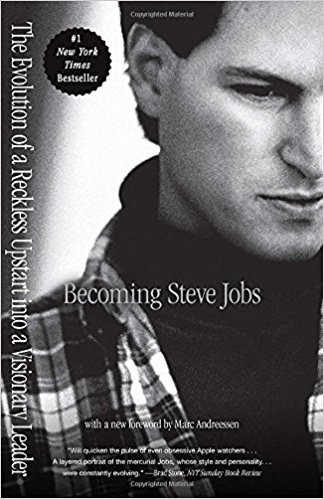
Tech Tuesday: Lessons for Leaders from Brent Schlender's Becoming Steve Jobs

It's already been five years since Walter Isaacson's biography Steve Jobs became a NYTimes bestseller. When I reviewed the book in 2012 I concluded, "This eye-opening page-turner is as exciting as any novel."

So when I discovered an audio version of Becoming Steve Jobs at our library two weeks ago, I had two immediate thoughts. First, what more can Brent Schlender say that hasn't already been said? Second, even if there's nothing new I would like to read his story again and see what new pearls I might find. It turned out to be a good decision, because there was plenty new to learn.

The full title is Becoming Steve Jobs: The Evolution of a Reckless Upstart into a Visionary Leader. Author Brent Schlender is an award-winning career journalist who made his mark writing profiles of high-profile entrepreneurs and business leaders in the digital revolution, including two decades as bureau chief and editor-in-chief at Fortune magazine. One can tell early on that he has had close up access to Jobs for a very long time.

The structure of the book is linear, beginning with the birth of Apple. But this is not a book about what happened. It is the story of Steve Jobs' education, the events that served to produce one of the great leaders of our time.

In point of fact, according to Jim Collins, author of the bestselling business books Good to Great and Built To Last, there have only been two truly great visionary leaders of the past century, Steve Jobs and Winston Churchill. Each of these men had experienced great failure early in their careers, and each developed a relentlessness and resilience that enabled them to re-emerge as leaders and accomplish great things.

The author's aim was not to assemble anecdotes and Apple trivia. Rather, his stories are shared with an aim to provide lessons that will have value to all of us. One example is the Steve Jobs observation that it's only in hindsight that we can "connect the dots on how things happened," whether in our lives or in business.

It is well known that Steve Jobs was a massive Bob Dylan fan. On one occasion Jobs described to the author the difference between artists and everyone else. "The artistic spirit is willing to take risks." The artist is willing to go out on a limb and risk failure in order to achieve his or her vision. Steve Jobs got this insight about himself, as an artist, by watching Dylan perform. He saw that Dylan was continuously re-inventing his songs, going different places in his performances, challenging himself and his band. It was not about the money. The true artist is always risking failure. Picasso and Dylan were true artists, Steve Jobs pointed out.

* * * *
Lessons

Insights from the Steve Jobs story are too numerous to list. Here are a few to whet your appetite in the hopes that you will find a way to read or listen to this book.

1. Jobs' passion for and investment in Pixar was a key component of its success. Schender shows how putting together a solid team is the foundation for miracles.

2. Many achievements were directly related to key partnerships between Steve and various individuals whose talents were affirmed within this relational context. What they accomplished was remarkable, Jobs being the catalyst. He surrounded himself with people smarter than himself and though he demanded a lot, when he had matured he gave them the freedom to push back. No yes-men. They all had a say and worked together to accomplish what needed to be done.

3. Very early on what Steve Jobs saw in his head was an early version of the Internet of Things (IoT) with the Macintosh at the center of a wheel as the hub, all the other elements connected to the hub like spokes. The consumer goods became consumer touch points.

4. Every consumer touchpoint, whether ads or iPhones or iPods and iPads or iTunes downloads, was part of a whole which Steve Jobs saw as The Apple Experience. This Apple Experience was designed to lead people into discovering how easy it is to interface with Apple products. Both easy and elegant.

5. Possibly the most notable product of his life was the iPhone, a product he personally may have not wanted to pursue, but his team had been given the green light and it went on to transform the applications business.

6.  Steve knew that even he had underestimated the potential of consumer electronics. Once this phase of the company began to explode, Apple steadily improved the experience of enjoying and managing music, photos and videos on personal electronic devices making the various technologies coherent in a way that no other company came even close to matching.

7. "The Apple Experience was an unprecedented merger of marketing and technology excellence" designed to make customers want to come back for more "This was a new kind of quality, something consumers have never experienced before."

The book includes the text to Steve Jobs' commencement speech that he gave in Stanford. You can listen to it here, as nearly ten million others have already done.

In case you haven't already noticed, I became quite enthused about this book. If you get the chance, especially if you are in marketing, I strongly recommend this to you.

Meantime, life goes on all around you. Don't let it pass you by.

EdNote: Becoming Steve Jobs was co-authored with Rick Tetzeli.

Popular Posts