Showing posts with label Steve Carell. Show all posts

Saturday, April 30, 2022

Here We Go Again? Margot Robbie in a Bubble Bath to Explain What Happened When the Housing Bubble Burst

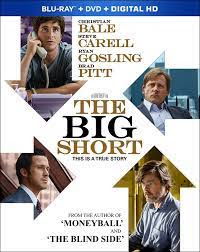
Have you seen The Big Short? I'm talking about the movie based on the book by Michael Lewis. All too often movies fail to live up to the vivacity sparked by the book. The Big Short is an exception.

Adam McKay wrote the screenplay and directed this remarkable film. Brad Pitt played a role in the film, delivered an important line and also produced the film.

For most Americans economics is a mystery, especially when it comes to Wall Street. Stocks, junk bonds, mutual funds, ETFs, options, derivatives, tranches, yield, moving averages, short squeeze... the lingo is so esoteric that the average clam on the street is clueless.  

Even when we don't know what things mean, we're all impacted by them when the shakedown comes. The tech bubble bruised a lot of peoples' investments and the housing bubble created pain all the way down into the trenches where many Americans exist day to day.

The Big Short was an exceptionally creative means of explaining what happened during the collapse of the housing market. It doesn't really tell the entire story, such as how mechanisms were created to help people who couldn't afford homes were shoehorned into properties that were beyond their means. That is, there was pressure placed on banks to make mortgage loans that exceeded their typical tolerance for risk

Needless to say, the film does a good job of showing how Wall Street insiders were clueless to what was really going on, and paid a price for it.

Early on in the film the director inserts Margot Robbie in a bubble bath, sipping wine, to explain subprime mortgages. 

Basically, Lewis Ramieri's mortgage bonds were amazingly profitable for the big banks. They made billions and billions on their 2% fee they got for selling these bonds. But they started running out of mortgages to put them in. After all, there are only so many homes and so many good jobs to put them in. So the banks began filling these bonds with riskier and riskier mortgages. That way they can keep that profit machine churning, right? By the way, these risky mortgages are called subprime. So whenever you hear "subprime" think "sh*&".

Our friend Michael Burry found out that these mortgage bonds which were supposedly 65% AAA were actually just mostly full of sh*&. Now he's going to short the bonds. Which means 'bet against.'

Got it? Good.

"Let me tell you how it is."
FWIW, Margot Robbie is an actress from Australia who played Tonya Harding in I, Tonya. She's also played Mary Queen of Scots and Sharon Tate in other films I've seen, though I never knew her name.

My interest in seeing this film (I've seen it several times already and read the book) was chiefly driven by the mess we're seeing right now in global markets and on Wall Street. I know that some people believe it's all a big conspiracy, that wrecking the economy is intentional. Somehow my personal feeling is that the decision makers are in over their heads. Things are simply too complicated today and the law of unintended consequences lurks behind every move.

There are a lot of stars in this film. The casting is superb. Christian Bale, Brad Pitt, Ryan Gosling and Steve Carell are the primary heavies, but even the most incidental character is perfect.

As a final note (knowing much more can be said), I also enjoyed the music score, especially Led Zeppelins When the Levee Breaks which summed up the film as the final credits rolled.    

Again, if you've not see this film, I recommended it highly. It's both entertaining and insightful. 

Ever ready to upset applecarts.

Wednesday, December 23, 2020

Woody Allen's Cafe Society... No Sizzle, and No Steak Either, But Some Noteworthy Elements

As most people who follow the career of Woody Allen know, at a certain point in time he veered from producing comedy to making more serious films, though some are spiced with comedic elements. Another way of saying that is that his later films appear to be more reflective than mere entertainments. Case in point: his painfully pointed Match Point

Since we're still in the pandemic lockdown regarding our local library, we're unable to enter the building and browse the DVD selections. Therefore, we search using the online browsing app. If you search by movie title, you can find quite a few flicks that are not in the library, and thereby waste a lot of time looking. An alternate way is to search by actor and all the films featuring that actor will get listed. 

I just finished watching Woody Allen's Cafe Society, starring (most prominently) Jesse Eisenberg and Steve Carell. Essentially, it is a movie about love triangles, against a backdrop of high society Hollywood and New York.

Jesse Eisenberg (Bobby) is the central character in this movie about a young man who leaves New York to get an education with his uncle, Phil Stern (Steve Carell) in 1930s Hollywood. Eisenberg struggles with the challenge of being at home in Hollywood, but through his experience meets and falls in love with his uncle's secretary. His uncle, has similarly been smitten, and Penelope choose the richer, successful Hollywood agent. 

As one of the losers on the love triangle (Steve Carell's wife is the other loser) Bobby goes back to New York, and takes on a primary role at his brother's hot nightclub. As it happens, he meets another love of his life, who coincidentally is named Penelope. Their amorous relationship results in her becoming pregnant and ultimately married.

The parallel story of his brother the gangster becomes a vehicle to insert ethical issues into a somewhat less complicated story. Love triangles and infidelity are almost commonplace, so a backstory about a brother who is a thug helps add a dimension.

Noteworthy Elements
There are a number of features in this film that tell you this is a Woody Allen film. Here are just a few.

Love for New York
Woody Allen was born in New York, and his passion for the city of his birth is hard to conceal. Manhattan was an opus of sorts. Here in Cafe Society it is barely concealed.

Philosophical Ponderings
The manner in which Woody Allen weaves theological questions and philosophical digressions into his films is quite intriguing. Over and over again we find characters debating conflicting views on ethical matters. 

Recurring Themes
High society glamour, jazz, Jewishness and gangsters are frequently inserted into Woody Allens films. Rule one to young writers is, "Write about what you know." High society, jazz and Jewishness are all facets of who he is. Where do the gangsters fit into his life experience? It probably doesn't matter, but serves as a method for dissecting some related ethical issues.

Witty Dialogue
As usual the characters have a lot of good lines. For some reason, though things feel emotionally barren. We've met these argumentative Jewish parents in an earlier Woody Allen film or two, so it almost feels like a cliche.

* * * 

There is a sense in which I was reminded of Robert Redford's screen adaptation of A River Runs Through It. In that film it seemed to me that Brad Pitt was chosen to play the role Redford would have played had he been a younger man. Redford also narrated the story. In this case, Woody Allen narrates, and Eisenberg is selected to play the role Allen would have played. In fact, in the early part of the move Bobby even sounded like Woody Allen. I don't think I was imagining it.

My original title for this movie review was going to be Woody Allen's Cafe Society... "Meh." At IMDB.com even the reviewers who liked it didn't go gaga over it. Yes, the exotic quality of high society life is well done, but we have seen that before, too. Hollywood is very much in love with itself, though Allen does have. Bobby and his uncle deliver a few barbs about it all.


Popular Posts